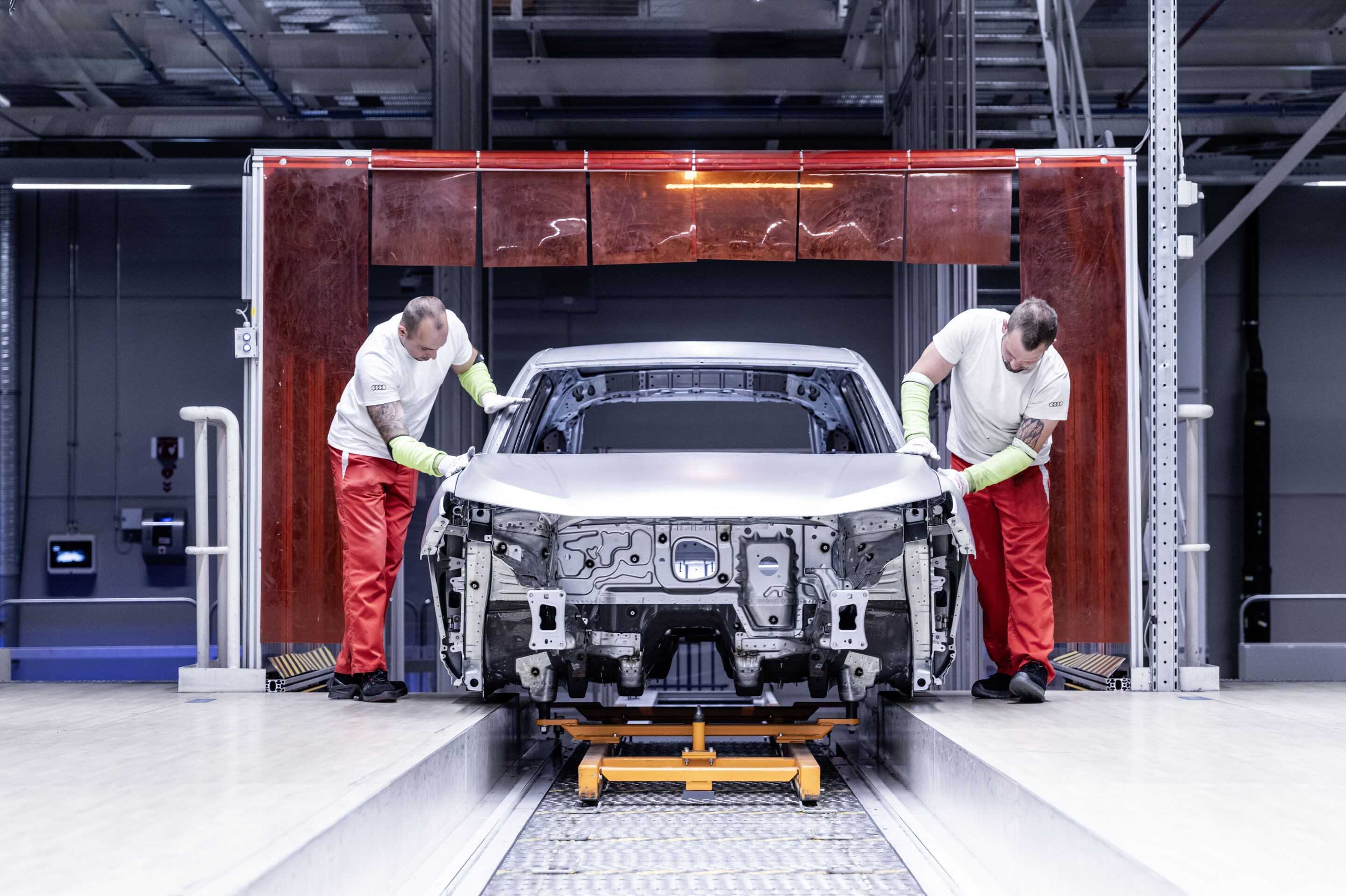
AUDI HUNGARIA Zrt. develops and produces drive systems in Győr, Hungary, for AUDI AG and other companies in the Volkswagen Group. The company produces more than 170,000 Audi vehicles annually and body components for Audi and the Volkswagen Group’s exclusive and sport models. Moreover, Audi Hungaria offers the entire Volkswagen Group various competence-oriented services.
Since its foundation in 1993, Audi Hungaria has become one of the country’s largest exporters and most profitable companies. Audi Hungaria is also one of the largest foreign investors in Hungary and the biggest employer in the region, with 11,430 employees as of December 31, 2025.
Powertrain production
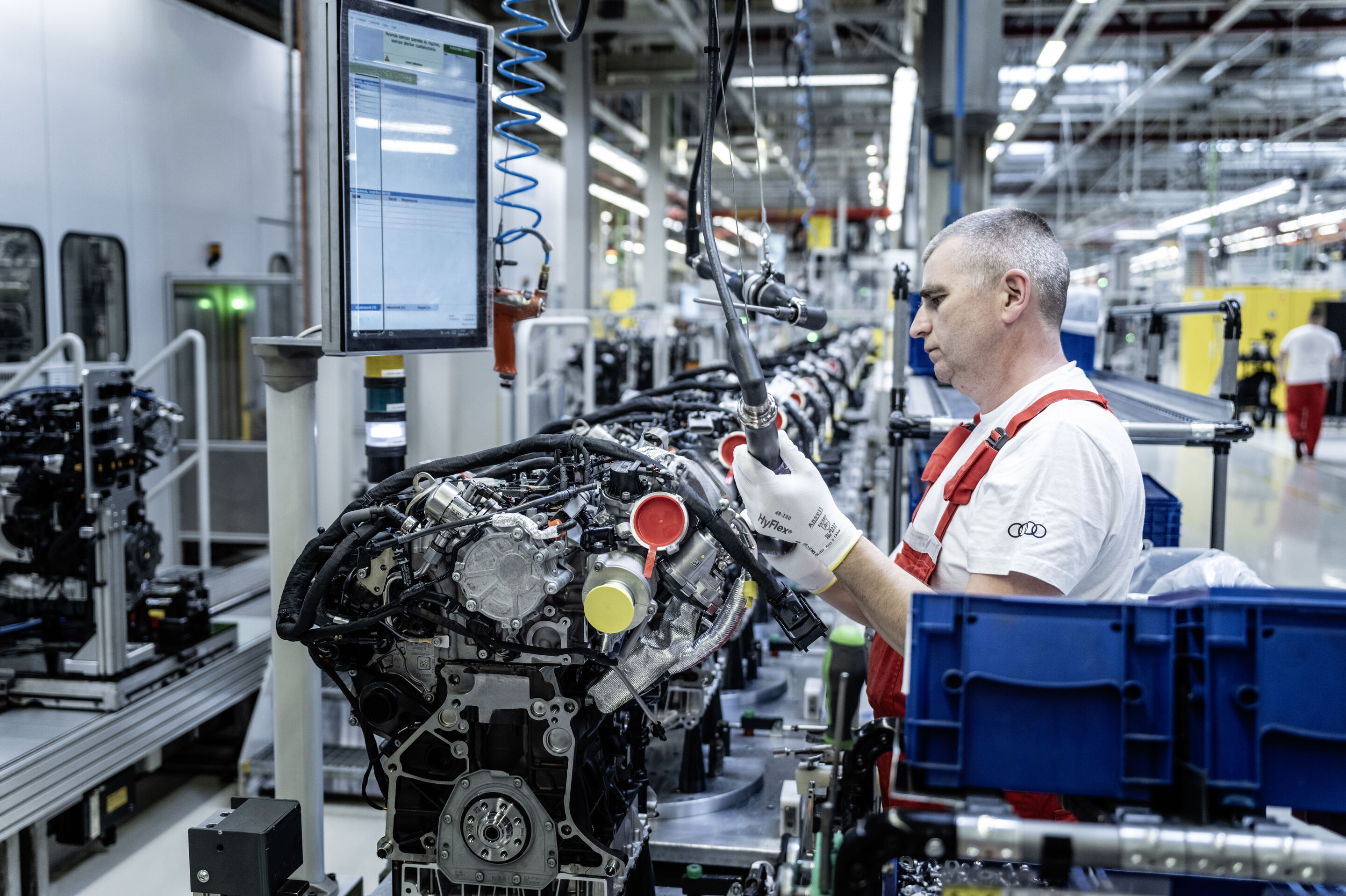
The site has manufactured drive systems for Audi and the Volkswagen Group since 1994. Over the years, the company has become the largest powertrain factory in the world. In 2025, Audi Hungaria produced 1,585,290 powertrains in Győr for 35 Volkswagen Group production sites.
- Of the engines manufactured in 2025, 1,048,639 were three- and four-cylinder gasoline and diesel engines. Including 59,168 four-cylinder diesel engines.
- The site’s employees also produced 15,272 five-cylinder gasoline engines, 195,850 six-cylinder gasoline engines, and 60,551 six-cylinder diesel engines. Additionally, 264,871 electric axle drive units were manufactured in Győr. This means that 17 percent of the engines produced were electric.
Overall, Audi Hungaria built four different gasoline and two diesel engine variants in 2025, as well as PPE (Premium Platform Electric) electric drive systems with a power spectrum from 120 kW (122 PS) to 280 kW (244 PS).
Electric axle drives have been produced in Győr since 2018. In the intervening years, its share of total production volume has risen sharply. The electric motors are installed in the Audi Q8 e-tron, Audi Q6 e-tron, A6 e-tron, and Porsche Macan.
The new electric drive systems for the Group’s fully electric models will also be supplied from Győr. They are based on the Premium Platform Electric (PPE), developed jointly with Porsche. In 2023, a new manufacturing area was set up to produce them.
A new manufacturing area is also being installed for the new MEBeco (Modular Electric Drive Toolkit) drives. Audi Hungaria will then produce a new family of electric motors with greater vertical integration. For example, Audi Hungaria will mass-produce the sheet metal package for electric motors for the first time. Rotors and power electronics will also be produced in Győr in the future. The powertrains will later be used in the Volkswagen Group's small electric cars.
Vehicle production
Győr has been producing automobiles for 28 years now. Automotive production at Audi Hungaria began in 1998 with the Audi TT Coupé series production. The company currently produces the Audi Q3 and Q3 Sportback. It set a new record in automotive production in 2025 by making 200,756 Audi models.
Audi Q3 models reached 80,669 SUV and 48,277 Sportback models. In addition to the sporty Q variants, the Audi RS Q3 and RS Q3 Sportback, the Audi Hungaria product portfolio includes the Q3 and Q3 Sportback models with a mild hybrid drivetrain (MHEV, Mild Hybrid Electric Vehicles). Both models feature a Győr 1.5-liter TFSI engine in combination with a 48-volt main electrical system and a belt alternator starter (BAS). The first plug-in hybrid vehicle from Audi Hungaria, an Audi Q3 Sportback, rolled off the line in early December 2020. In May 2022, Audi Hungaria produced its 100,000th hybrid drive model.
The Q3 and Q3 Sportback models produced in 2025 included 8,568 plug-in hybrids. The company has integrated plug-in hybrid production into its existing production process. Around 1,500 employees were prepared and trained for that purpose. In addition, numerous Hungarian employees were able to assist and gain experience at various plants of the Volkswagen Group.
Production celebrated multiple anniversaries in 2025 when the 1,000,000th second-generation Q3 model and the first third-generation Q3 and second-generation Q3 Sportback models rolled off the line.
The series production of the CUPRA Terramar started in September 2024, making Audi Hungaria the first production site in the Audi Group where a model of a sister brand is produced alongside Audis. In 2025, 71,810 CUPRA Terramar vehicles drove off the production line in Győr.
Technical development
Audi Hungaria opened its Technical Development department in 2001. Staffed by 693 specialists, its drive system development and whole vehicle development divisions are now AUDI AG’s third-largest technical development unit and provide development services to almost the entire Volkswagen Group.
Drive system development carries out complete development projects on various conventional and electric drive modules. Moreover, the division’s development portfolio includes chassis system development and power electronics. Audi Hungaria covers the entire development spectrum, from construction to thermodynamics and from numerical simulations to trials on the test bench and in the vehicle. To that end, drive system development can draw on 17 test stands for combustion engines and four for electric axle drives. These include two for acoustic tests and four climate test benches for simulated environmental testing. As part of its leadership in different types of development, the department is responsible for international powertrain projects.
Another core responsibility is supervising the series production of various drive systems from the development side. In the future, entire drive systems could be developed here.
Whole-vehicle development works on a project basis from conception to the series supervision phase on issues pertaining to acoustics, thermal energy, water management, ground clearance, strength and durability, product data management, and technical conformity. The focus is on the virtual development of overall vehicle characteristics with the help of numerical simulations and E/E integration using hardware-in-the-loop (HiL) applications.
Moreover, whole-vehicle and sub-system tests in the test center and road tests with customer-oriented use-cases are an important part of the competency portfolio.
In the coming years, due to the transition to electric mobility, Technical Development at Audi Hungaria is expected to expand further in the development of electrics/electronics and will focus on creating more testing capabilities and modernizing the existing test infrastructure.
Tool shop
The tool shop was founded in 2005, so it celebrated its 20th anniversary this year. At approximately 60,000 square meters (646,000 sq. ft.), it is one of the biggest of its kind in Central and Eastern Europe. It currently employs about 490 specialists with various qualifications in the three fields of activity, namely “toolmaking,” “plant and fixture construction,” and “exclusive series production.” Today, the portfolio covers the entire process chain of engineering and manufacturing car body parts – from design and the feasibility assessment, production simulation, method planning, and the construction of production equipment through to component manufacturing.
The core of the manufacturing process is a flexible production concept that enables the economical production of high-quality body components in small batches – for individual single parts and also ready-to-install assembled components, such as fenders, doors, bonnets and tailgates.
The Győr exclusive series production manufactures the aluminum body components for the Audi e-tron GT and all RS models.
High-quality and emotional components are supplied for Lamborghini Urus SUV, Revuelto, and the latest model Lamborghini Temerario.
The Bentley brand is also a customer, with body parts for the Bentley Bentayga produced in Győr.
Shared Competence Center (SCC) of AUDI HUNGARIA Zrt. and AUDI HUNGARIA AHEAD Kft.
In addition to more than 30 years of experience in powertrain and vehicle construction, AUDI HUNGARIA Zrt. is increasingly focusing on shared services for the Volkswagen Group based on its employees’ skills. These services are primarily flowing into the customers’ value chains.
With their help, processes and activities can be designed more uniformly and efficiently to realize more synergies within the Group. All these services form the so-called Shared Competence Center (SCC), which consists of the SCC virtual division of AUDI HUNGARIA Zrt. and AUDI HUNGARIA AHEAD Kft. with around 1,300 employees.
The SCC virtual division of AUDI HUNGARIA Zrt. covers Technical Development Services Drive System & Whole Vehicle, Finance services, Production-close Services (i.e. Supply Chain, Corporate Quality Powertrain & Vehicle) and Legal Services.
AUDI HUNGARIA AHEAD Kft. was founded in 2023 as a wholly owned subsidiary of AUDI HUNGARIA Zrt. and began operations with around 400 employees. At the end of 2025, it employed nearly 500 people. The subsidiary’s portfolio includes a subset of services not closely related to production in Győr, such as all procurement services and various IT and Finance services.
Flexible and efficient Supply Chain
- The company relies on smart solutions – not only in production, but also in the supply chain. Audi Hungaria relies on a modern logistics infrastructure to ensure a smooth and reliable production supply. Integrated smart solutions such as modern, driverless transport systems as well as digital approaches such as an internationally standardized scheduling system and a global transport label mean that logistics processes are kept lean. Automated guided vehicles (AGVs) transport components autonomously to workstations – such as supplying the production lineless electric motor production and the body shop in the vehicle plant. They use laser scanners to orient themselves in the hall and look for the optimal route. Algorithms and machine learning, controlled by an intelligent IT system in the control center, enable these future-proof processes.
- The Supply Chain team deals with challenging supply situations every day in a uniform and flexible way. With holistic crisis and bottleneck management across all locations, the team ensures smooth supply under the most difficult conditions.
- Sustainability is a key aspect of the corporate and supply chain strategy at Audi Hungaria.
- As part of the Mission:Zero environmental program, the supply chain is continually looking for ways to reduce its environmental footprint. One example is the cooperation between Audi Hungaria Zrt. and AUDI AG that launched a combined transport solution in spring 2024, connecting three Audi plants between Germany and Hungary. As part of the material supply chain between Ingolstadt, Neckarsulm, and Győr, the green train connection from Regensburg in Germany to Lébény in Hungary, in combination with the upstream and downstream truck transports with biogenic fuels, is going to avoid emissions of up to 11,500 tons of carbon dioxide every year. Audi Hungaria was responsible for around 5,000 tons of the avoided emissions.
- One of the largest solar parks in Europe – with a total area of 160,000 square meters of photovoltaic modules located on the roofs of the two logistics centers – also contributes to the climate neutrality of the site.
Corporate quality
Audi Hungaria’s quality management system is based on DIN EN ISO 9001:2015; the TÜV (German technical inspection association) confirmed its effectiveness with very good results. Corporate quality is embedded in every division of the company, from development and planning to production to the service process. This allows the high quality of the powertrains and cars produced at the Győr site to keep advancing with the help of the most up-to-date testing technology.
Consistent testing process planning is the foundation for vehicle conformity in the reproduction process. The effectiveness of quality management is evident in high levels of customer satisfaction, which was confirmed by the 2025 J.D. Power customer satisfaction study in the US.