Not all automatic transmissions are the same, and not all drivetrains are the same. In this section, we explain the different technologies and how they operate.
Note: The technologies described here reflect the state of development at Audi, either as it currently stands or as it has been in the past. Not all systems mentioned are available in the current model range.
Contents
Turn assist
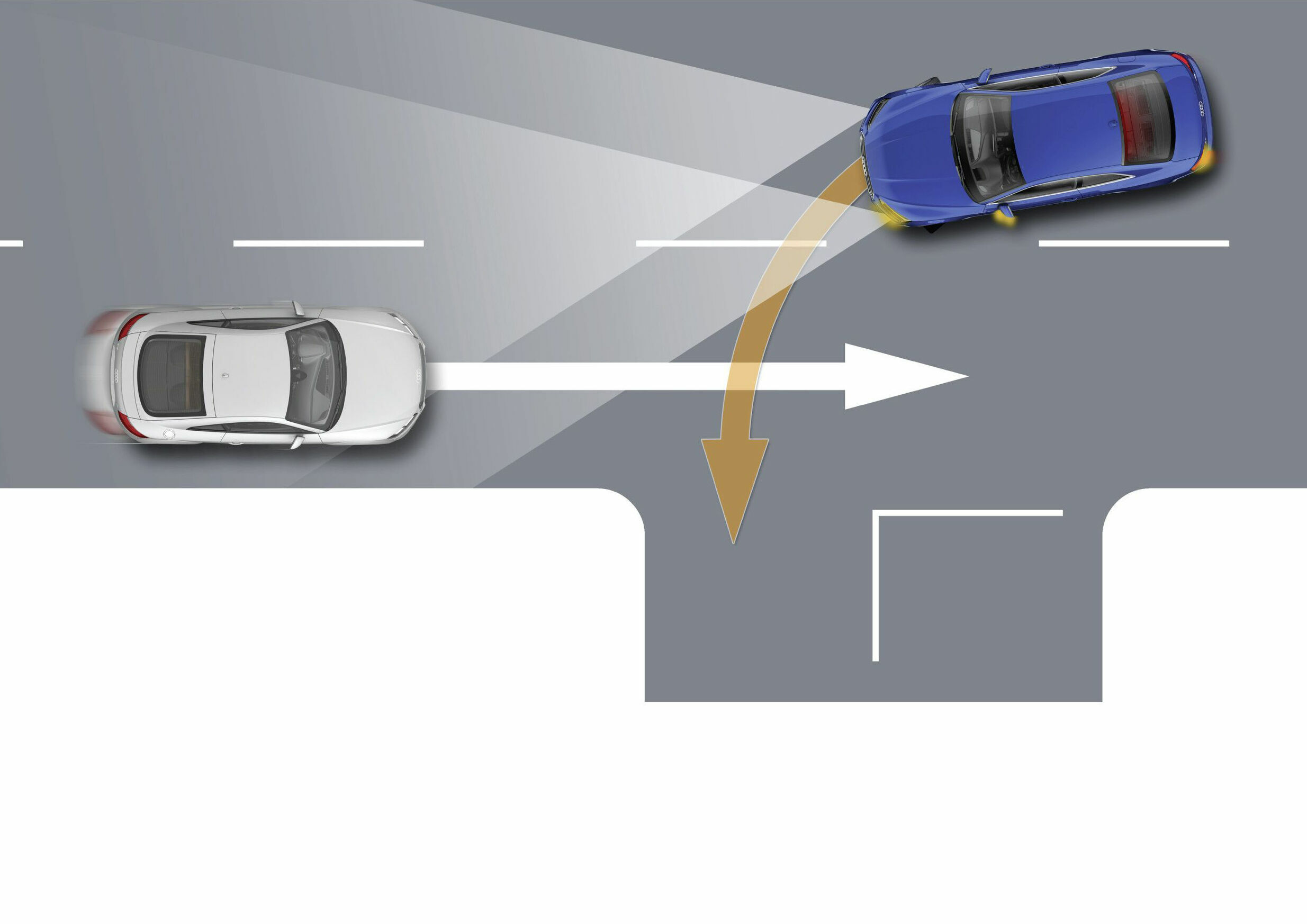
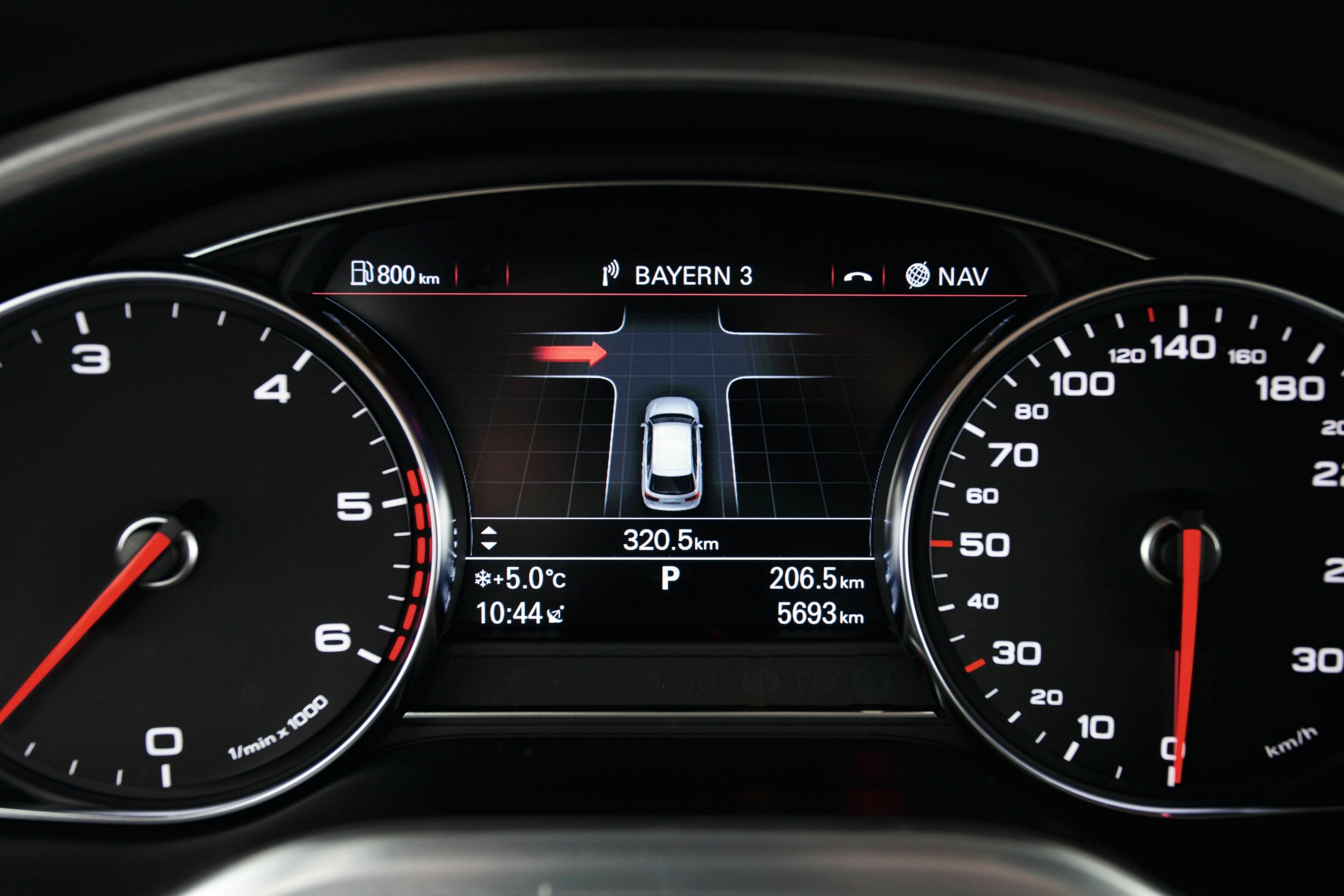
When starting off or driving slowly at a maximum speed of 10 km/h, the turn assist can ensure that the vehicle does not collide with an oncoming vehicle when turning left by applying the brakes. The turn assist monitors the opposite lane using radar sensors, the front camera and, depending on the model, also using the laser scanner as soon as the turn signal is activated. If the vehicle detects a hazard, the system can apply the brakes to prevent your car from colliding with an oncoming vehicle when turning across the opposite lane. The braking action causes the car to stop before reaching the opposite lane. A display in the instrument cluster informs you of the intervention.
Adaptive cruise control
Adaptive cruise control (ACC) takes the strain off drivers, especially on long journeys and in heavy traffic. Audi adaptive cruise control (ACC) provides automatic distance control in the range from 0 to 250 km/h. Within the system limits, the system keeps the preset distance as constant as possible by automatically braking and accelerating. Five selectable distance levels are available for this purpose. In addition, the acceleration and control behavior can be configured via Audi drive select. With S tronic and tiptronic, the Stop & Go function enables automatic braking to a standstill and automated restarting if the driver so wishes. Depending on the chosen engine type, the vehicle can also brake itself to a complete stop in Stop & Go mode when the clutch is engaged. ACC remains active when the vehicle is stationary. However, the driver must start the vehicle manually. After starting, the ACC function becomes available again. It is operated via a separate steering column stalk.
Adaptive cruise assist and adaptive cruise assist plus
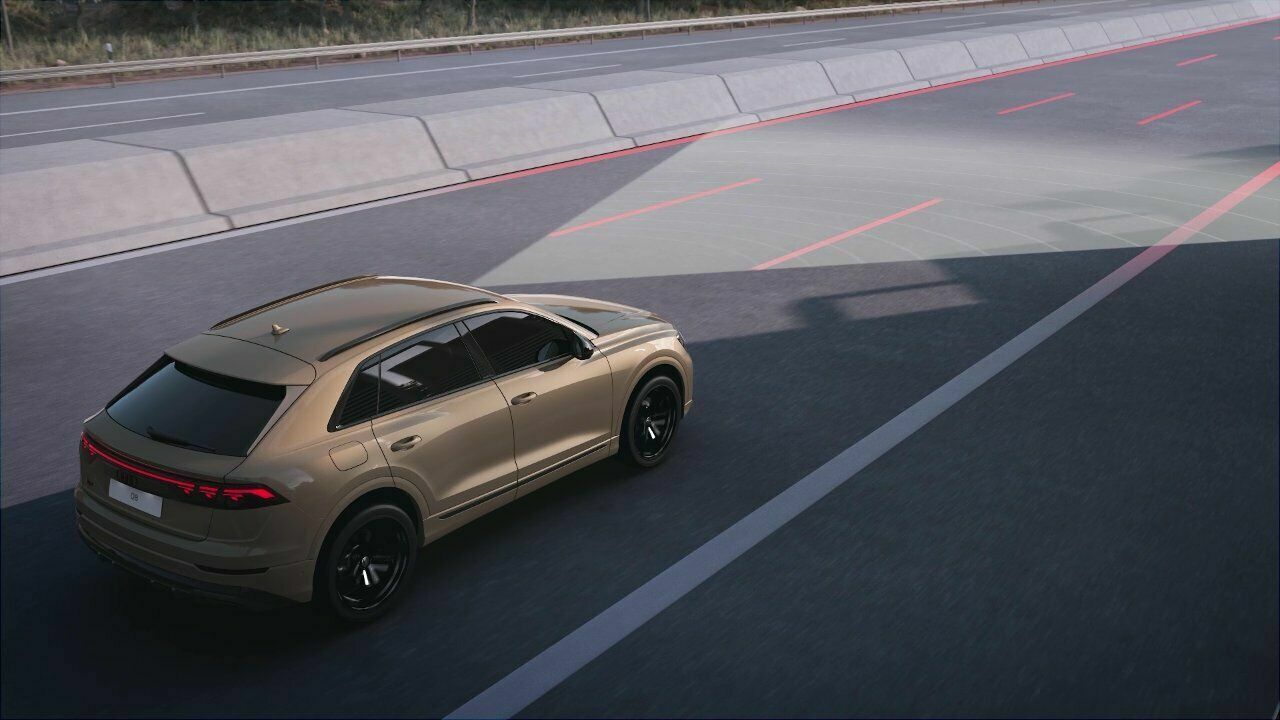
Adaptive cruise assist supports with steering, acceleration, and deceleration across the entire speed range – a significant benefit in terms of comfort, especially on long journeys. To do this, the adaptive cruise assist system integrates the functions of adaptive cruise control and active lane assist.
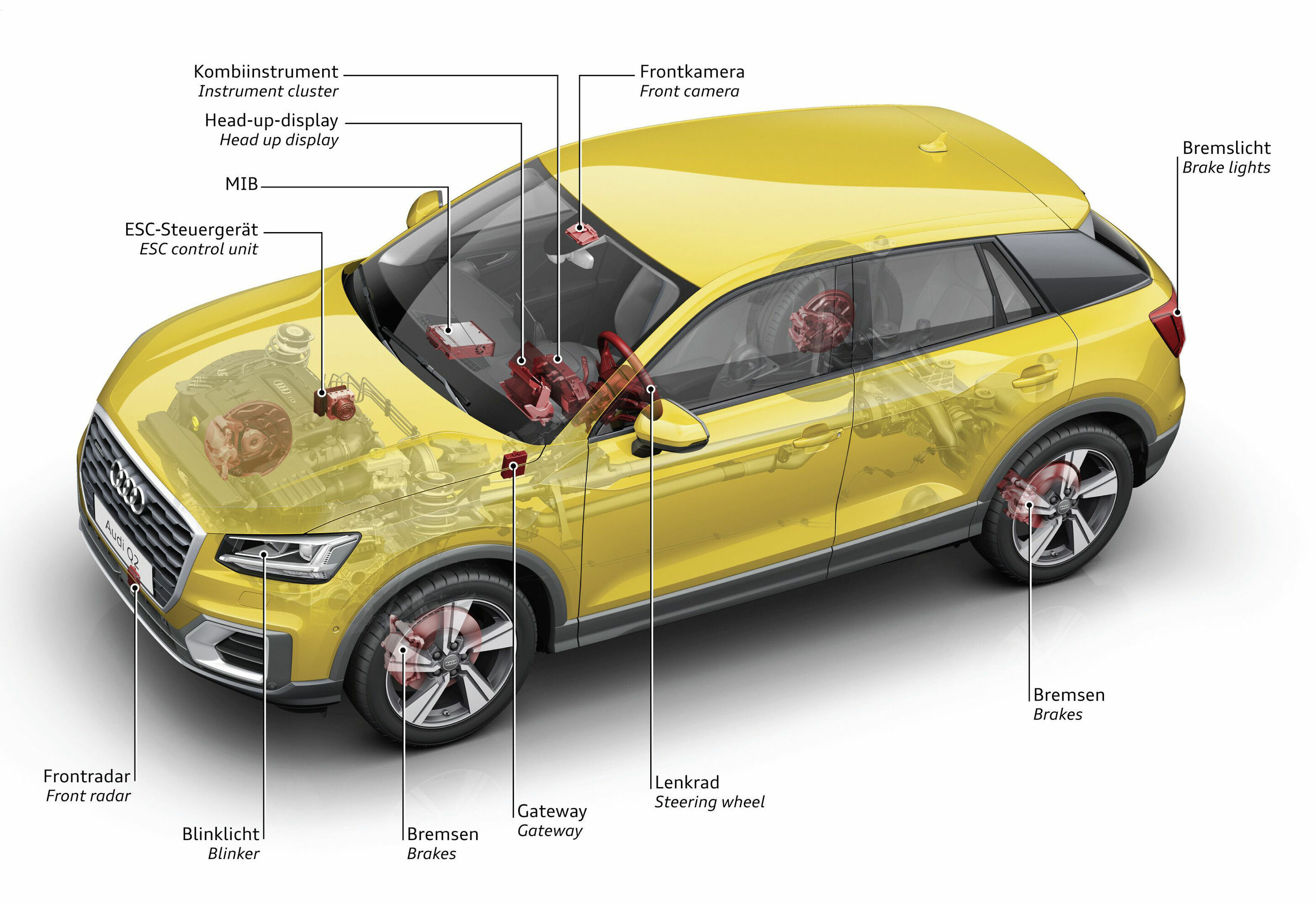
Depending on the model, adaptive cruise assist uses radar and ultrasonic sensors mounted on the front of the vehicle, as well as the front camera and (depending on the model) the laser scanner, to continuously monitor the vehicle’s surroundings.
Depending on the sensor equipment, the system detects lane markings, roadside structures, vehicles in adjacent lanes, and vehicles in front. From this information, adaptive cruise assist derives a so-called virtual driving corridor in which it guides the car. Assisted steering is also part of the system, enabling the car to consistently stay in the center of its lane. In some models, the system also uses the laser scanner. This allows the adaptive cruise assist system to recognize when the lane is too narrow to drive side by side and enables staggered driving.
Adaptive cruise assist also regulates the speed and the distance to the vehicle in front by accelerating and braking independently. The vehicle automatically adjusts its speed to the traffic and the route, taking into account the speed limit, for example in curves and at intersections. In stop-and-go traffic and in traffic jams, adaptive cruise assist brakes to a standstill. Depending on the duration of the stop, the car can restart automatically.
Adaptive cruise assist not only supports with acceleration, maintaining speed, maintaining distance, and lane guidance, but also uses high-resolution map data and swarm data from other vehicles calculated in the cloud to improve the driving behavior of the Q6 e-tron1.
Hold assist
Hold assist enables easy starting on inclines and declines found in everyday traffic situations and prevents the vehicle from rolling away. With hold assist activated, the system automatically activates the electromechanical parking brake when the car is stationary for a longer period of time. Drivers no longer need to activate it manually. In conjunction with S tronic, the car only starts moving again after coming to a standstill, for example at a traffic light, when the accelerator pedal is pressed. The system is activated at the touch of a button.
Trailer assist
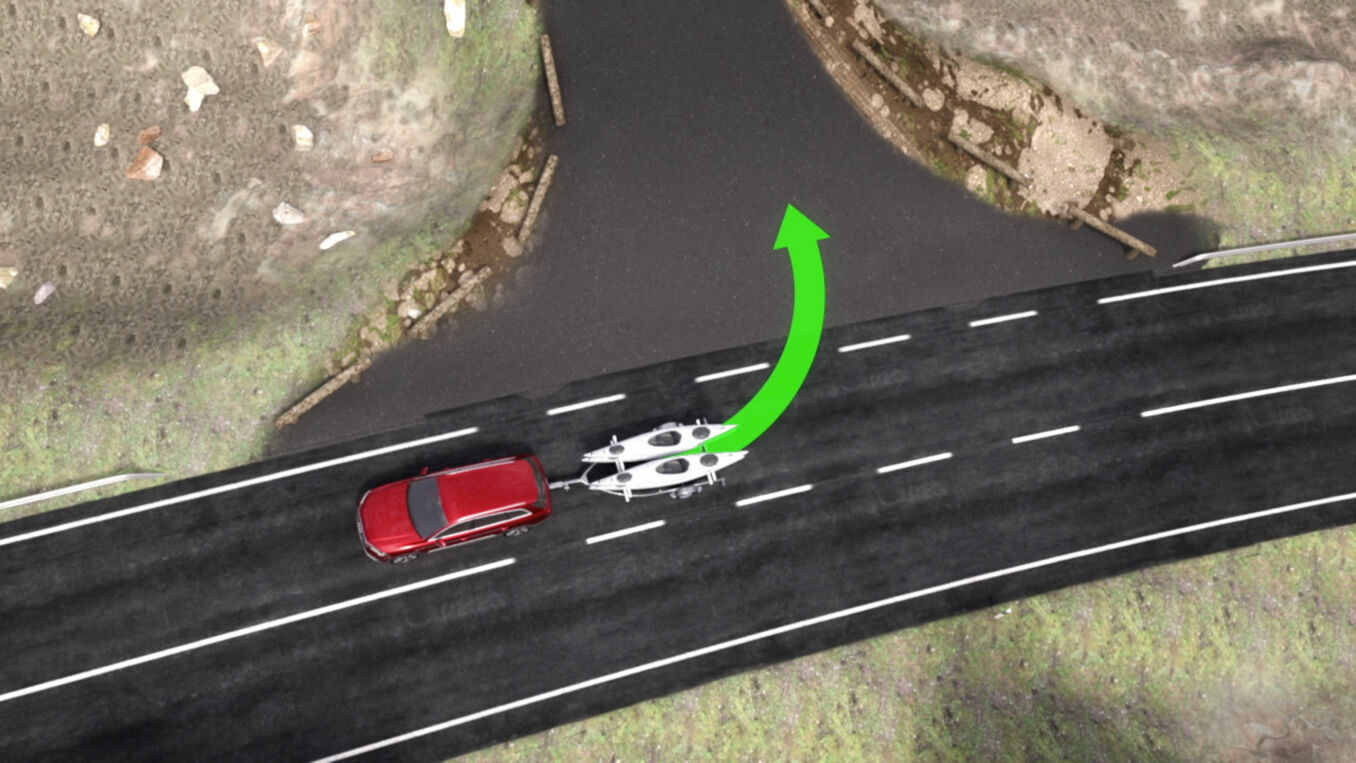
Trailer assist makes it easier to reverse-maneuver a trailer with a rigid drawbar. Depending on the operating concept, the driver uses the rotary/push button or the Audi MMI display (Multi Media Interface) to set the angle at which they want to reverse. The image from the reversing camera on the display shows guide lines for orientation. Trailer assist turns the steering wheel and steers the trailer steadily along the selected course. It allows speeds of up to 10 km/h. If the articulation angle becomes too large, the system issues a warning and, in an emergency, applies the brakes. The system thus prevents the vehicle and trailer from colliding. The technical basis for this is either a sensor in the ball head of the trailer coupling, which detects the angle between the towing vehicle and the trailer, or a rear-facing camera.
Audi active lane assist
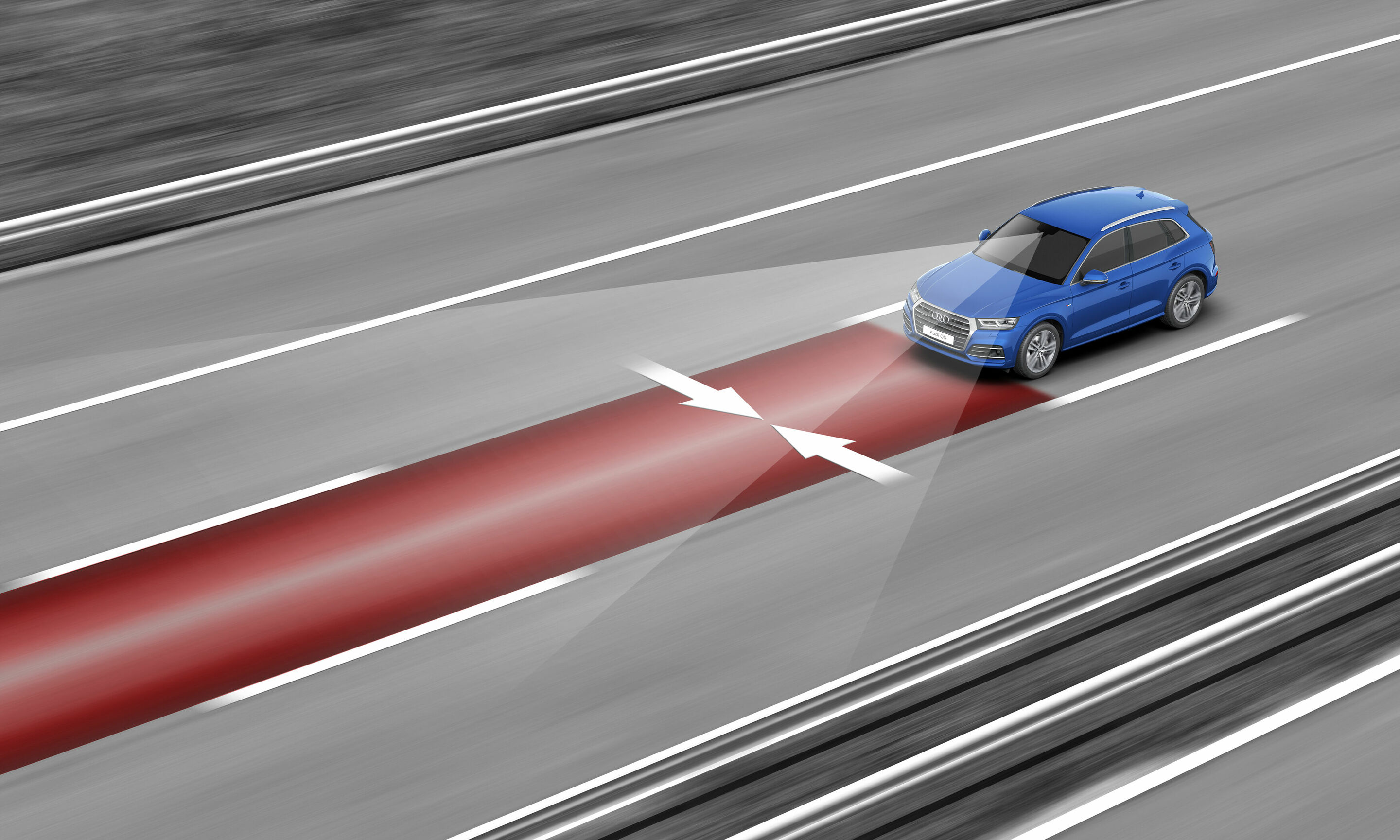
At speeds above 65 km/h, Audi active lane assist helps keep the car in its lane. A camera detects the lane markings and the course the car is following between them. The camera can distinguish between yellow lines in construction zones and standard white markings. If the car approaches a line without signaling, the system helps to steer back into the lane by making subtle but noticeable interventions in the electromechanical steering. A setting in the MMI system determines how early the assistant should intervene. With early steering intervention, the system assists by gently centering the steering toward the middle of the lane. With late steering intervention, Audi active lane assist only intervenes shortly before the detected lane marking is likely to be crossed, specifying the direction of correction with a steering intervention. In addition to this, drivers can be warned by steering wheel vibration when they cross detected lane markings.
Audi pre sense 360˚
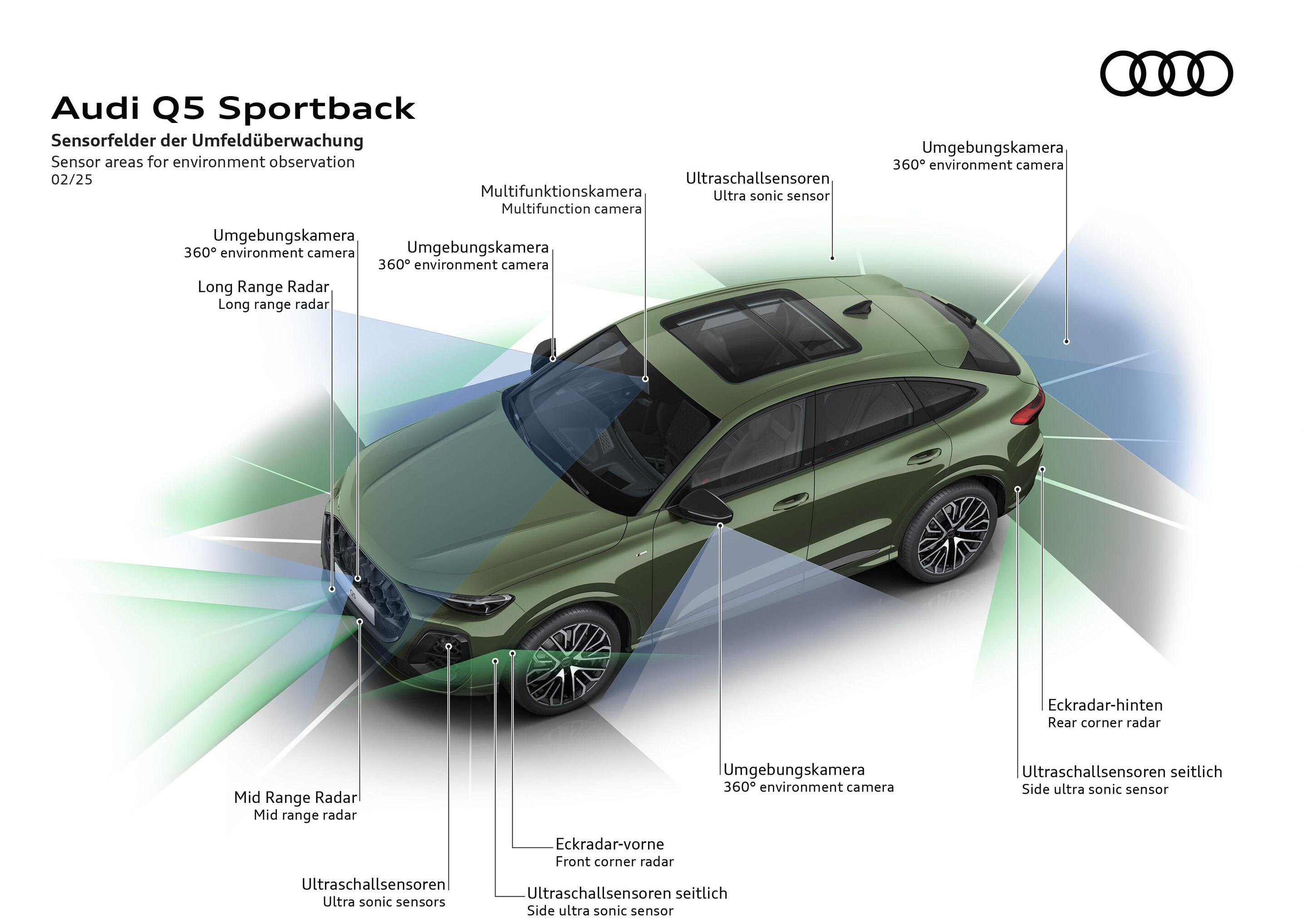
Audi pre sense 360˚ detects collision hazards around the car and initiates targeted safety measures such as optimizing seat positions, closing windows, applying brake force assistance or full braking, and even tightening seat belts.
Audi pre sense 360˚ includes the following driver assistance systems:
- Audi pre sense basic
- Audi pre sense front
- Audi pre sense rear
- Audi pre sense side
Audi pre sense basic
Audi pre sense front
Depending on the model, Audi pre sense front uses the data from the radar sensors and front camera to calculate the probability of rear-ending the vehicle in front. It warns of impending collisions within the system limits depending on the situation and speed and initiates appropriate braking. When the vehicle is traveling at speeds up to 250 km/h, the system can detect other vehicles; when traveling up to approx. 85 km/h, it can detect pedestrians; and when traveling more than 5 km/h, it can detect cyclists.
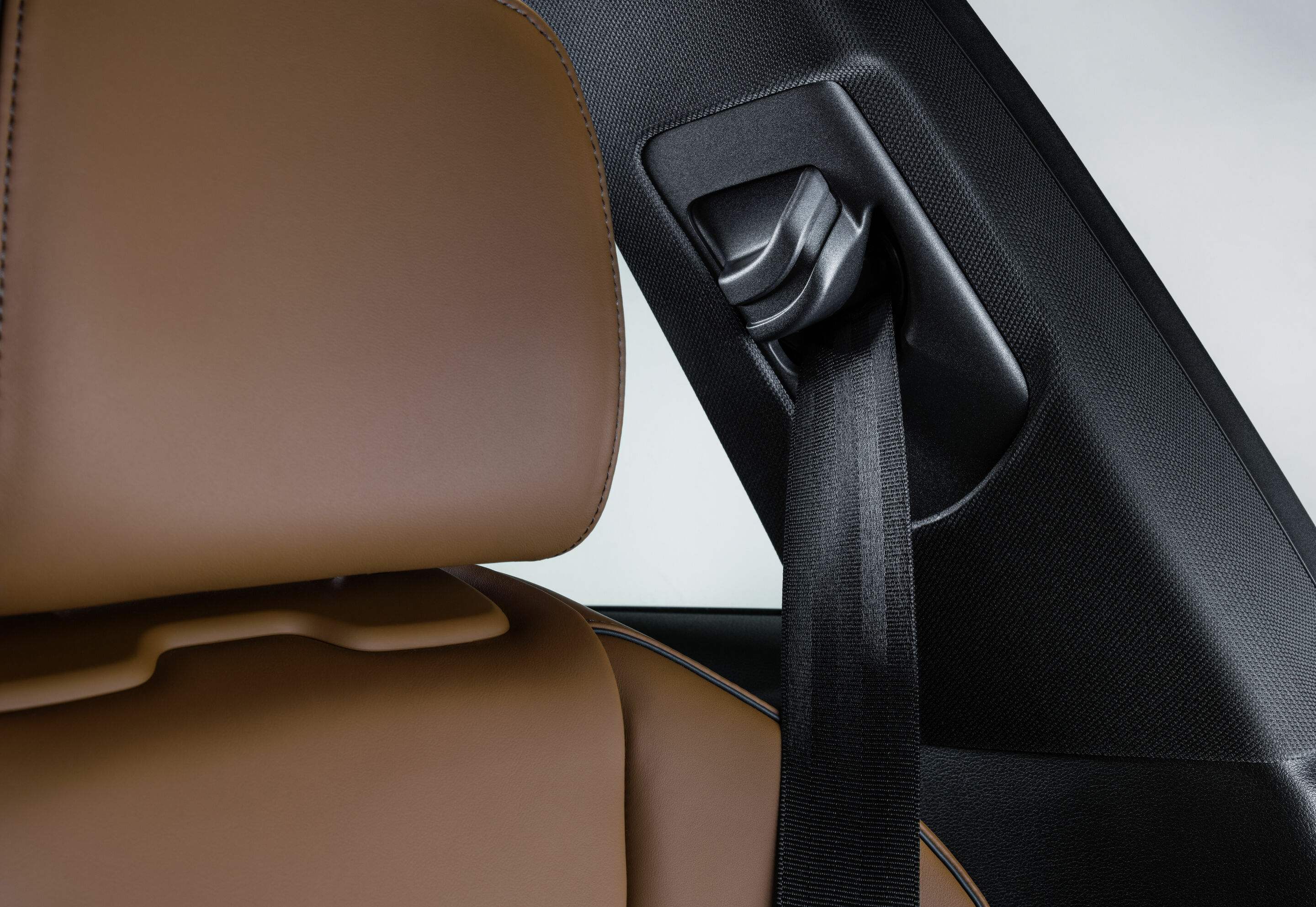
If an imminent frontal collision is detected, the system issues visual, acoustic, and haptic warnings in a multistage concept. If necessary, it provides brake force assistance to reduce speed or initiates full braking, and thus avoids a collision in some circumstances. Measures are also taken to protect the occupants: hazard warning lights are activated, seat belts are tightened, seat positions are optimized, and windows and the optional sunroof are closed.
Audi pre sense rear
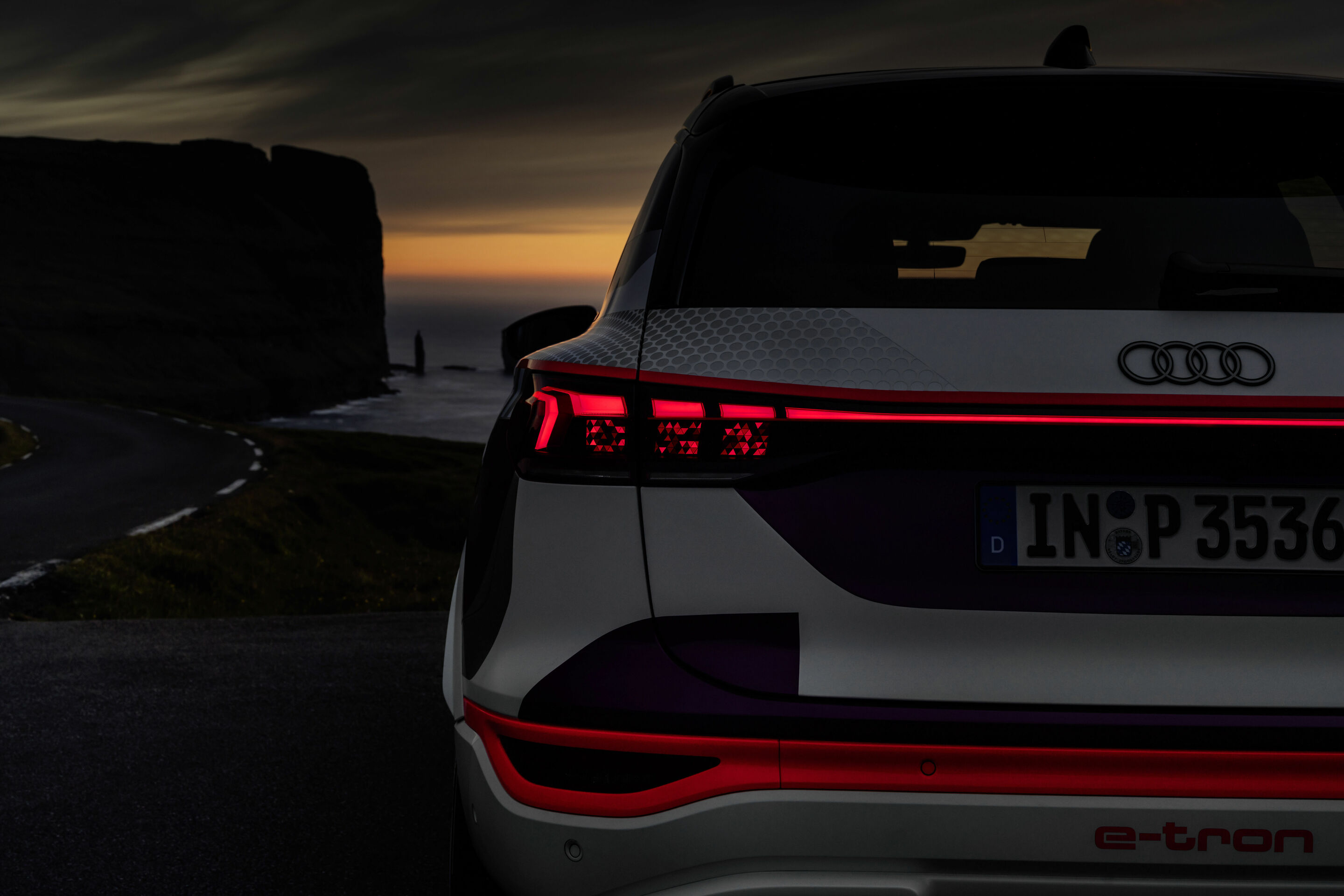
Audi pre sense rear includes a warning and braking function that reacts to vehicles and other road users. Radar sensors in the rear bumper detect an imminent rear-end collision and initiate preventive protective measures. This includes electrically tightening the seat belts and closing the windows and optional sunroof. The system also activates the hazard warning lights to alert traffic behind of the critical situation. This activates the rear-end collision alert signal (RECAS), which causes the hazard warning lights to flash at a high frequency. Audi pre sense rear is active in the background across the entire speed range, except when towing a trailer.
Audi pre sense side
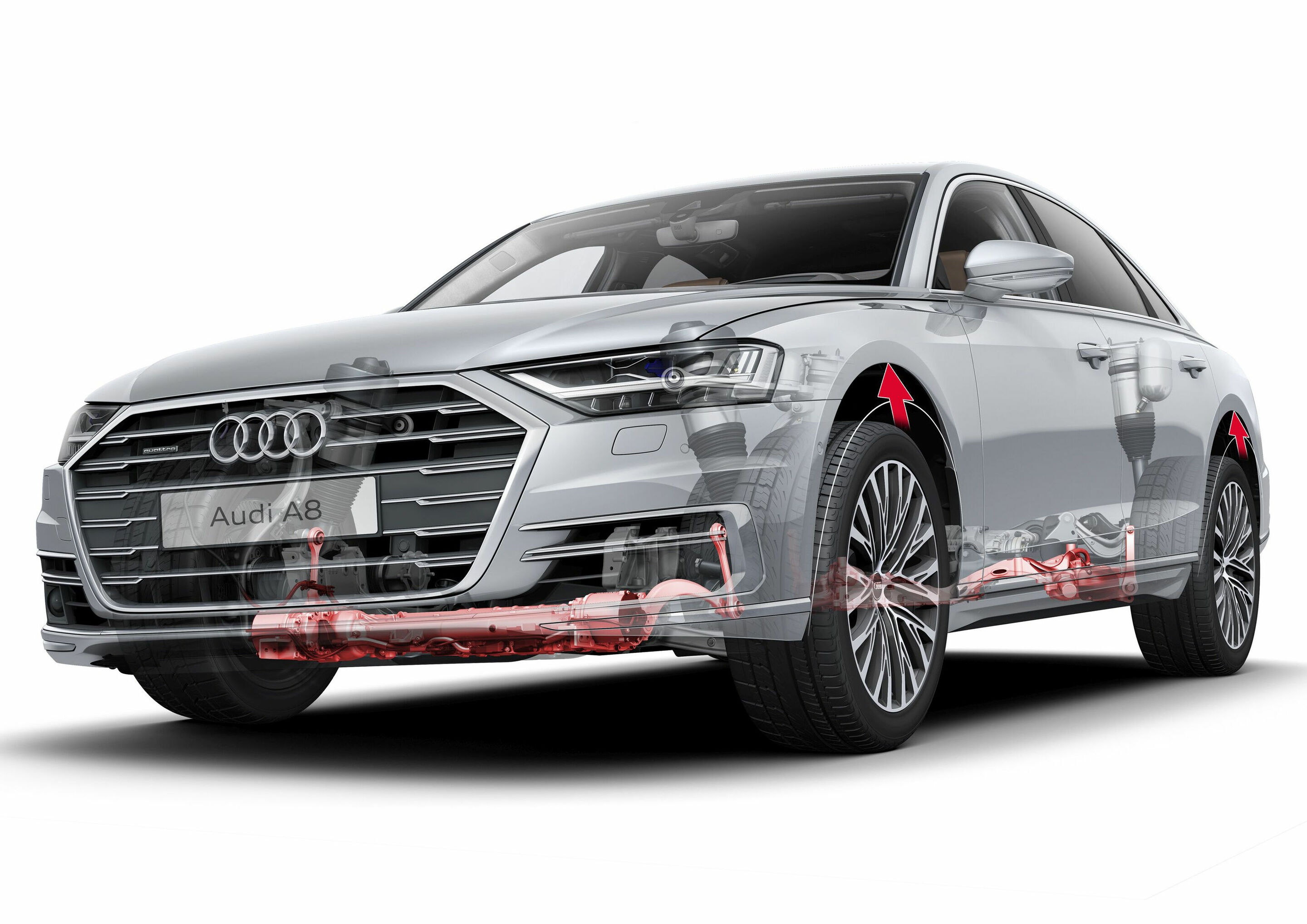
Audi pre sense side reacts in the event of a side collision. It uses data from additional radar sensors installed in the front and rear of the vehicle, as well as other sensors, to calculate the probability of a collision with vehicles crossing the road or approaching from the side. The system can detect impending side collisions at speeds of up to approximately 60 km/h and contribute to protecting the occupants with preventive measures: hazard warning lights are activated, seat belts are tightened, seat positions are optimized, and windows and the optional sunroof are closed.
In the event of an imminent side impact from a vehicle traveling at more than 25 km/h, the suspension actuators of the optional Audi AI active suspension raise the body on the endangered side by up to 80 millimeters within half a second. This shifts the impact to an even more robust area. The side sill and floor structure absorb most of the impact forces. The deformation of the passenger compartment and stress on the occupants, especially in the chest and abdominal areas, is up to 50 percent lower than in a side crash without any body lift.
Audi side assist
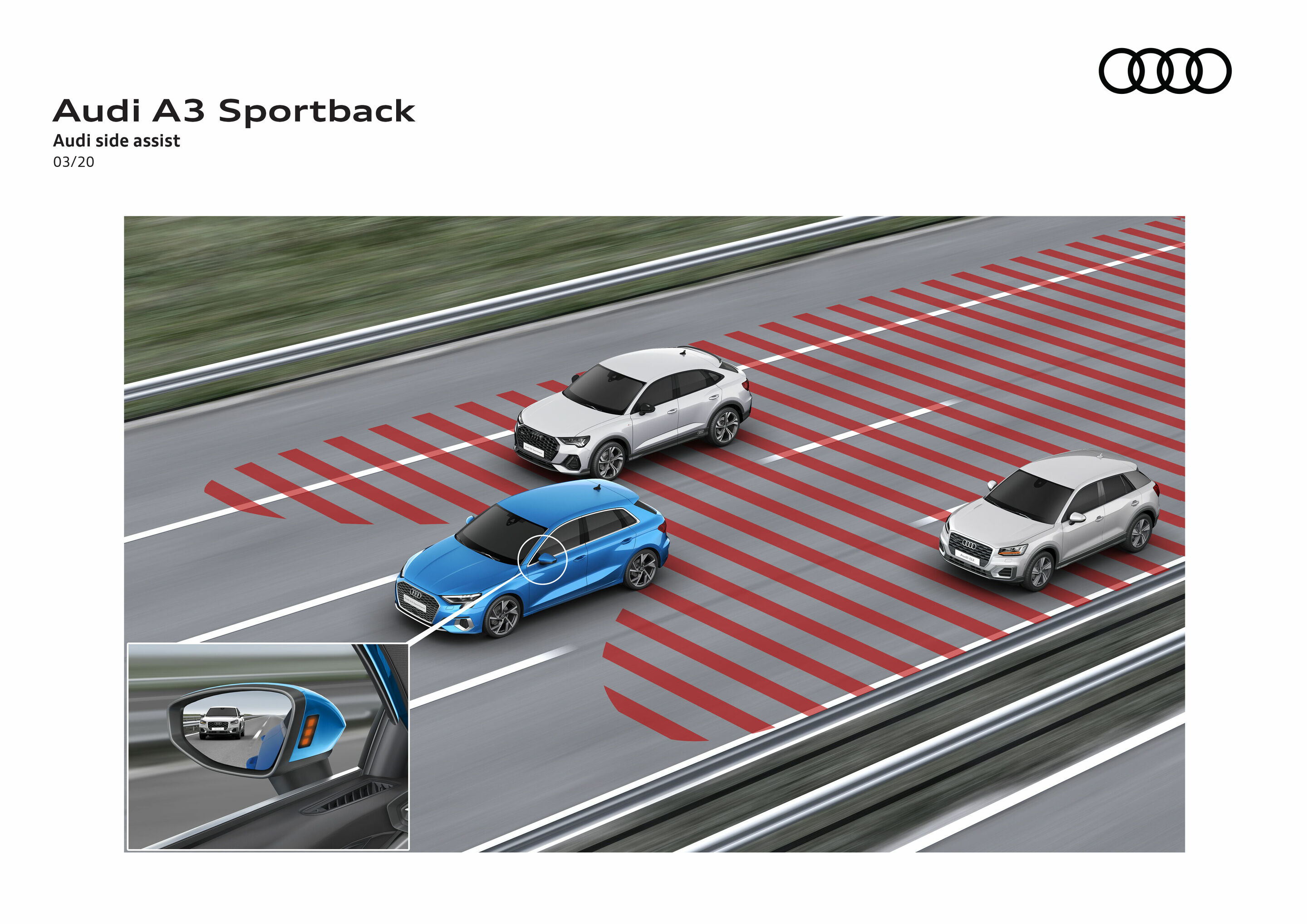
Audi side assist helps monitor the traffic behind the vehicle in city traffic and when driving on multilane roads. Two radar sensors installed in the rear detect vehicles approaching from the side at the rear. The distance and speed differential can be measured and analyzed. If a lane-change situation is classified as critical, a warning light is shown on the side-view mirror of the side in question. If a lane change is indicated by the turn signal at that moment and the system detects a critical situation, a warning will also flash on the display. The system operates in the range of approximately 30 to 250 km/h and can be activated via the corresponding menu in the Audi MMI.
Exit warning
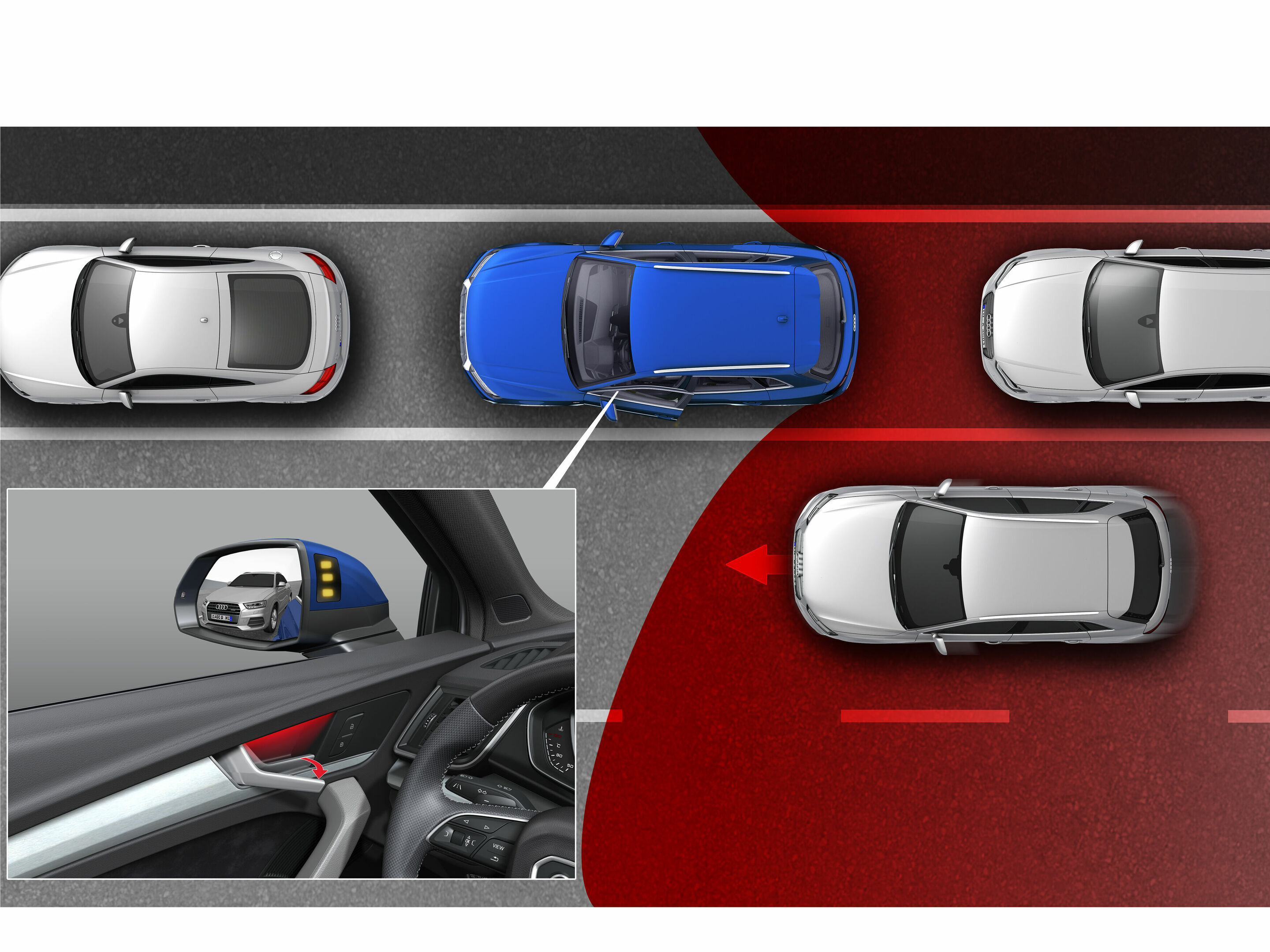
The exit warning increases safety, especially in city traffic. When the car has come to a stop and other vehicles or bicycles are approaching from behind and are classified as critical, the system warns passengers when they open the doors. The system uses LED lights in the door panel as a warning. In a situation that is considered dangerous, these flash and light up red. The Audi side assist LEDs in the respective side-view mirror are also activated. The exit warning remains on standby for about three minutes after the ignition is switched off.
The system is based on the radar sensors of Audi side assist, which monitor the area behind and to the side of the vehicle. Depending on the model, an additional feature supplements the exit warning: when active, it delays the opening of the electric door locks by about one second.
Swerve assist
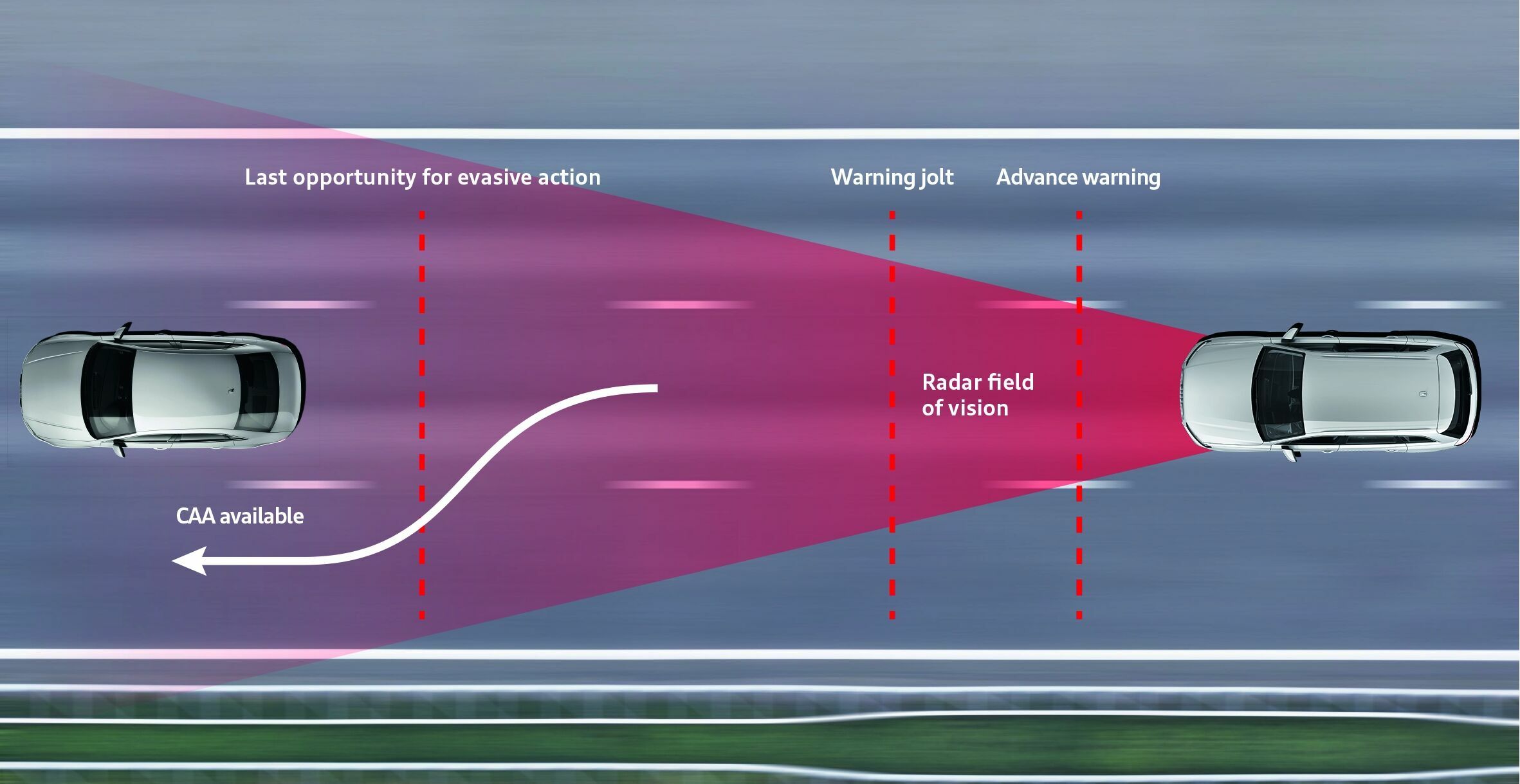
In critical situations, swerve assist helps steer the vehicle around an obstacle. The system uses data from the radar sensors and front camera to do this. It calculates a suitable evasive route based on the distance, width, and relative position of the vehicle in front. Swerve assist is available at speeds between approximately 30 and 150 km/h and requires the driver to actively steer throughout the maneuver. A display in the instrument cluster informs the driver of the intervention.
First, a warning jolt is given to indicate the danger. If the driver then actively avoids the obstacle, the assistant supports them by applying some slight steering torque to correct the steering angle or change lanes. On some models, the targeted braking of individual wheels also brings the vehicle onto the calculated course.
Curb warning
Multicollision brake assist
Main beam assist / High-beam assist
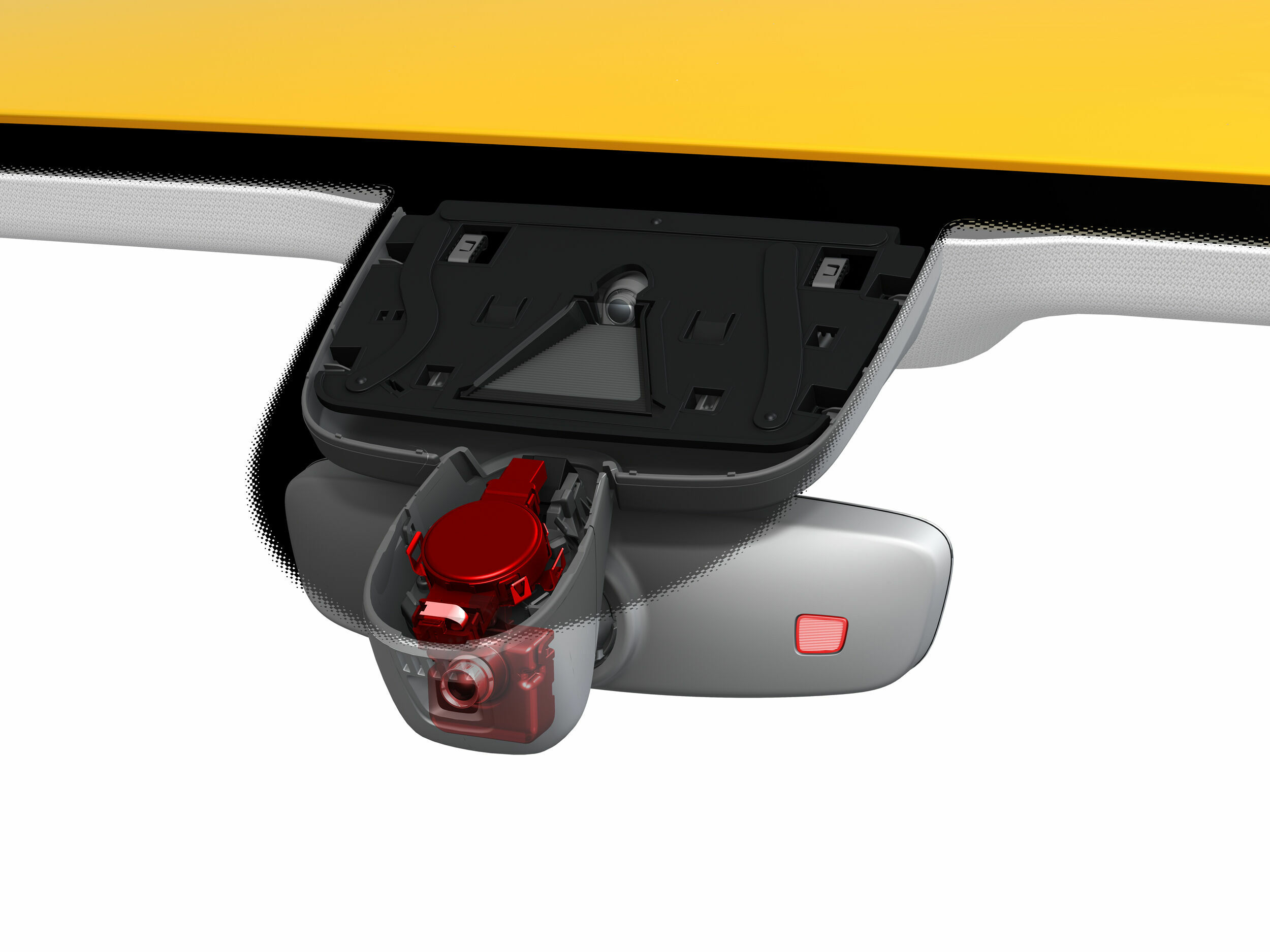
High-beam assist uses a camera on the interior mirror and, within the system limits, automatically detects the headlights of oncoming traffic, rear lights of other road users, and light sources from populated areas. Depending on the traffic situation, the high beams are automatically switched on or off. The system thus improves visibility and increases comfort.
Cruise control
Intersection assist
Laser scanner
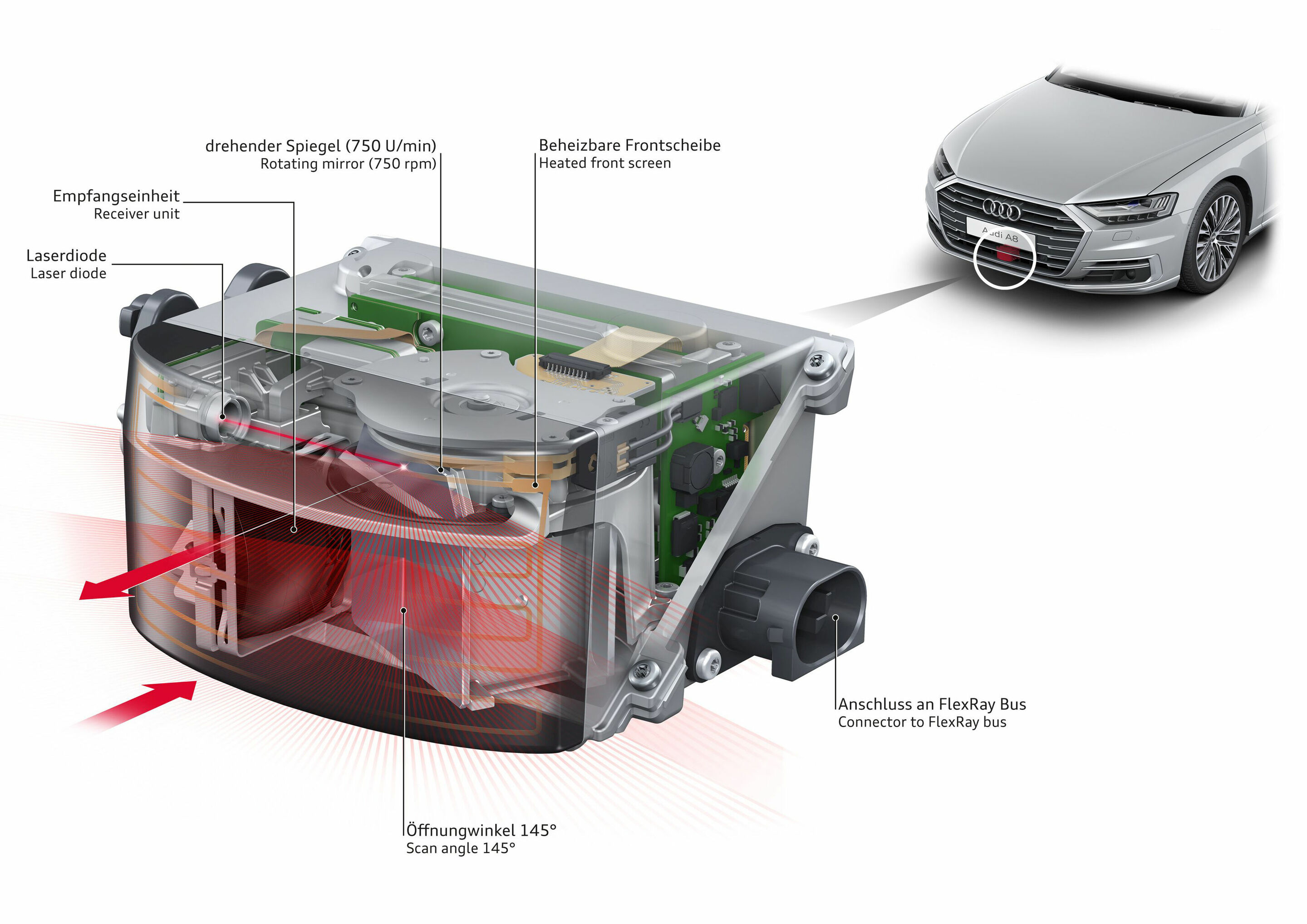
The laser scanner, together with the long-range radar and the front camera, forms a trio of sensors in which the different strengths of the three elements complement each other. This – plus the central driver assistance controller, which generates an image of the surroundings from all the sensor data – is what makes automated driving even possible.
The laser scanner covers a field of approximately 80 meters in length and an aperture angle of 145 degrees. The fist-sized component is mounted in the front bumper and emits modulated light pulses at multiple vertical levels at any speed, which are distributed in a fan-like pattern by a mirror. With their wavelength in the near-infrared range, the extremely short flashes of light are harmless and invisible to the human eye. They are reflected by objects in front of the car and return to the laser scanner, where they are detected by photodiodes.
This results in a sharp and detailed image of the static surroundings. The laser scanner displays other vehicles as cuboids with the corresponding dimensions, while also measuring information such as distance and orientation and distributing it to the partner control units. With its large horizontal opening angle, it detects approaching vehicles very early. Detailed information about the roadside infrastructure, such as guard rails, completes the picture. The laser scanner also works in the dark. An independent cleaning and heating system for the cover panel keeps the component operational even in wet conditions, as long as the conditions do not become too extreme.
Maneuver assist

Night vision assist
The system assists with night driving by displaying an infrared thermal image of the road surroundings ahead of the vehicle on the Audi virtual cockpit display. Any people and larger wild animals detected are displayed in yellow. If their movement and position indicate a potentially dangerous situation, the marking changes to red. A warning triangle also appears on the display and an acoustic warning is triggered. Night vision assist is automatically activated in the dark when the low beams are turned on or when the light switch is in AUTO mode.
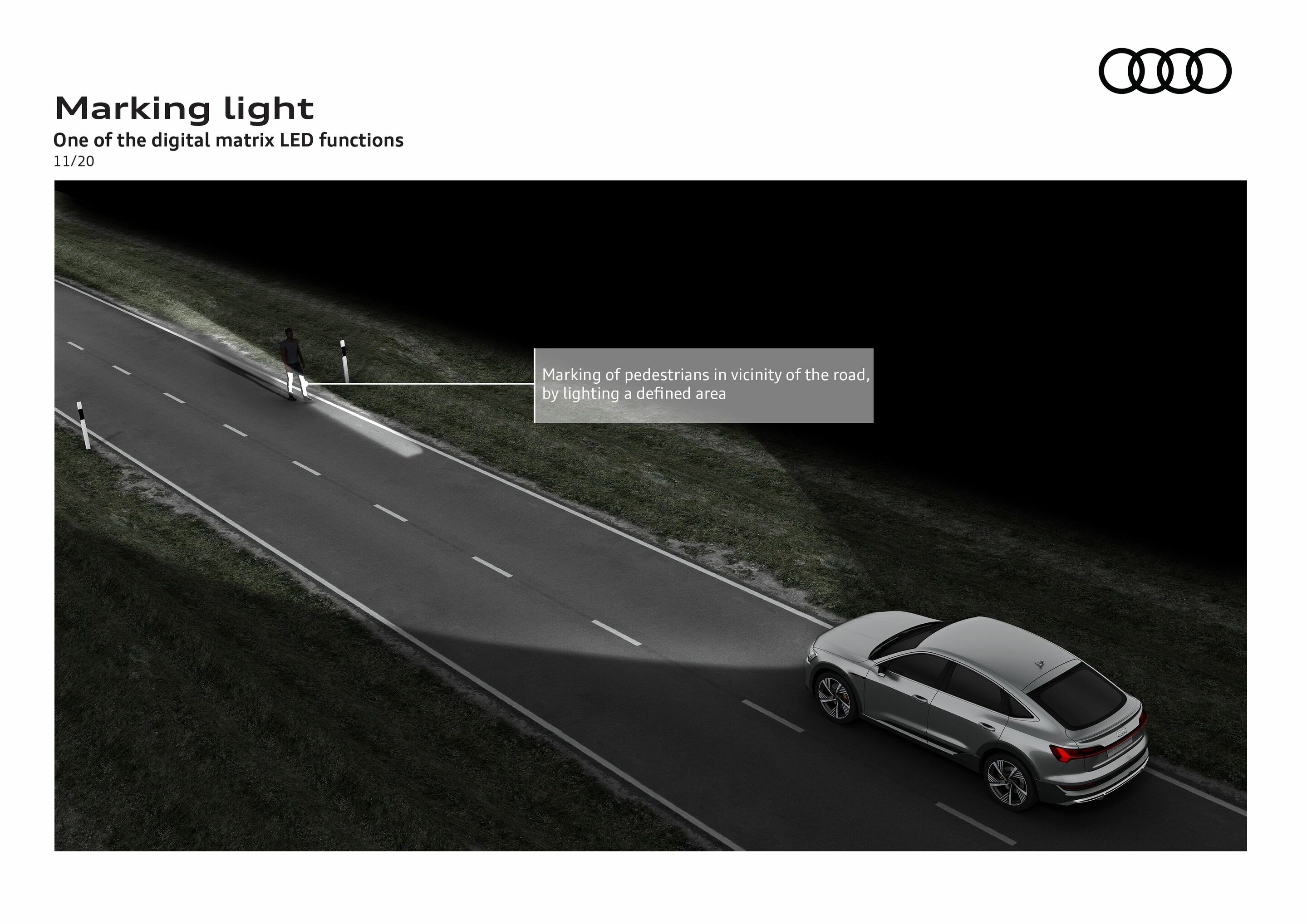
In combination with the matrix LED headlights, a marking light will flash several times to illuminate a person detected in the lane. This makes the person more visible and a warning is displayed. If a head-up display is available, additional warnings are shown there.
This system only operates outside of illuminated populated areas and at speeds above 60 km/h.
Emergency assist
Park assist and park assist plus
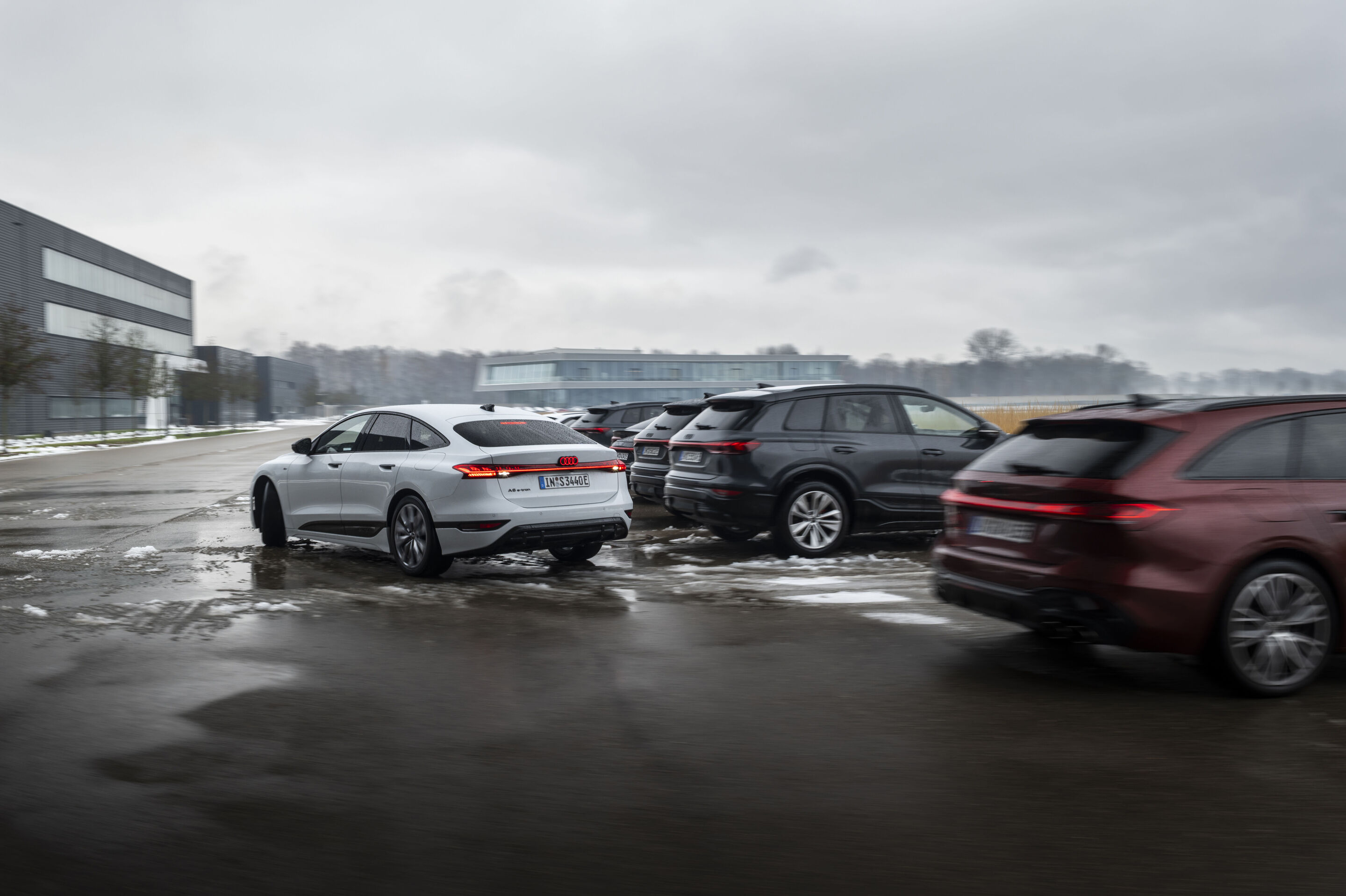
Park assist can automatically steer the car into parallel and perpendicular parking spaces. To perform these maneuvers, it uses ultrasonic sensors at the front, rear, and sides of the vehicle. Drivers only have to accelerate, brake, and change gears.
When driving past at moderate speed, the sensors measure the parking spaces along the road – perpendicular parking spaces at maximum 20 km/h, parallel parking spaces at maximum 30 km/h. If there is a suitable parking space, a message appears on the MMI display. The system takes over the steering process during parking. Acoustic signals also provide assistance. If necessary, park assist steers in several moves, forwards and backwards. It also maneuvers out of parallel parking spaces. Depending on the model, drivers activate the system via a button in the center console or via a button on the lower infotainment display. The maximum speed for all maneuvers is 7 km/h.
The (remote) park assist plus, which is activated at the touch of a button, detects suitable parking spaces and can automatically maneuver the vehicle into and out of a parallel or perpendicular parking space at the touch of a button. Drivers are responsible for the maneuver. They can remain seated in the car during the parking process or get out beforehand – in which case parking can be monitored via the myAudi app. When drivers hold down the respective button, the vehicle enters the space, in several stages if necessary. Once the car has reached its final position, the system switches off the motor, activates the parking brake, and locks the doors.
The rear parking system assists with reverse parking and maneuvering within the system limits by acoustically indicating the distance to a detected object behind the vehicle. The measurement is carried out by ultrasonic sensors discreetly integrated in the bumper, which are activated when the vehicle is put into reverse.
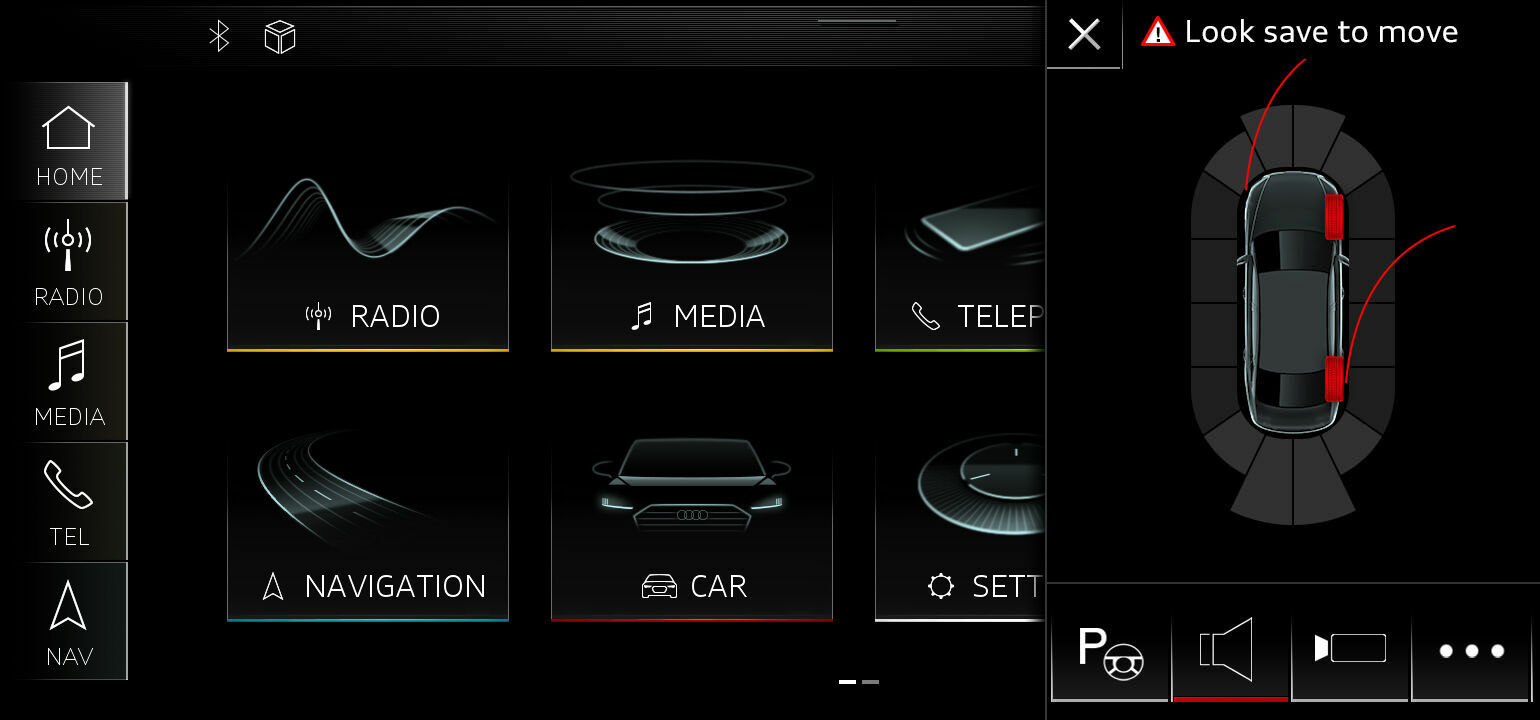
Parking system plus assists the driver when parking, leaving a parking space, and maneuvering forwards and backwards by means of acoustic signals and a visual display with virtual lane guidance. The warnings are triggered as soon as the driver puts the vehicle into reverse, activates the system using a button in the center console, or – depending on the model – the distance to a detected object in the vehicle’s path is less than 90 centimeters. Ultrasonic sensors measure the distance, and the Audi MMI display shows it visually. A white segment indicates a detected object outside the vehicle’s path, while red segments indicate detected obstacles in the vehicle’s path. The virtual lane display also provides lateral guidance lines that are calculated in advance based on the steering angle currently selected. A warning that increases in speed signals the decreasing distance to the obstacle.
Distraction and Driver Alert System
The system warns the driver visually and/or acoustically if it detects a lapse in attention caused, for example, by distraction or fatigue. Sensors are used to monitor driving and steering behavior within the system limits to determine the driver’s level of fatigue. The system then issues warnings in various stages in the Audi virtual cockpit in the form of a color-highlighted pop-up prompting the driver to take a break, as well as an audible message.
Lane departure warning with emergency assist
The lane departure warning system helps to prevent the vehicle from unintentionally leaving its lane within the system limits. Emergency assist can bring the vehicle to a standstill within the system limits. If the system is activated and ready for operation and no turn signal has been activated, the lane departure warning system helps to prevent the vehicle from crossing recognized lane markings by making corrective steering interventions. An additional steering wheel vibration can be set at the driver’s request. The system operates at speeds of approximately 60 km/h or higher.
In combination with side assist (lane change warning), lane departure is prevented if the adjacent lane is occupied, even if the turn signal has been activated. The system is activated as soon as the vehicle is started. It can also be switched on and off manually via the MMI touch display. Emergency assist detects when the driver is inactive within the system limits. In such cases, it issues visual, acoustic, and haptic warnings. If there is no reaction, the system takes control of the vehicle and brings it to a stop in its own lane. This activates occupant protection measures such as tightening the seat belts and closing the windows and panoramic glass roof (if available). The vehicle is prepared for the rescue of the occupants. If available, an automatic emergency call is made.
(Predictive) efficiency assist

Predictive efficiency assist supports the driver in driving proactively for better fuel efficiency. In conjunction with MMI navigation plus with MMI touch response, adaptive cruise control uses the data from the efficiency assistant to adaptively regulate speed – even when there is no vehicle in front. To do this, the system uses the information stored in the navigation data on curve radii, entries to populated areas, and speed limits. The system is supplemented by information from the camera-based traffic sign recognition system, which is also included. Efficiency assist also controls engine thrust and coasting phases in a targeted manner, thereby promoting efficient driving with adaptive cruise control and cruise control.
Front cross-traffic assist
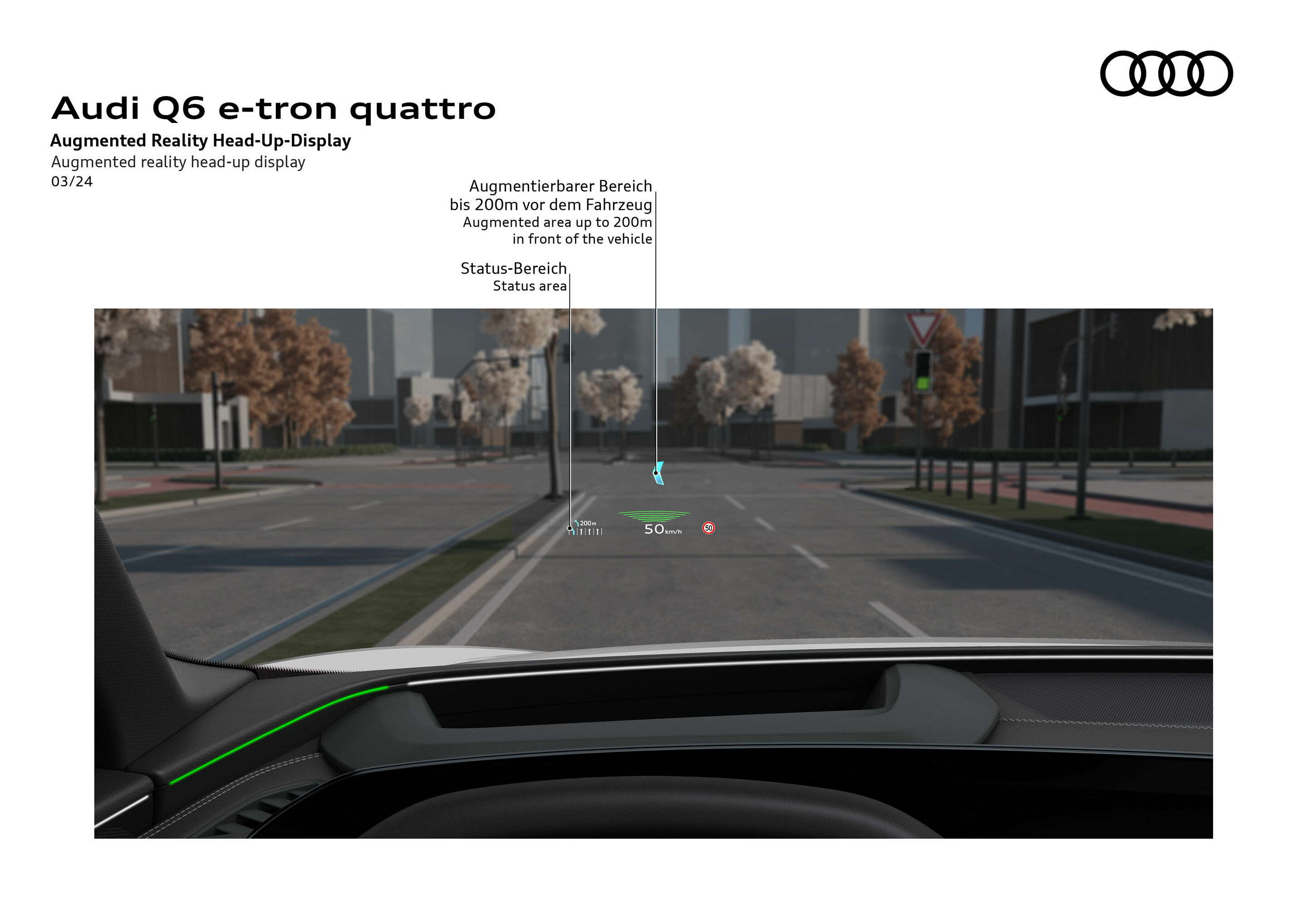
Front cross-traffic assist uses the radar sensors installed in the front of the vehicle to monitor the front and sides of the vehicle when driving near intersections and road exits. Within the system limits, approaching moving objects such as cars are detected. The system operates at speeds of up to 65 km/h. In situations identified as critical, multi-stage warnings are triggered. First, a visual and acoustic warning is given. If the driver does not react to this, a warning brake pulse is activated. The warning is displayed in the Audi virtual cockpit plus and, if the parking system is activated, in the MMI touch display as well. When combined with the augmented-reality head-up display, a warning of critical situations is also shown there.
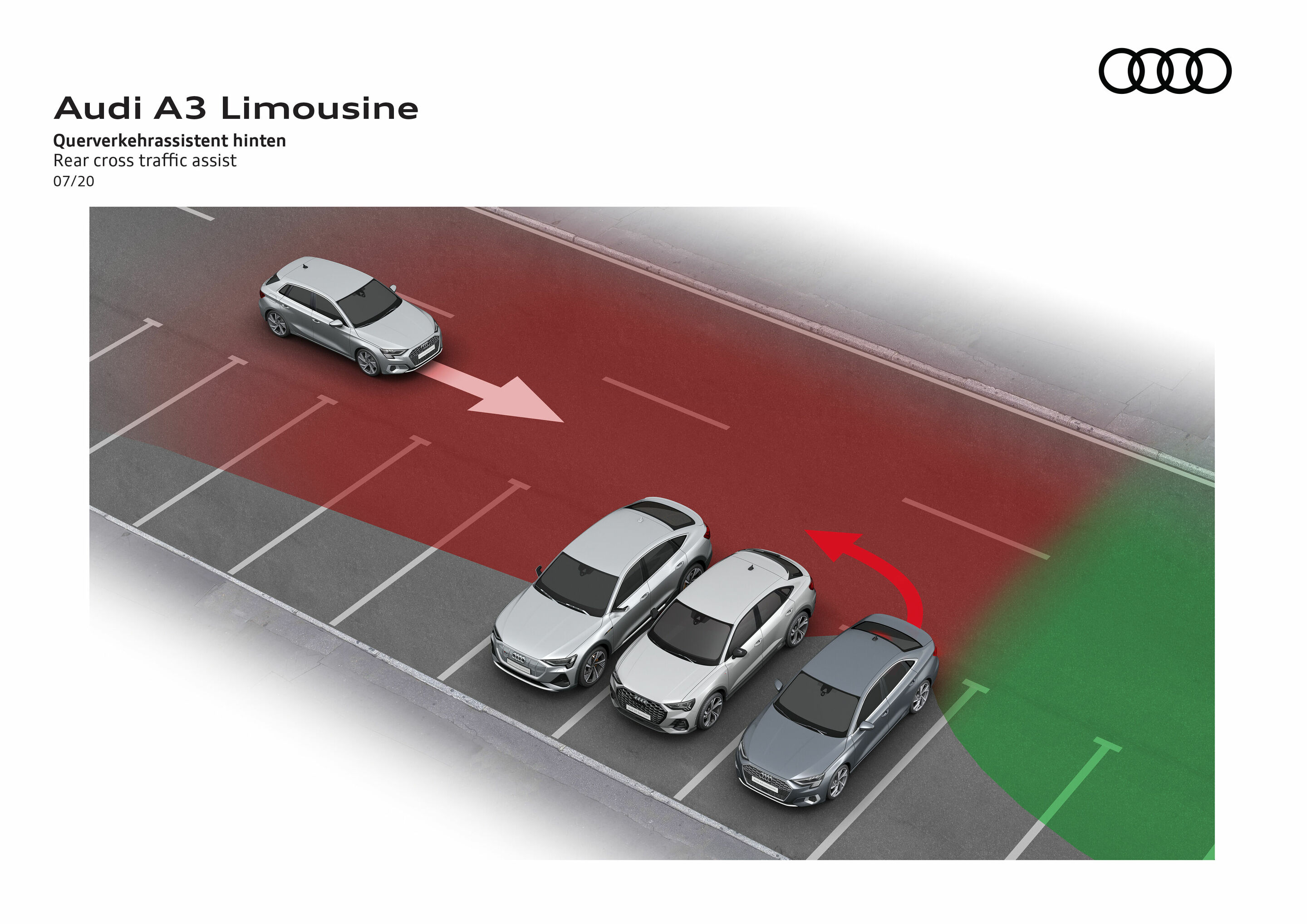
Rear cross-traffic assist
(Remote) parking pilot and remote garage pilot
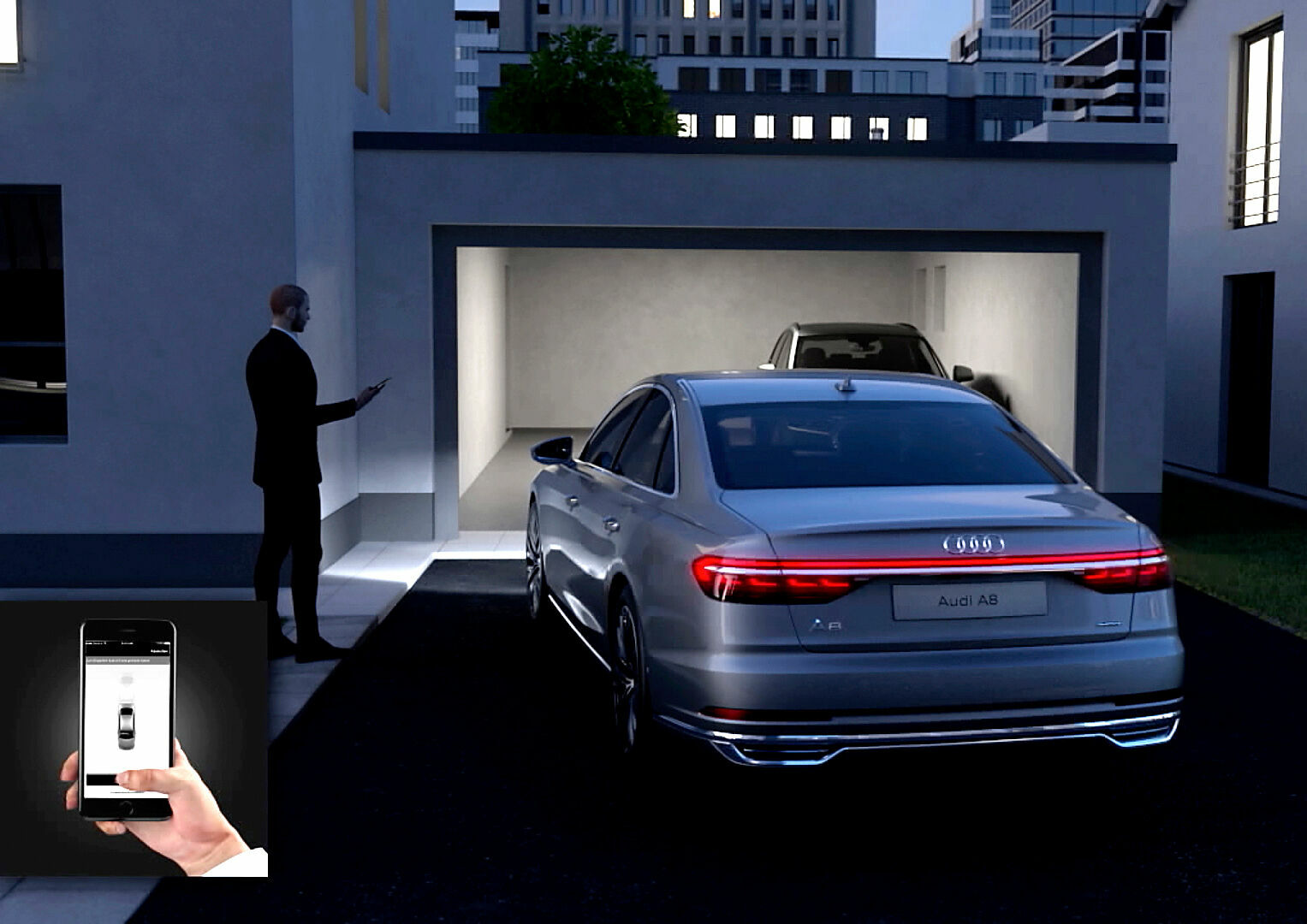
The (remote) parking pilot and remote garage pilot make parking and leaving a parking space extremely easy. Both systems automatically steer the vehicle into and out of a parallel or perpendicular parking space or garage. They control the steering, accelerator, brakes, and automatic transmission. Users can either sit in the car (parking pilot) or monitor the maneuver from outside using their smartphone (remote parking pilot and remote garage pilot). The relevant systems are activated via the parking button on the MMI display. When the vehicle is traveling at moderate speed, ultrasonic sensors measure the parking spaces along the road. The garage pilot also uses a laser scanner.
If a parking space is suitable, a message appears on the MMI display. The driver can then stop, select smartphone operation in the MMI, get out of the car, and initiate the parking maneuver using their cell phone. To do this, they press the Audi AI button in the myAudi app and hold it down throughout the entire parking process. The display shows a live image from the surround-view cameras. The driver must remain within six meters of the car. The car drives into the parking space at a speed of up to 6 km/h, in several stages if necessary. It is only possible to drive into the garage forwards. As soon as the vehicle has reached its final position, the tiptronic shifts into P, and the engine and ignition are switched off. When you want to drive off again, you can start the car via smartphone and have it drive out of the parking space or garage on its own.
Alternatively, the driver can also start the parking pilot directly from the vehicle. This is done using the AI button in the center console. This button must also remain pressed throughout the entire parking maneuver.
The (remote) parking pilot and remote garage pilot work intelligently. For example, the car can successfully enter a garage even if it has to negotiate a curve. In the garage, the vehicle can maneuver very close to walls and obstacles such as bicycles – or refrain from entering the garage altogether if there is not enough space. The innovative laser scanner is particularly beneficial in this context.
Reversing camera
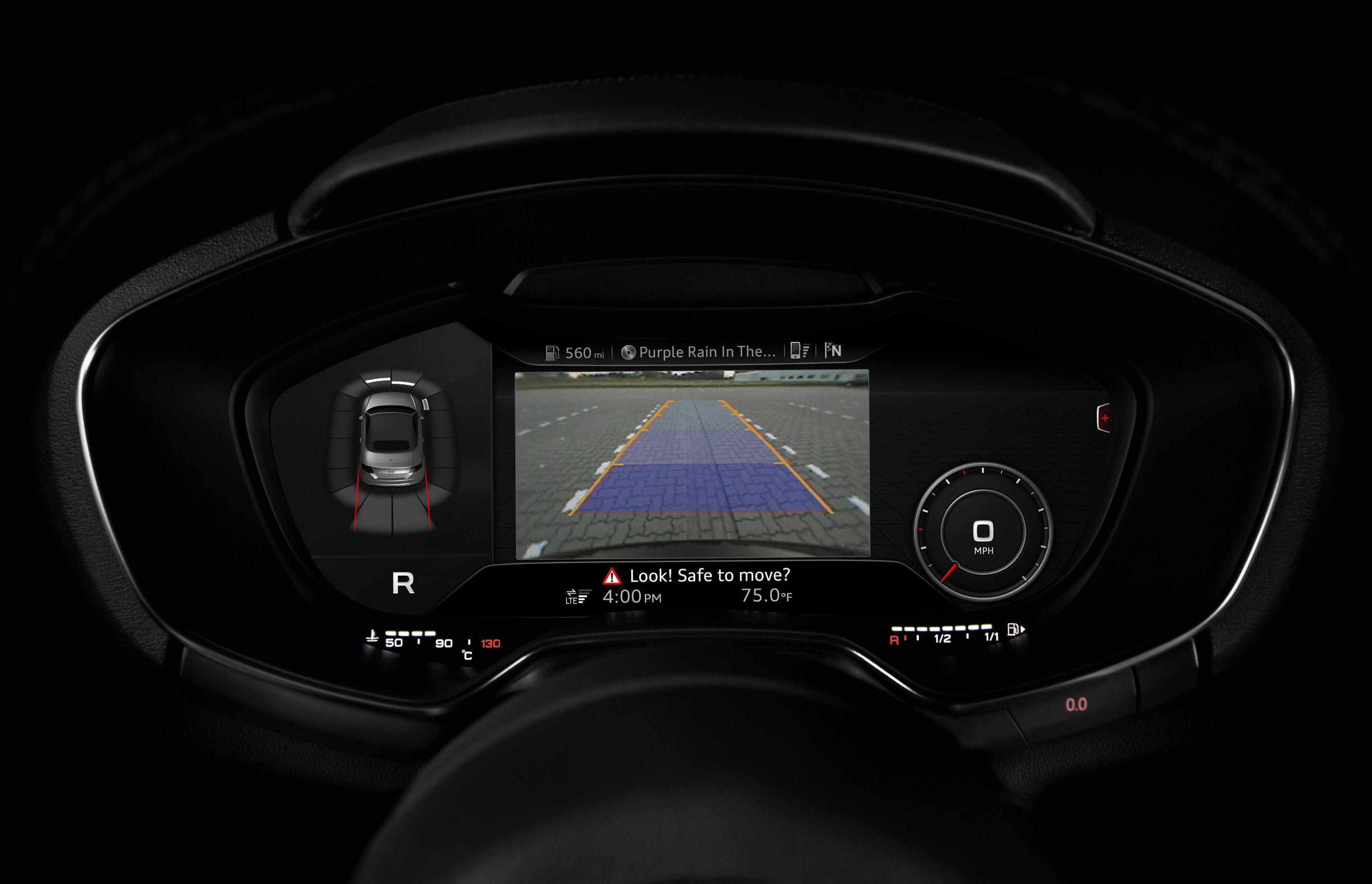
The reversing camera makes maneuvering easier by showing the area behind the vehicle on the MMI touch display. Depending on the steering angle, it displays the calculated lane as well as reference and guidance lines. Combined with the turning points for parallel parking, the guidance lines direct the vehicle precisely into the parking space. The blue area in the camera image indicates where the vehicle will be positioned after parking. The reversing camera is discreetly integrated into the handle strip of the luggage compartment lid. It is activated as soon as the vehicle is put into reverse or the respective button is pressed.
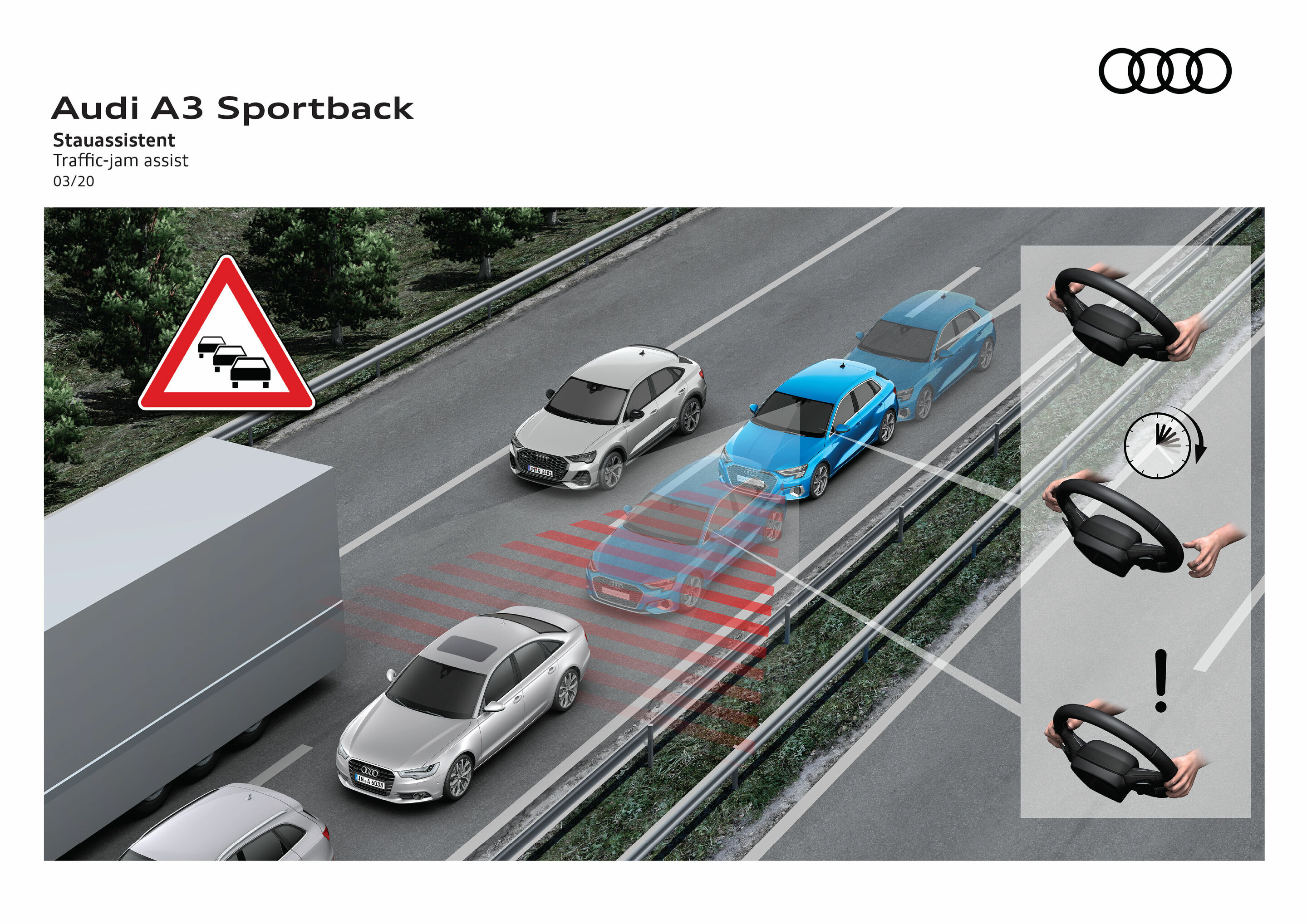
Traffic jam assist
Surround-view cameras
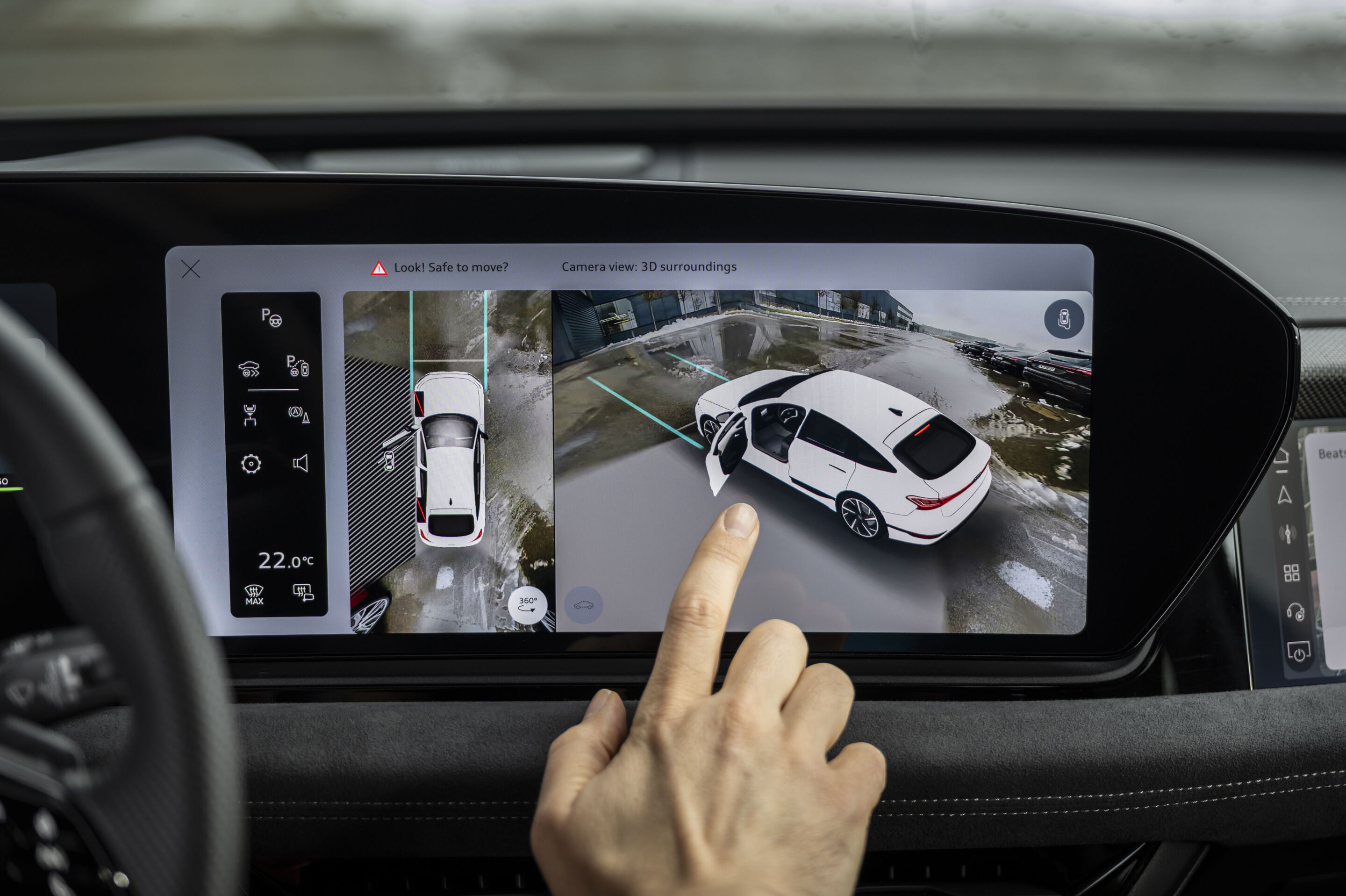
The surround-view cameras on the vehicle capture its immediate surroundings and display obstacles. You can choose between different views to make parking and maneuvering easier. A virtual top view in the MMI display provides an overview of the entire parking situation. The panoramic view at the front and rear covers an angle of almost 180 degrees and enables a better view when driving out of tight parking spaces, driveways, or blind intersections. Guide lines in the reversing camera view make perpendicular parking and coupling trailers easier. The view from the front camera helps when maneuvering by detecting obstacles in front of the car. The camera system switches on automatically when reversing or by touching the button.
Some models also have a virtual 3D view. The image section of the car and the real vehicle surroundings can be continuously panned and zoomed using the touchscreen. There is also a view of the front or rear wheels. This means the car can be precisely brought up to a curb.
Camera-based traffic sign recognition and Traffic sign-based speed limiter
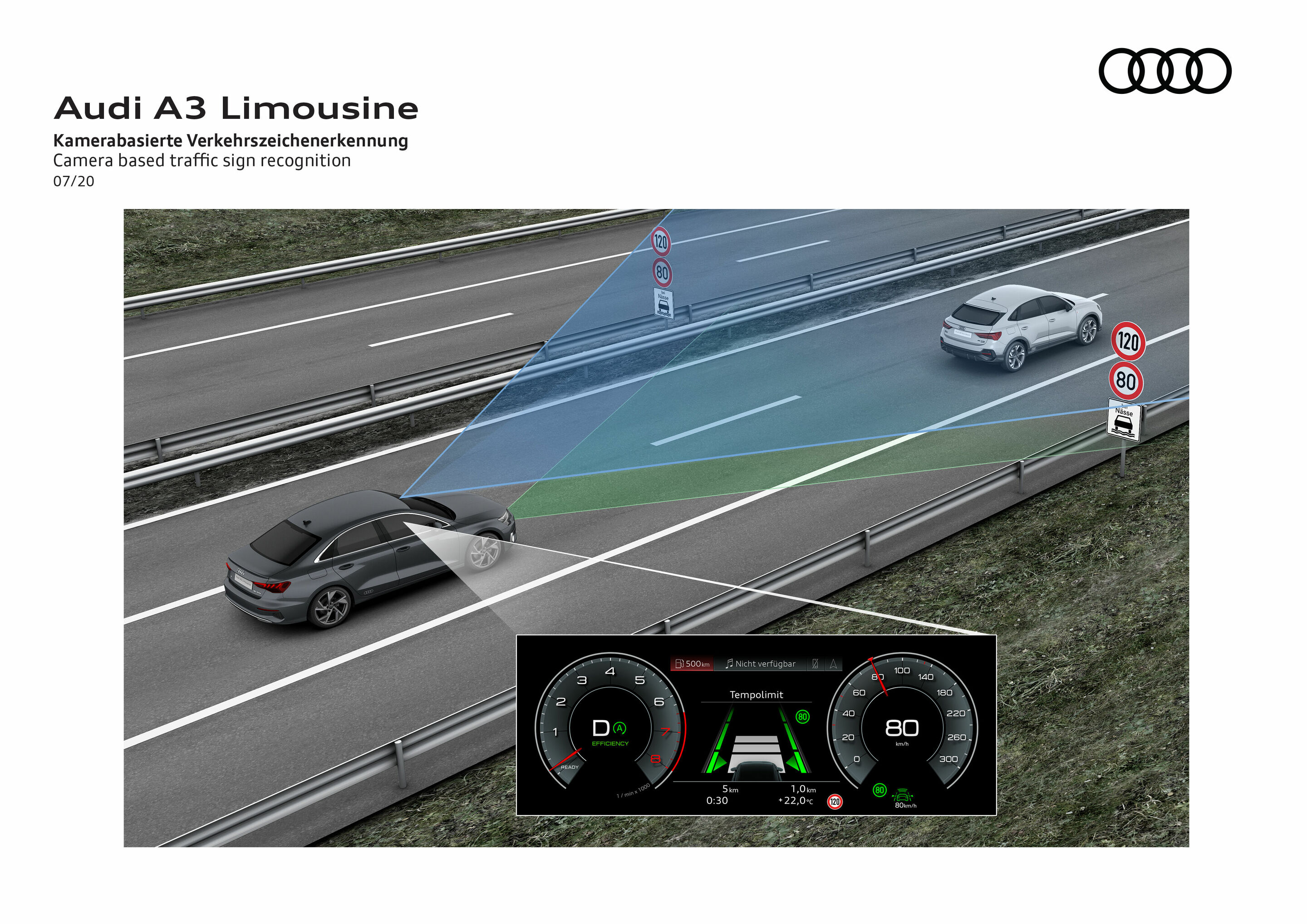
Camera-based traffic sign recognition identifies traffic signs such as speed limits (including digital displays), no overtaking, no entry, and various additional signs and displays them graphically. They appear in the driver information system or in the Audi virtual cockpit and head-up display. The camera on the windshield also registers temporary speed limits, for example in construction zones, as well as time-related and weather-related restrictions. The system displays the speed limit that is currently in effect. If, for instance, a lower speed is mandatory in wet conditions, this is displayed – provided the windshield wipers are activated. Time-restricted speed limits are only displayed at the relevant times. Drivers can also select a warning threshold as an offset from the applicable speed limit. If the selected speed is exceeded, a visual warning is issued. The camera-based traffic sign recognition is purely of an informative nature.
The adjustable speed limiter helps to ensure that a preset maximum speed is not exceeded when driving approximately 30 km/h or more, for example in populated areas. When the set limit is reached, the vehicle gently slows down. The accelerator pedal can be pressed by the driver up to the kickdown point without accelerating beyond the set speed. The speed limiter can be deactivated at any time, for instance to overtake another vehicle by kickdown, until the vehicle’s speed falls below the set maximum speed again.
It is operated via a separate steering column stalk. The set maximum speed and the system status are displayed in the digital instrument cluster. In conjunction with camera-based traffic sign recognition, the speed limiter is supported within system limits by automatically adopting the detected speed limit as the maximum speed if required.
Central driver assistance controller
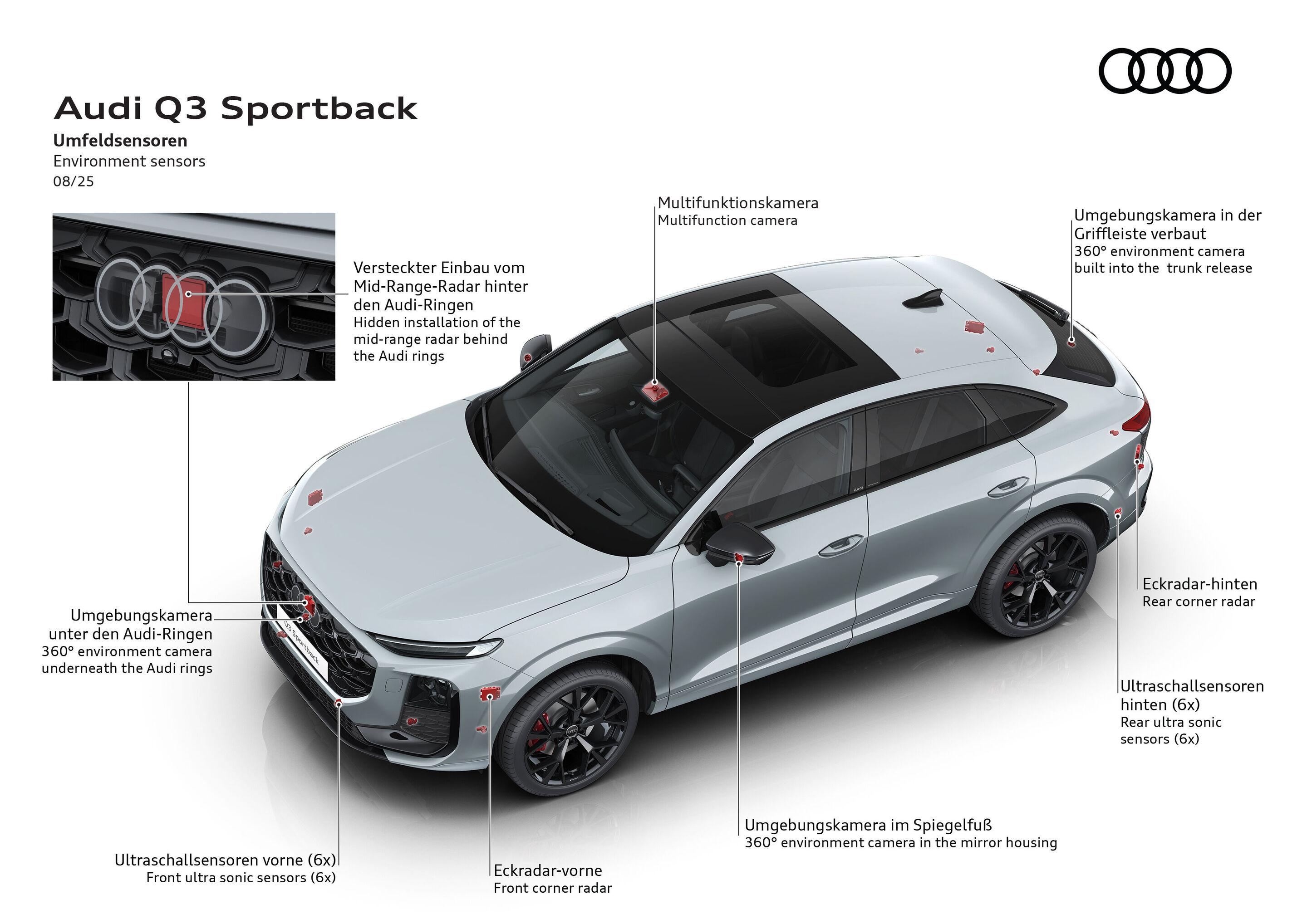
Highly automated driving at Level 3, in which the vehicle drives completely independently under certain conditions while the person behind the wheel performs other tasks, is based on two innovations: the sensor set with the laser scanner and the central driver assistance controller, or zFAS for short. The tablet-sized computer continuously processes the signals and uses them to create a complete image of the vehicle’s surroundings. To do this, it uses processors from leading global suppliers – Nvidia (Tegra K1), Altera (Cyclone V), Infineon (Aurix), and Mobileye (EyeQ3).
The data from the sensors is read into the so-called fusion layer in the zFAS and combined to form a differentiated environment model. It includes moving objects, static obstacles, and a street model. The latter is generated both from the conventional navigation map and from the road markings and boundaries detected by the sensors. The vehicle is precisely located in the model, and this position information is then fed into the navigation map that the driver sees. This offers many advantages, for example in complex intersection situations.
The zFAS is the central interface for piloted driving and for almost all assistance systems. Whether it’s intersection assist, emergency braking, adaptive cruise assist, or traffic jam pilot – none of these functions are linked to one specific sensor anymore. Each system accesses the environment model and is made even better by its high precision. This enables the vehicle, for example, to detect the end of a traffic jam and initiate targeted braking accordingly.
The principle of the central fusion level, which is based on standardized sensor interfaces, gives Audi a further advantage: independence from individual sensors. The sensors can be replaced at any time if better devices become available on the market.