Search
All search results for "Auto Union 1000S"
(65)
History of the Four Rings
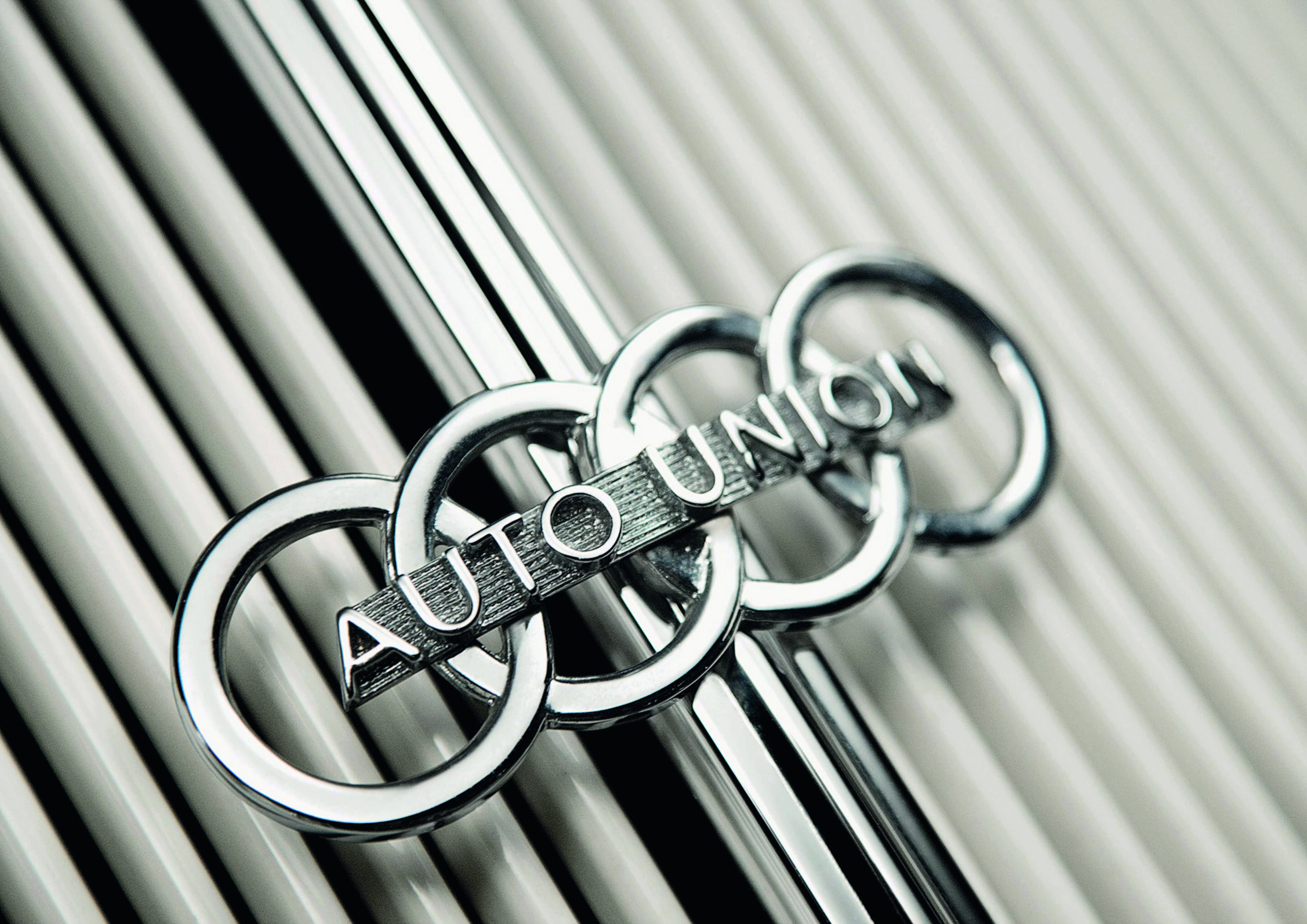
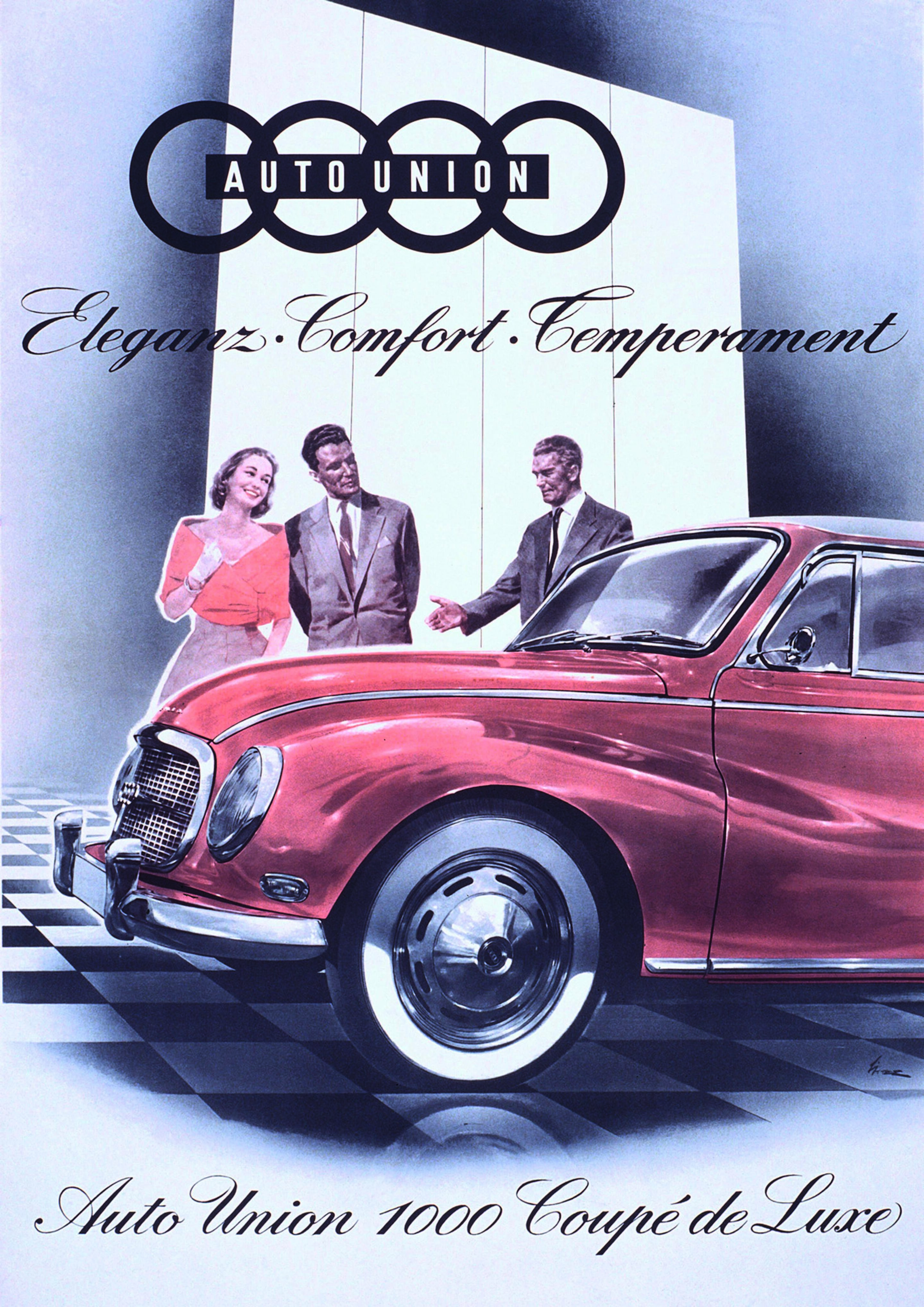
AUDI AG can look back on a very eventful and varied history; its tradition of car and motorcycle manufacturing goes right back to the 19th century. The Audi and Horch brands in the town of Zwickau in Saxony, Wanderer in Chemnitz and DKW in Zschopau all enriched Germany’s automobile industry and contributed to the development of the motor vehicle. These four brands came together in 1932 to form Auto Union AG, the second largest motor-vehicle manufacturer in Germany in terms of total production volume. The new company chose as its emblem four interlinked rings, which even today remind us of the four founder companies. After the Second World War the Soviet occupying power requisitioned and dismantled Auto Union AG’s production facilities in Saxony.
Leading company executives made their way to Bavaria, and in 1949 established a new company, Auto Union GmbH, which continued the tradition associated with the four-ring emblem. In 1969, Auto Union GmbH and NSU merged to form Audi NSU Auto Union AG, which since 1985 has been known as AUDI AG and has its head offices in Ingolstadt. The Four Rings remain the company's identifying symbol. Horch This company's activities are closely associated with its original founder August Horch, one of Germany's automobile manufacturing pioneers. After graduating from the Technical Academy in Mittweida, Saxony he worked on engine construction and later as head of the motor vehicle production department of the Carl Benz company in Mannheim. In 1899 he started his own business, Horch & Cie., in Cologne. In his automobile designs he was the first German engineer to use cast aluminium engine blocks and gearbox housings, to adopt shaft drive and to specify high-strength grades of steel for gearwheels. Horch moved his company to Saxony in 1902, initially to Reichenbach and two years later to Zwickau. In 1903 he began to build cars with a twin-cylinder engine. Later, in Zwickau, four-cylinder engines were built.
Allan McNish - Biography
Racing Director, Audi Revolut F1 Team
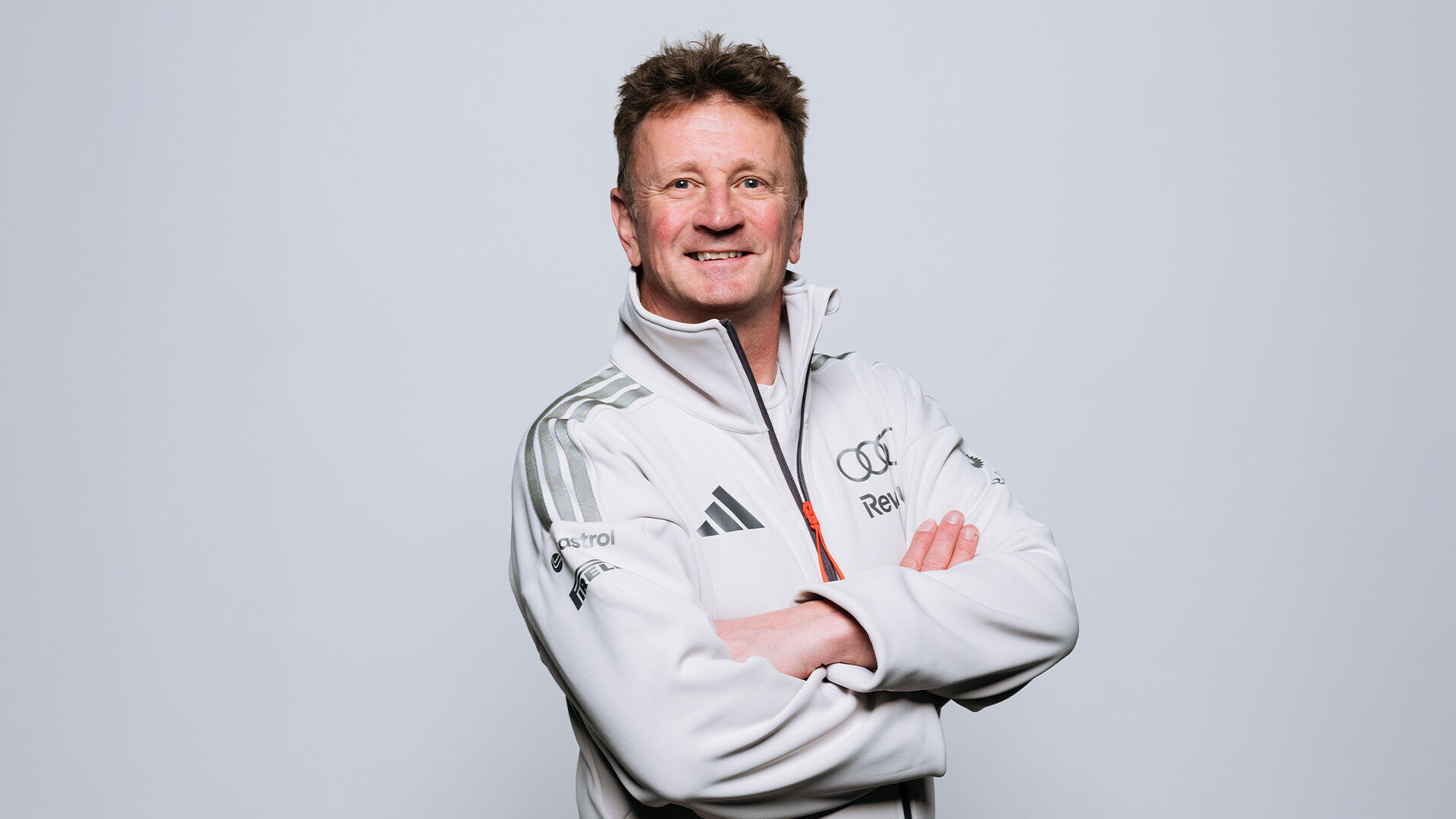
Allan McNish is Racing Director of Audi Revolut F1 Team, reporting to Mattia Binotto. In this role, he is responsible for all race-track activities, overseeing Strategy and Sporting operations, Driver Management and the team’s Heritage programme. He also represents the team across race weekend media and partner engagements, while continuing to lead Audi’s Driver Development Programme, a key pillar of its long-term Formula One strategy. Born in Dumfries, Scotland, McNish built his reputation as one of motorsport’s most accomplished and versatile drivers. After early success in karting and junior categories, he entered Formula One as a test driver with McLaren and went on to race for Toyota, alongside test and reserve roles with McLaren, Benetton and Renault. He is widely regarded as one of endurance racing’s most successful drivers and has been closely associated with the Audi brand since 2000. McNish secured three overall victories at the Le Mans 24 Hours and was crowned FIA World Endurance Champion in 2013. His career also includes multiple wins at the Sebring 12 Hours, Petit Le Mans and Silverstone 1000km, as well as three American Le Mans Series titles. Following his retirement from racing, McNish transitioned into senior leadership roles within Audi’s motorsport structure. He served as Director of Co-ordination for Audi Group Motorsport and as Team Principal of Audi Sport ABT Schaeffler in Formula E, where he led the team to the FIA Formula E Teams’ Championship in its debut season. McNish has been a key figure in Audi’s Formula One project from its inception, most recently serving as Senior Consultant for Technical Partnerships and Director of the Driver Development Programme.
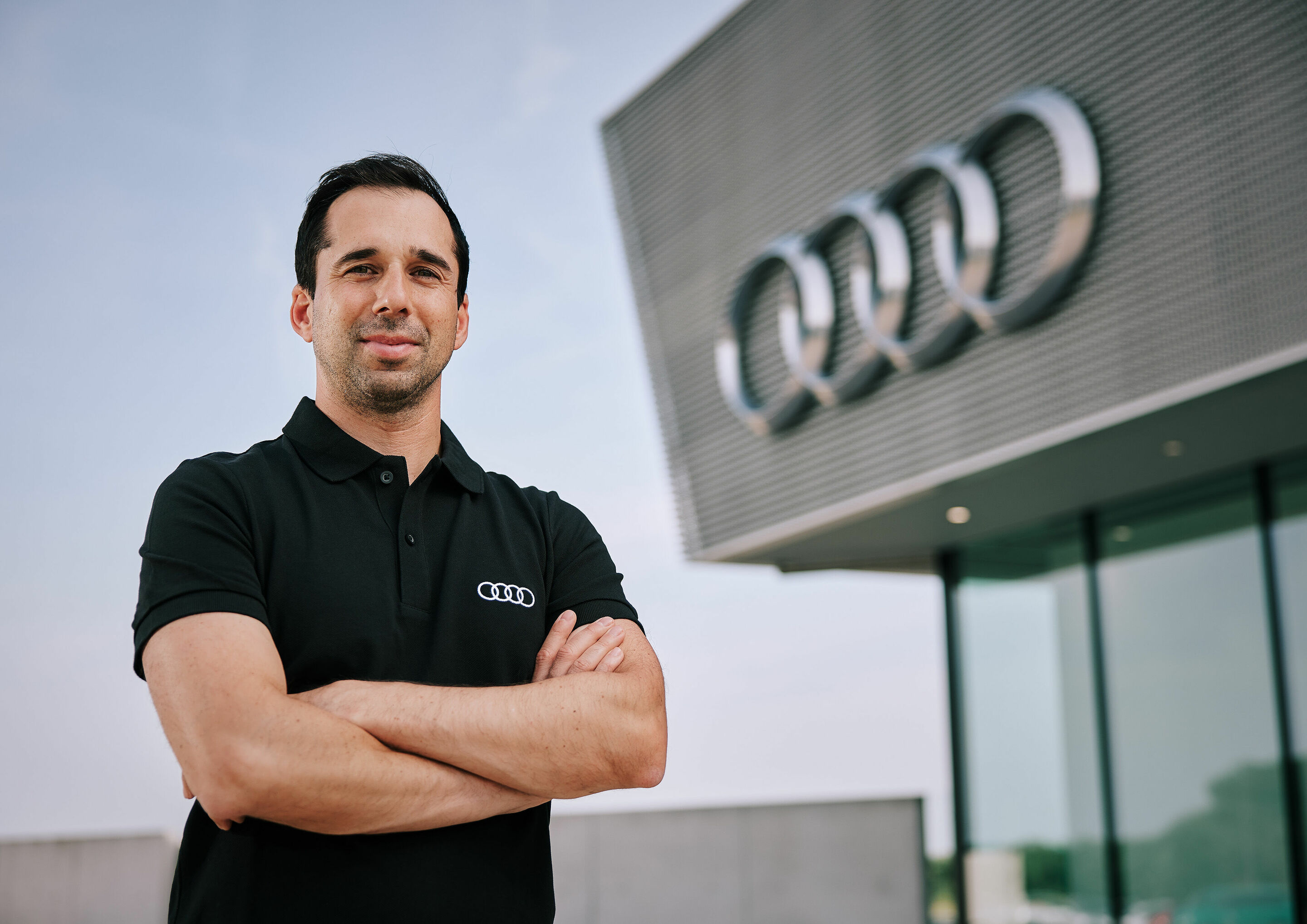
Neel Jani - Biography
Date of birth: 8 December 1983 Place of birth: Rorschach (CH) Place of residence: Bellmund (CH) Status: married, one child Career: 1996–2000 Karting 2000 1st Formula Lista Junior Switzerland 2001 Formula Renault 2000 Eurocup, Formula Renault Italy 2002 2nd Formula Renault 2000 Eurocup 2003 2nd Formula Renault V6 Eurocup 2004 Formula Renault V6 Eurocup, Formula 1 test driver (Sauber F1) 2005 GP2 Series 2006 Formula 1 test and reserve driver (Scuderia Toro Rosso) 2007 1st A1GP Series, Champ Car World Series 2008 1st A1GP Series, Formula 1 tests (Red Bull Racing) 2009 Le Mans 24 Hours, Formula 1 tests (Red Bull Racing) 2010 3rd Le Mans Series (LMP1), Le Mans 24 Hours, Formula 1 tests and show runs (Red Bull Racing) 2011 1st Le Mans Series (LMP1), 6th Le Mans 24 Hours, Formula 1 tests and show runs (Red Bull Racing) 2012 4th FIA World Endurance Championship WEC, 4th Le Mans 24 Hours, Formula 1 tests and show runs 2013 1st Petit Le Mans, 3rd Sebring 12 Hours, 2nd Laguna Seca, 2nd Long Beach (both American Le Mans Series), LMP1 test program for Porsche 2014 3rd FIA World Endurance Championship WEC (LMP1, Porsche) 2015 3rd FIA World Endurance Championship WEC, 5th Le Mans 24 Hours (LMP1, Porsche) 2016 1st FIA World Endurance Championship WEC, 1st Le Mans 24 Hours (LMP1, Porsche) 2017 4th FIA World Endurance Championship WEC (LMP1, Porsche), FIA Formula E 2017/18 (two races, Dragon Racing) 2018 5th in FIA World Endurance Championship WEC 2018/19, 4th in Le Mans 24 Hours (LMP1, Rebellion Racing) 2019 4th Le Mans 24 Hours (Rebellion Racing) 2020 2nd Sebring 12 Hours (GTLM), FIA Formula E 2019/2020 2021 2nd FIA World Endurance Championship WEC (GTE Pro) 2022 1st Sebring 12 Hours (DPi) 2023 Asian Le Mans Series, 3rd Le Mans 24 Hours (LMP2, Duqueine) Simulator driver Audi Formula 1 project
Audi Tradition - Anniversary Dates 2024
When NSU was taken over by Volkswagenwerk AG, the presentation of the newest NSU model, which had been scheduled for the Geneva Motor Show in March 1969, was cancelled. The merger of NSU and Auto Union to create Audi NSU Auto Union AG sparked rumours that the K 70 would not be built as a product to rival the Audi 100 and VW 411/412. But this did not happen and VW adopted the last new car to be developed in Neckarsulm, getting it ready for production with help from former NSU engineers at the newly constructed plant in Salzgitter within a year. From August 1970 to May 1975, 211,127 VW K 70 rolled off the production line in Lower Saxony. Audi Tradition 18 Anniversary Dates 2024 Takeover of Auto Union GmbH by Volkswagenwerk AG Years 60 1964 was a key turning point for Auto Union in Ingolstadt. In an extraordinary meeting of the shareholders on 16 December 1964, those present decided to increase the share capital from 80 to 160 million DM. At the same time, the acquisition of 51% of the capital by Volkswagenwerk AG, which had been prepared back in October of the same year, received the required approval. The officials thus initiated the gradual takeover of Auto Union GmbH from Daimler-Benz AG (previously the sole shareholder) by Volkswagenwerk AG. The takeover became legally effective on 1 January 1965. The rest of the shares were acquired from Daimler-Benz in further stages. From 1 November 1966, Auto Union GmbH was a fully owned subsidiary of VW. Audi Tradition 19 Anniversary Dates 2024 DKW F 102 The long-awaited successor to the outdated Auto Union 1000 made its debut at the International Motor Show in Frankfurt in September 1963, but only hit the market in March 1964. Hailed as the “Formula of Progress”, the DKW F 102 was a car with a modern design that was noted for its self-supporting body which was a departure from the separate design of chassis and body that had previously been customary at the company.
Audi Tradition to commemorate numerous anniversaries in 2025
Booklet features a selection of more than two dozen anniversaries The launch of the Audi A2 25 years ago; the first new Audi in post-war times 60 years ago; and Hans Stuck’s record-breaking exploits in the “world’s fastest road-going car” near Lucca 90 years ago
With the “Anniversary Dates 2025” booklet, Audi Tradition is showcasing the most important moments in the product and company history of Audi, which is as eventful as it is diverse. Audi historians have selected a total of 27 dates to commemorate in 2025.
Twenty-five years ago, the Audi A2 hit the market. With its aluminum body, it made a name for itself as a progressive compact car: light, aerodynamic, and economical. The Audi A2 polarized opinion with its design and unusual proportions; the concept was ahead of its time. However, sales remained below expectations, and Audi ended production after roughly five years and 176,377 units built. Since then, the A2 became a fan favorite and is now a sought-after collector’s item. Sixty years ago, the first post–World War II Audi rolled off the production line. With the “Auto Union Audi” vehicle, Auto Union GmbH revived the tradition-steeped Audi brand name in 1965. The new name was meant to show that this car represented a fresh start for Auto Union in terms of technology. The Audi was the first car from the brand with four rings to feature a four-cylinder four-stroke engine, and it marked the beginning of a new era in Ingolstadt. Twenty years later, on January 1, 1985, Audi NSU Auto Union AG was renamed AUDI AG, and since that time, the company and its products have shared the same short, memorable name. Ninety years ago, in February 1935, a spectacular attempt to break speed records took place in Italy. After test drives in October 1934 with the Grand Prix racing car on the AVUS in Berlin, the Auto Union racing department started developing the vehicle that would later be known as the “Lucca” car.
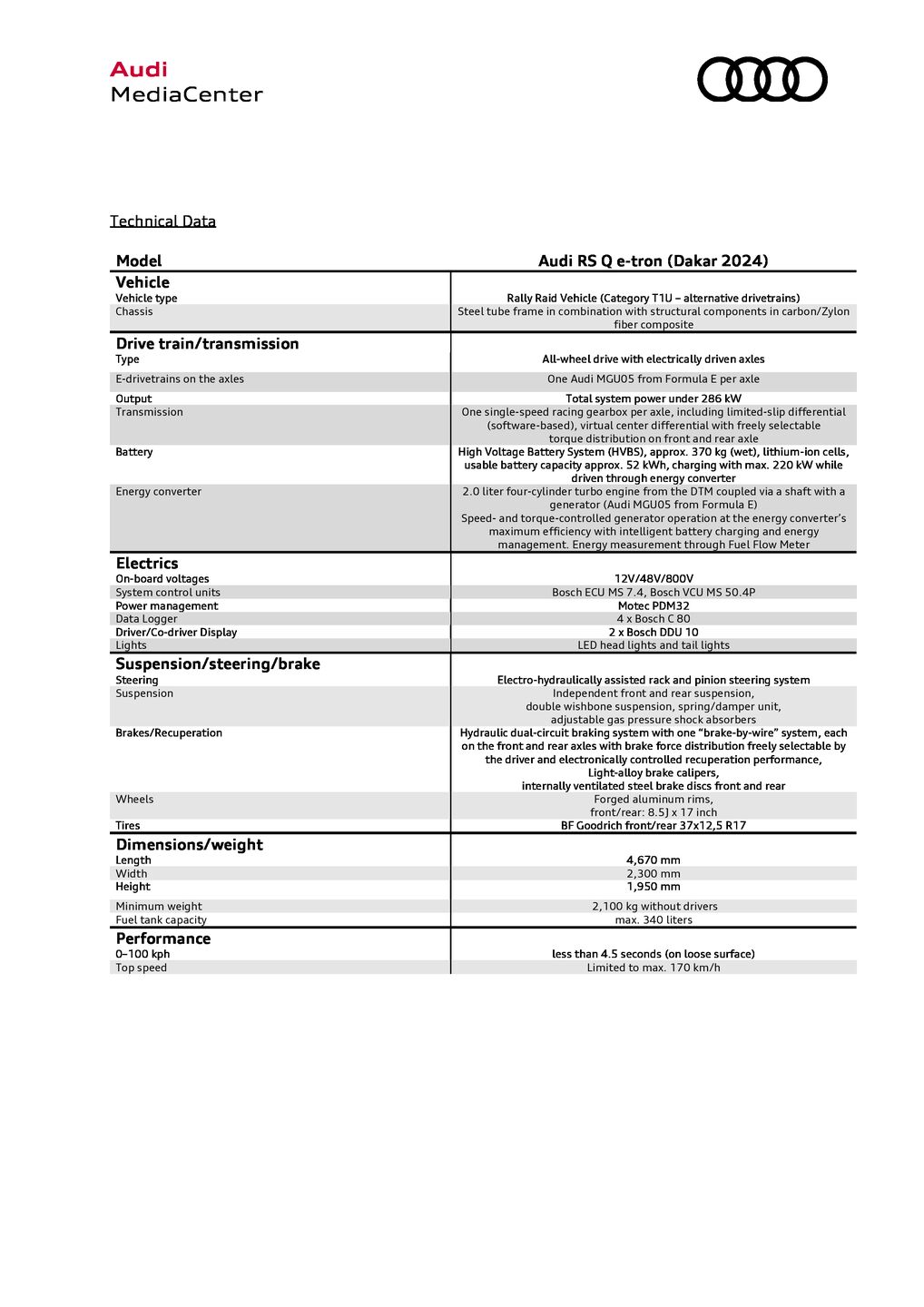
Technical Data: Audi RS Q e-tron (Dakar 2024)
Audi MediaCenter Technical Data Model Audi RS Q e-tron (Dakar 2024) Vehicle Vehicle type Rally Raid Vehicle (Category T1U – alternative drivetrains) Chassis Steel tube frame in combination with structural components in carbon/Zylon fiber composite Drive train/transmission Type All-wheel drive with electrically driven axles E-drivetrains on the axles One Audi MGU05 from Formula E per axle Output Total system power under 286 kW Transmission One single-speed racing gearbox per axle, including limited-slip differential (software-based), virtual center differential with freely selectable torque distribution on front and rear axle Battery High Voltage Battery System (HVBS), approx. 370 kg (wet), lithium-ion cells, usable battery capacity approx. 52 kWh, charging with max. 220 kW while driven through energy converter Energy converter 2.0 liter four-cylinder turbo engine from the DTM coupled via a shaft with a generator (Audi MGU05 from Formula E) Speed- and torque-controlled generator operation at the energy converter’s maximum efficiency with intelligent battery charging and energy management.
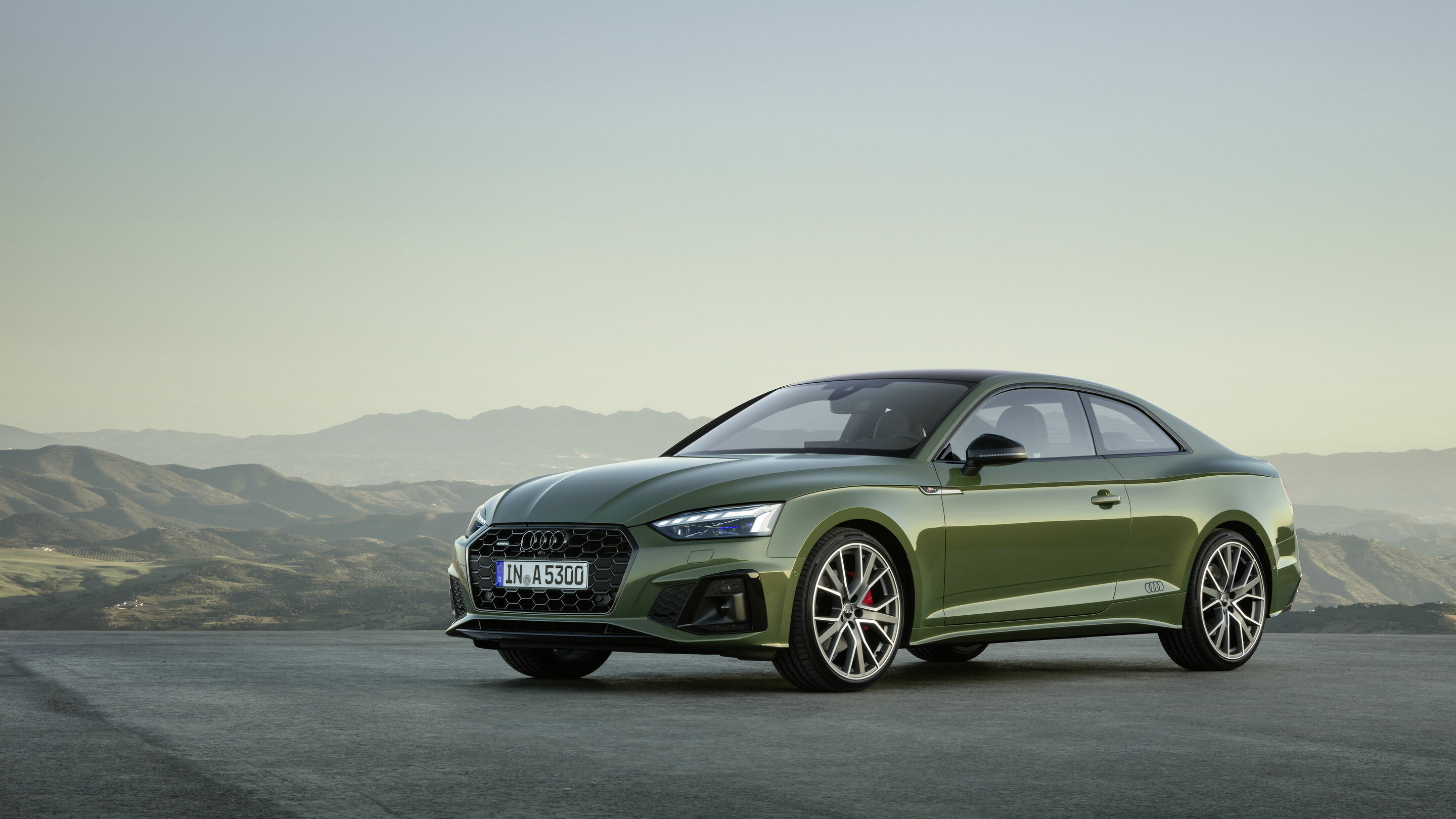
The Audi A5: New Look and New Technologies (2020)
Aesthetic design, electrified and well connected – Audi upgrades the A5. All variants – the Sportback, the Coupé and the Cabriolet – get the cutting-edge MMI touch operating concept. Mild hybrid technology offers greater comfort while also reducing fuel consumption. The Audi S5 Sportback and S5 Coupé are now equipped with a 3.0 TDI with 255 kW (347 hp) (combined fuel consumption in l/100 km: 6.2 – 6.1*; combined CO2 emissions in g/km: 162 – 160*). It offers a unique combination of brawny pulling power, high efficiency and long range.
* Information on fuel consumption and CO2 emissions as well as efficiency classes in ranges depending on the tires and alloy wheel rims used.
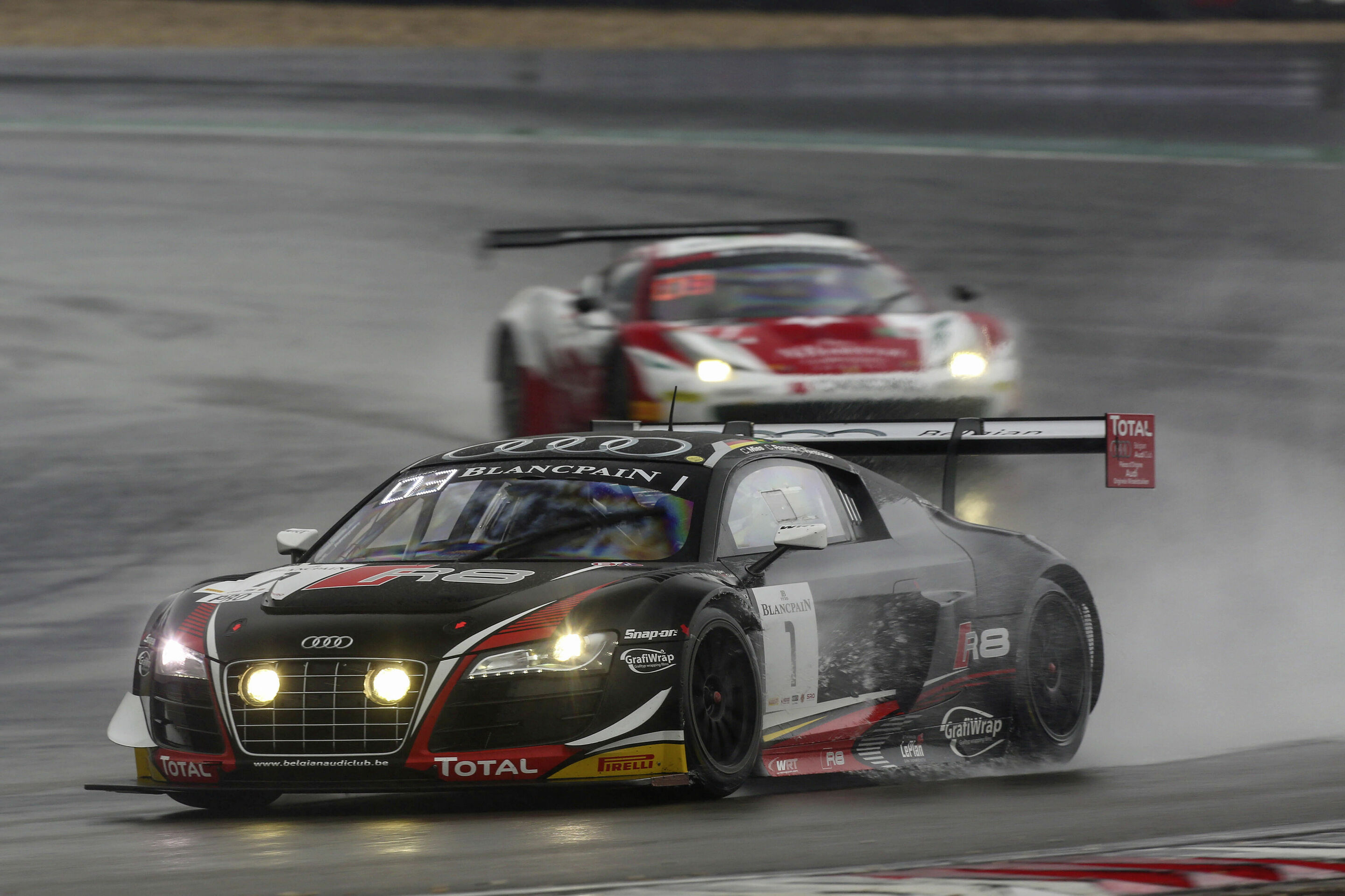
Laurens Vanthoor wins title in Blancpain Endurance Series for Audi
#1 Audi R8 LMS ultra wins in finale at the Nürburgring Belgian Audi Club Team WRT wins teams’ classification as well First title for the Audi R8 LMS ultra in the 2014 season
Laurens Vanthoor in the Audi R8 LMS ultra won the driver title in the Blancpain Endurance Series (BES) for Audi Sport customer racing. In the season finale, the Nürburgring 1000, the mere 23-year-old Belgian together with Christopher Mies and César Ramos was victorious in difficult conditions. In addition, the 33 points awarded for the victory at the Nürburgring earned the Belgian Audi Club Team WRT the team title in the prestigious endurance racing series. With that, the driver and team titles have gone to Audi for the third time in the Blancpain Endurance Series that has existed since 2011.
Vanthoor, who together with the Germans Markus Winkelhock and René Rast had won the 24-hour race at Spa-Francorchamps at the end of July, had traveled to the Nürburgring as the sole leader of the standings with a seven-point advantage. His team-mate Christopher Mies put the #1 Audi R8 LMS ultra on the pole position in qualifying. In the race that was started behind the safety car in pouring rain, start driver Christopher Mies stood his ground in the pack of front runners. In second place, he turned over driving duties to the Brazilian César Ramos. Shortly after the turbulent race’s midpoint, Christopher Mies took the lead. Laurens Vanthoor defended the top position on a drying track and after six hours of racing crossed the finish line with an advantage of 57 seconds. “Obviously, after having won the Sprint Series last year, I’m overjoyed about now winning the Endurance Championship. This shows that we’re competitive in both series,” said the Belgian. “I’d like to thank my team-mates without whom I couldn’t have clinched this title because in Markus Winkelhock, René Rast and Marc Basseng, and now here in the finale in Christopher Mies and César Ramos, I’ve had strong drivers running with me this season.”