Glorious five: Audi RS 3 competition limited
- Exclusive: limited edition to celebrate “50 years of five cylinders”
- Essential: the legendary 2.5 TFSI engine and its evocative throaty sound
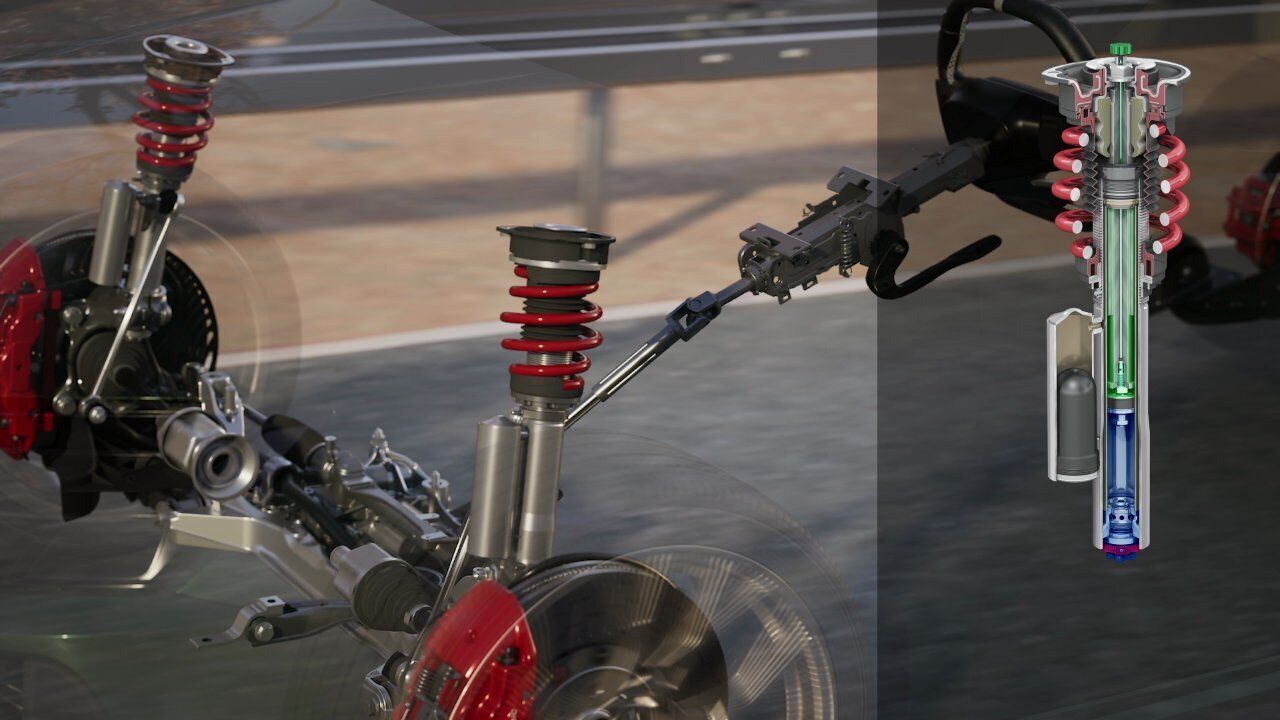
- Exciting: adjustable coilover suspension with new rear stabilizer
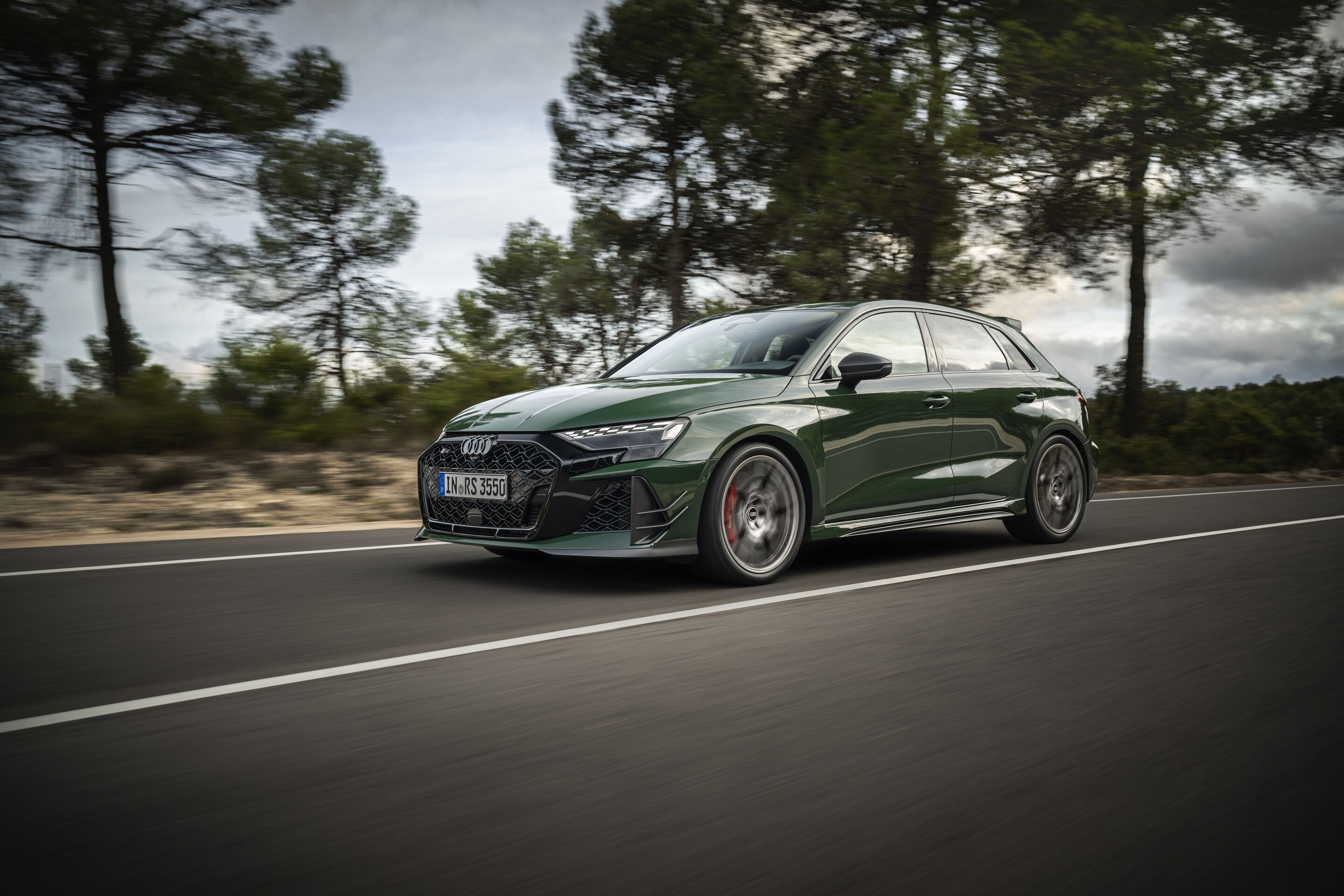
- Expressive: exterior with carbon elements and special malachite green paint
- Extraordinary: interior in Neodymium gold and consecutive numbering
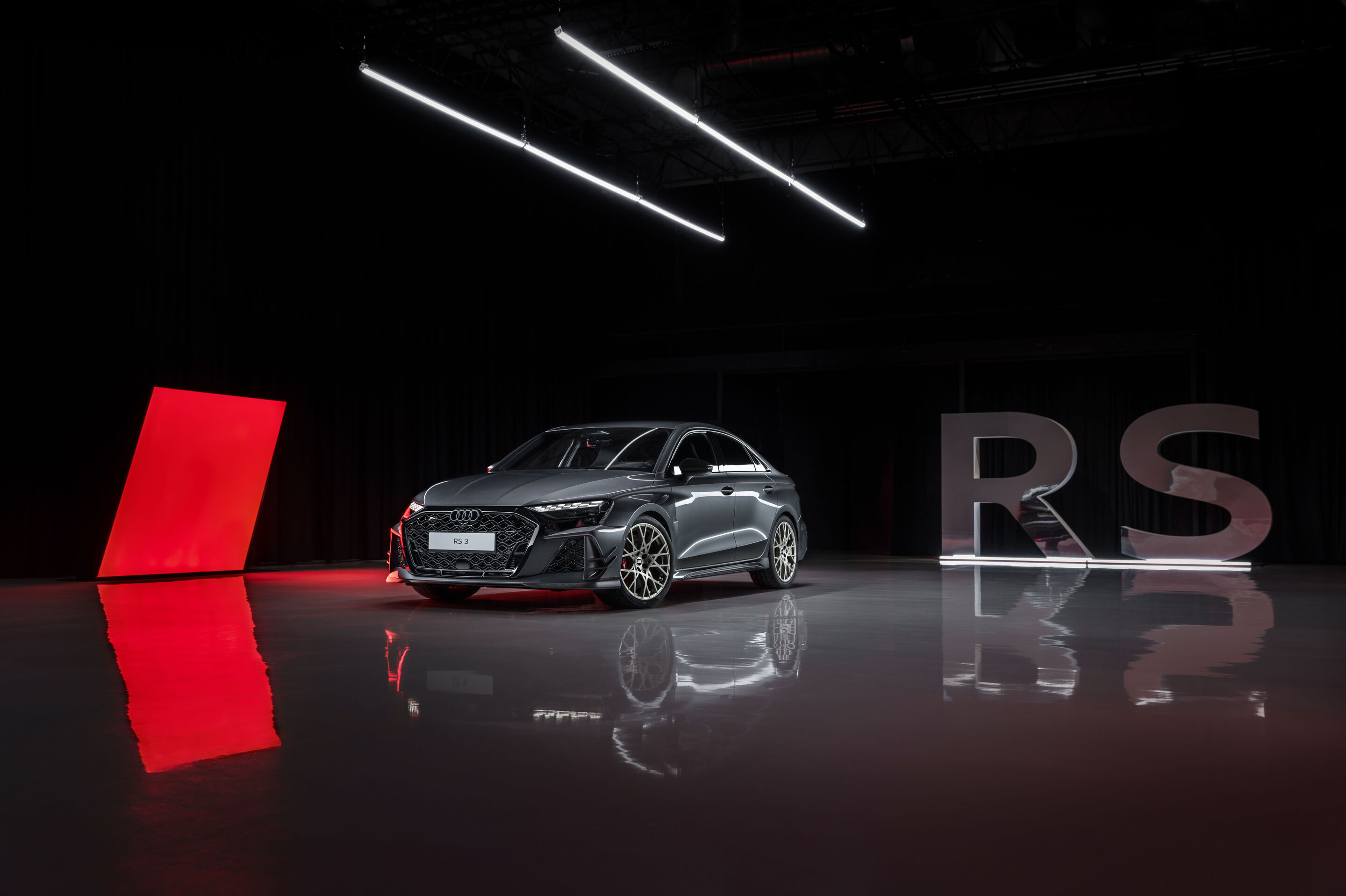
To celebrate the 50-year anniversary of the legendary five cylinder engine, Audi Sport is unveiling an exclusive special-edition model: the RS 3 competition limited. With 750 examples to be built, it stands for a five-decade-long success story from the brand with four rings. Its inline five makes the brawny compact unique in its segment, combining extraordinary performance with an unmistakable sound. When driven, the RS 3 competition limited lives up to its sporting pedigree thanks to a coilover suspension and a stiffer rear stabilizer. Visually, extra carbon elements leave no doubt about its credentials. Combined with the exclusive interior, the special edition evokes pure emotion.
A legacy that began in 1976 with the second-generation Audi 100 is now reaching new heights with the Audi RS 3 competition limited. To mark “50 years of five cylinders,” Audi Sport is endowing the RS 3 with numerous upgrades that will make the special edition highly sought after by collectors. Limited to 750 examples, the RS 3 competition limited exudes exclusivity from every detail.
Exterior: sharpened front, plenty of carbon, and subtle details
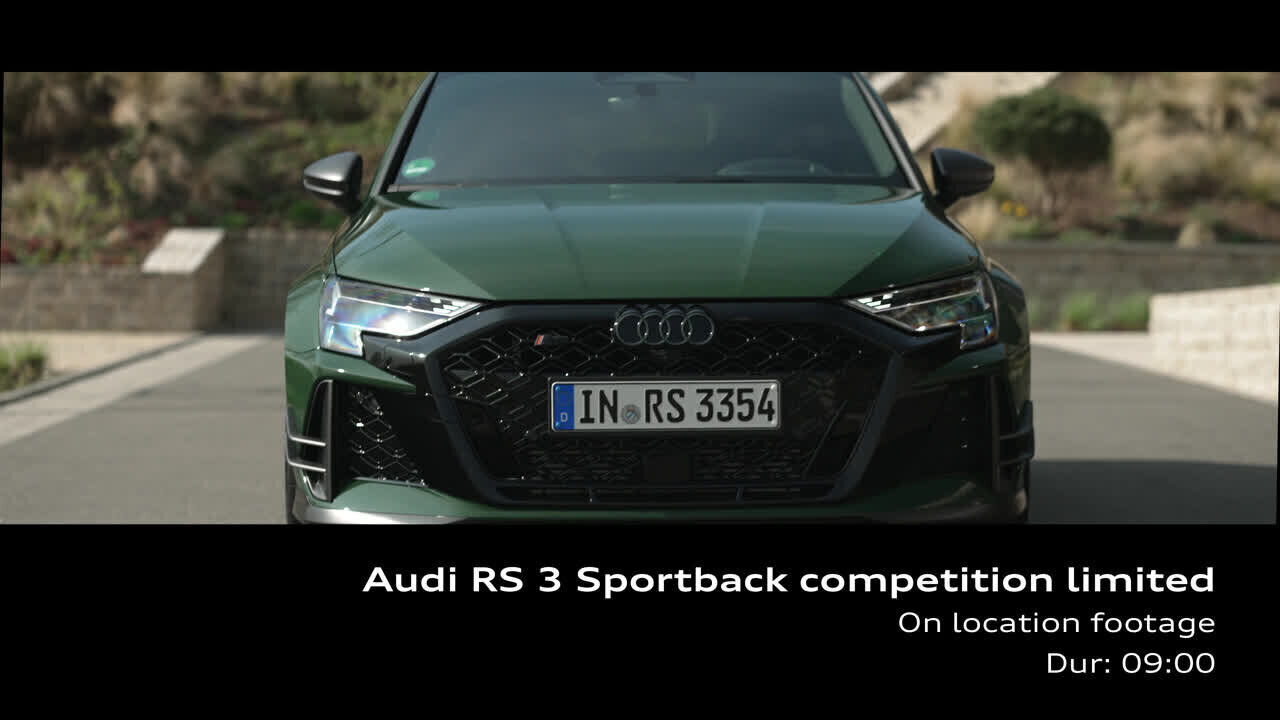
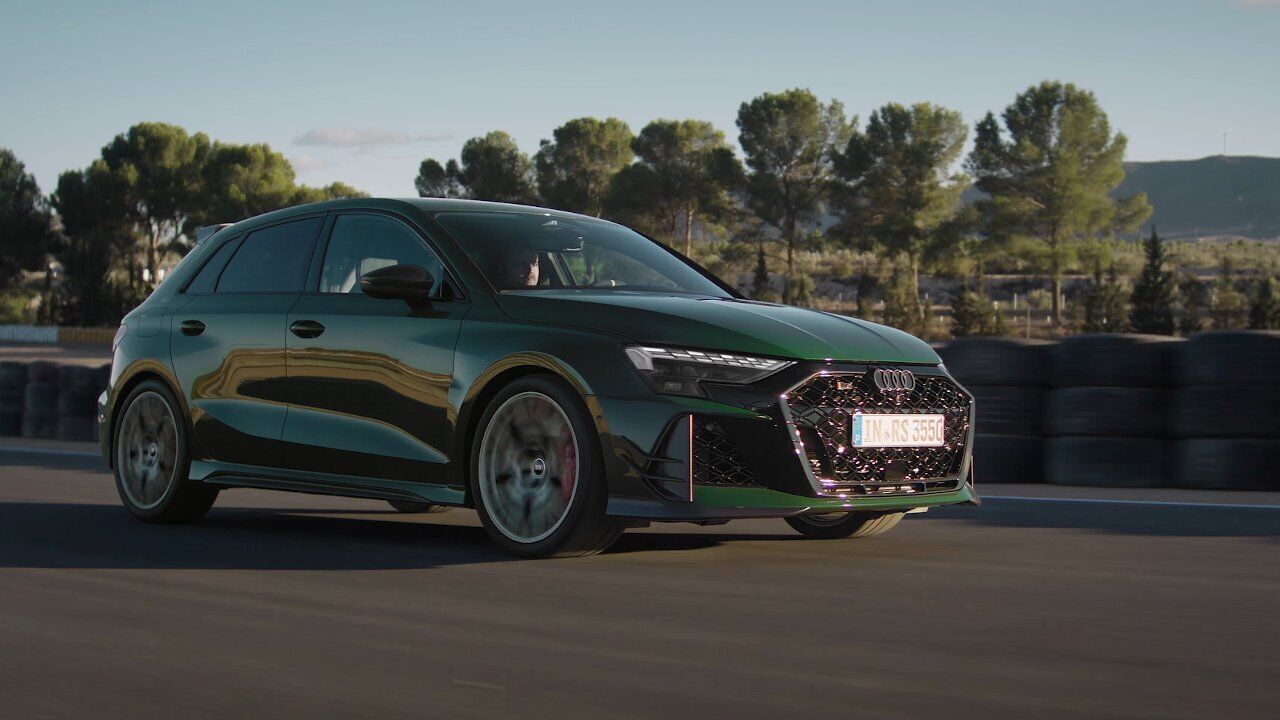
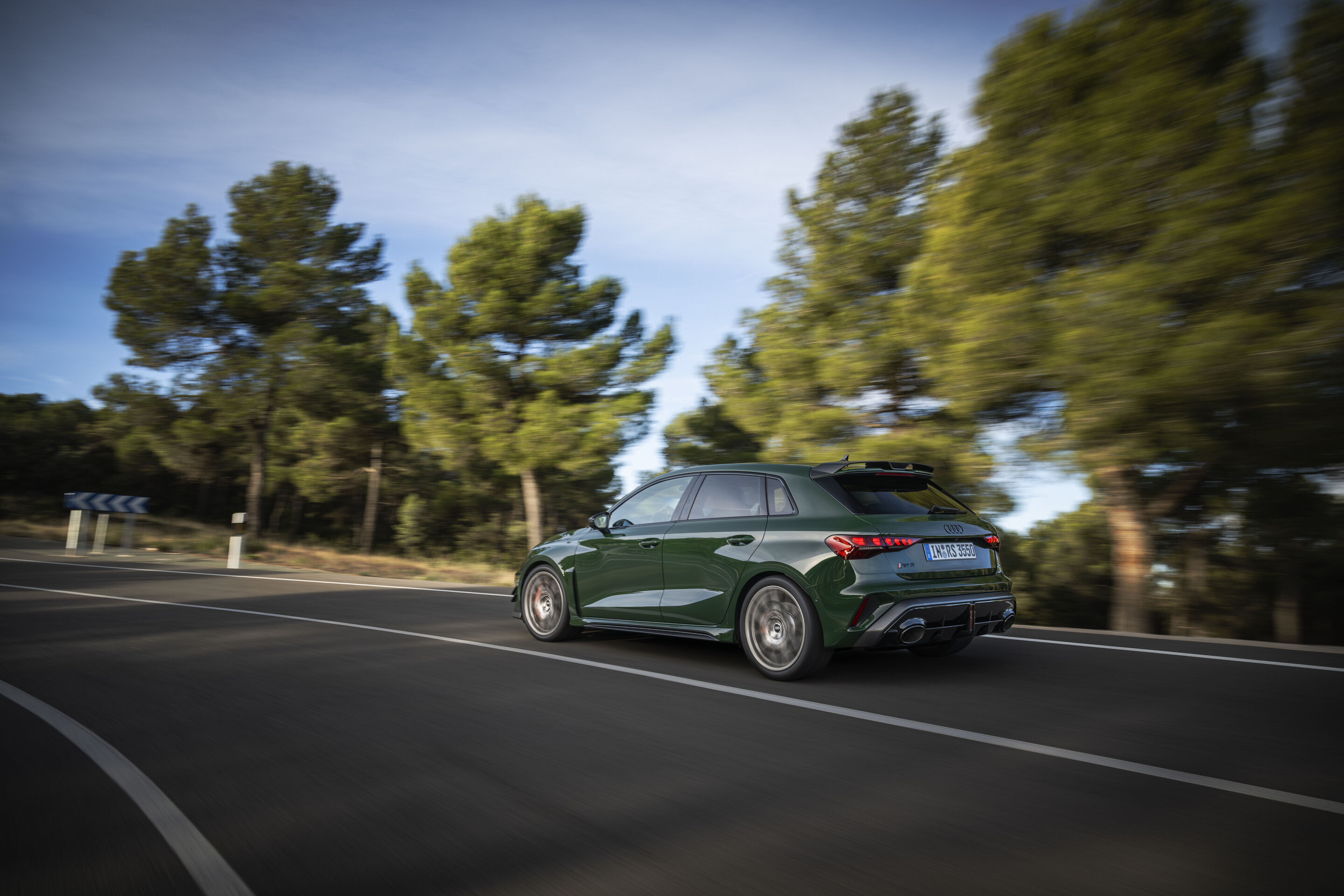
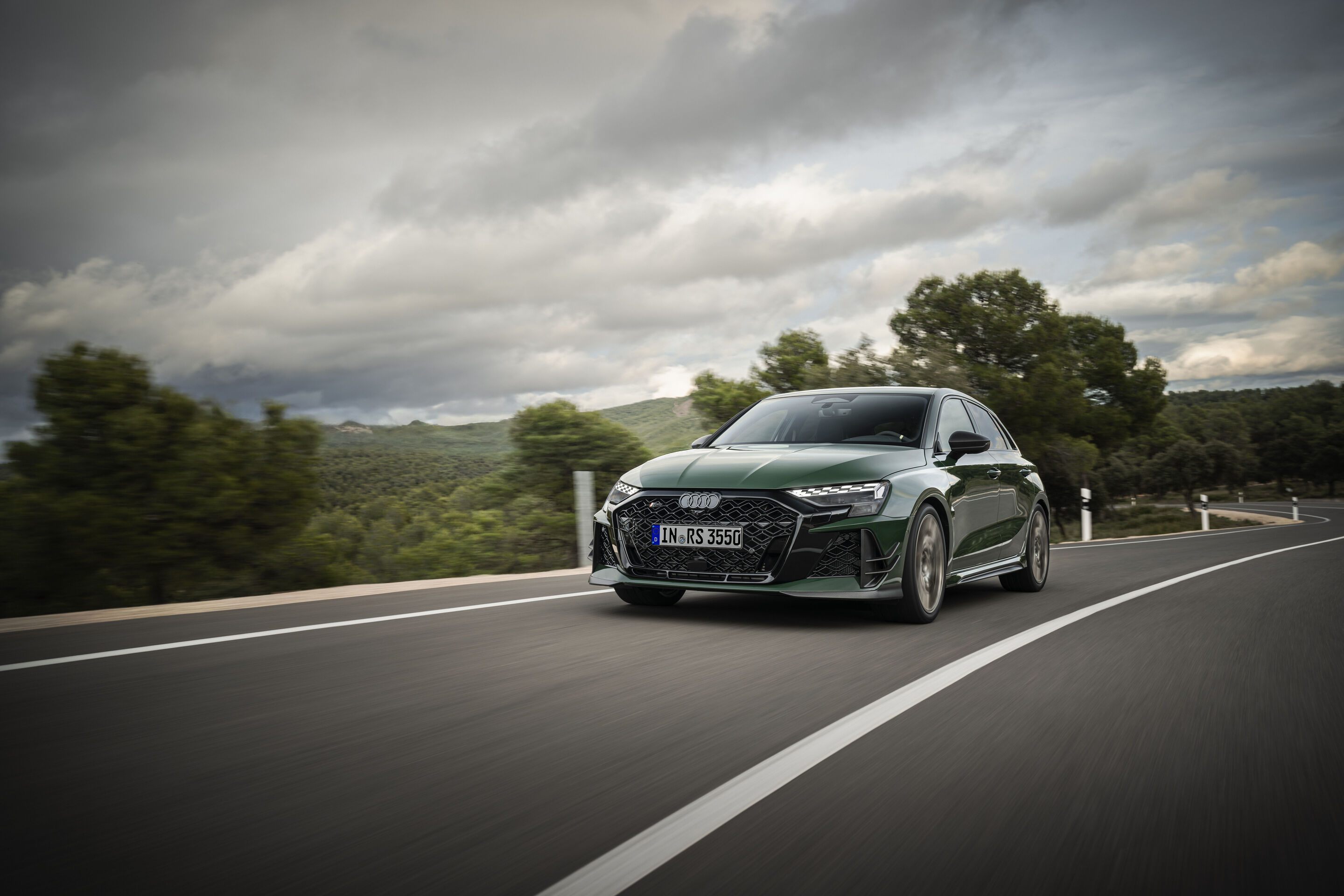
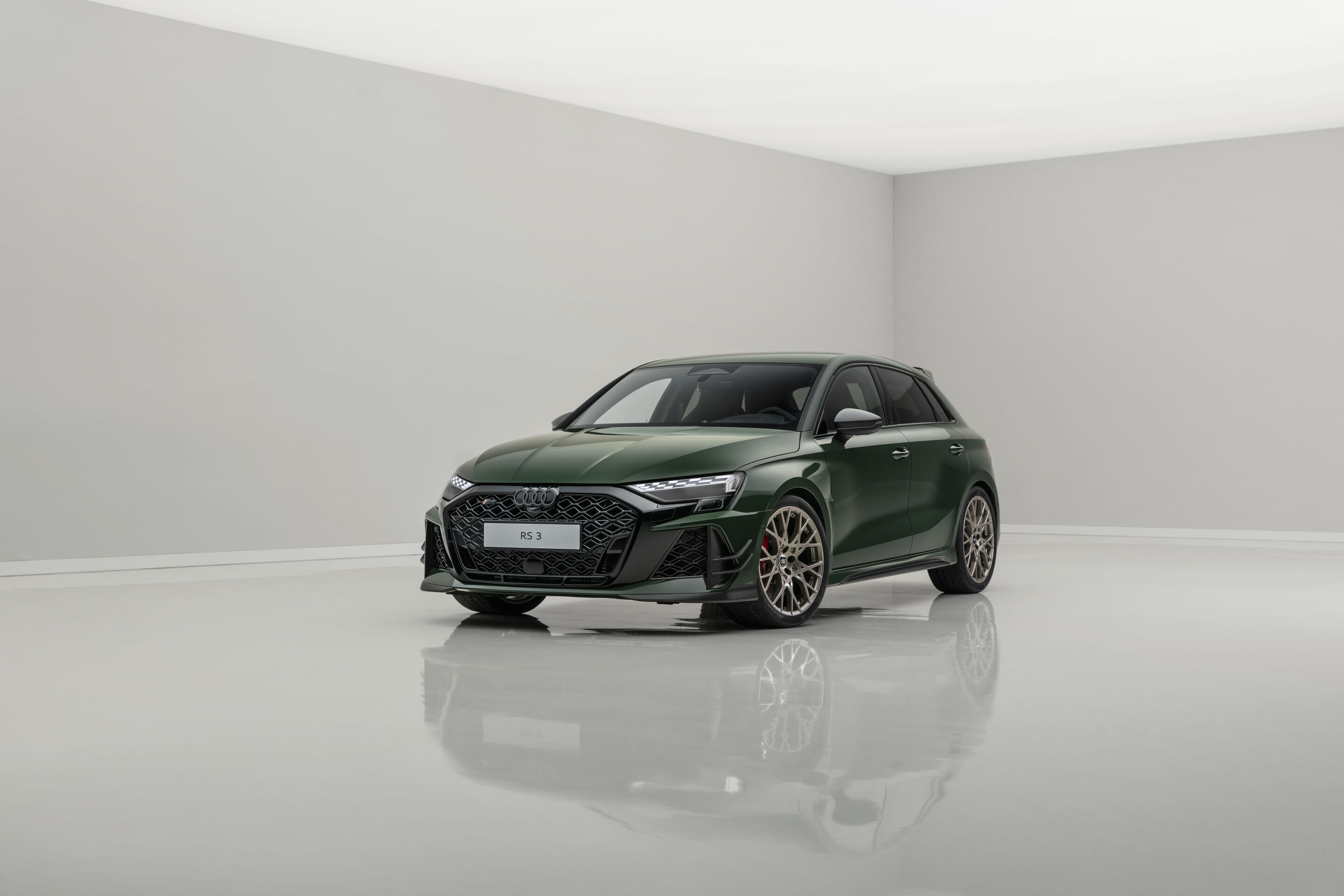
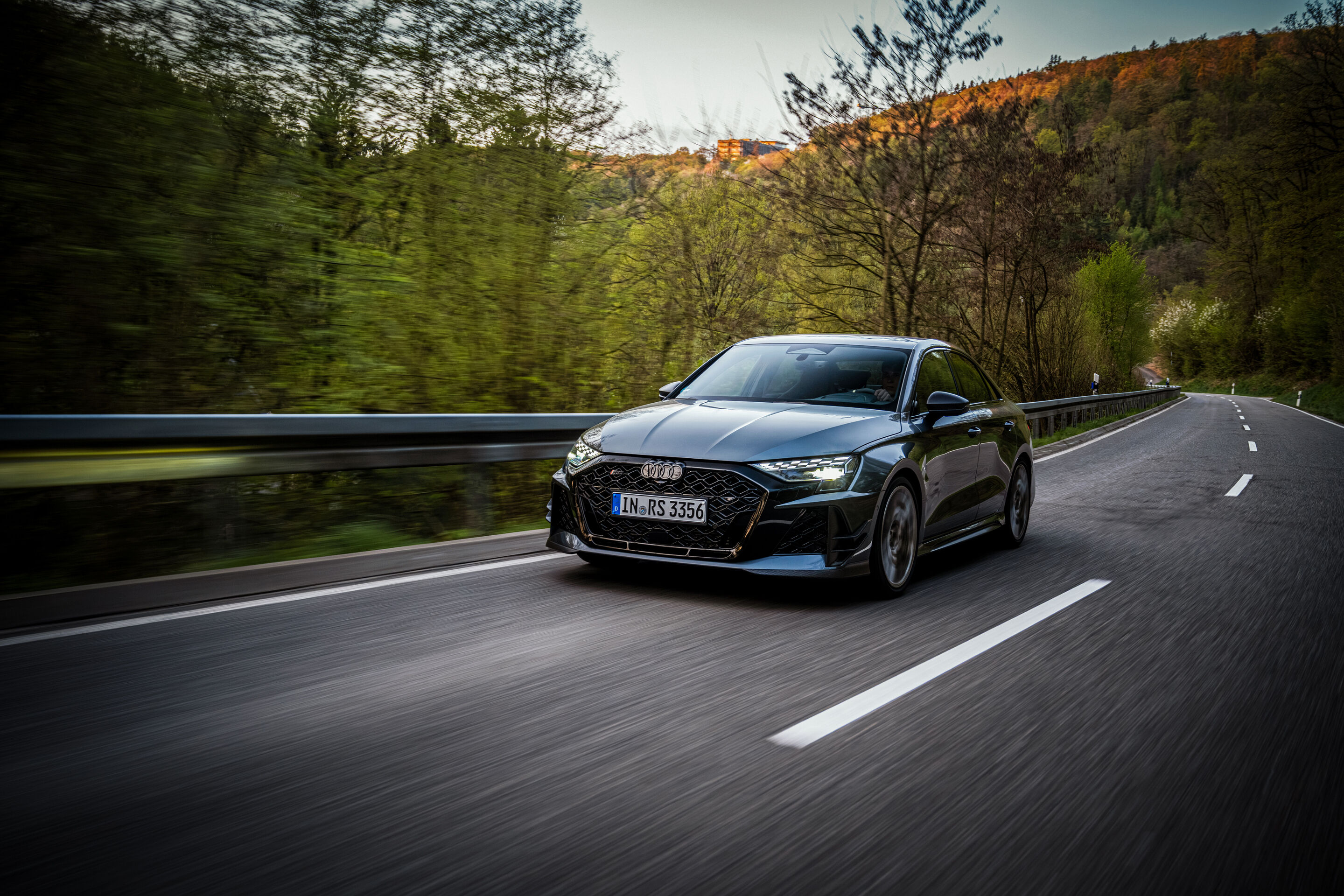
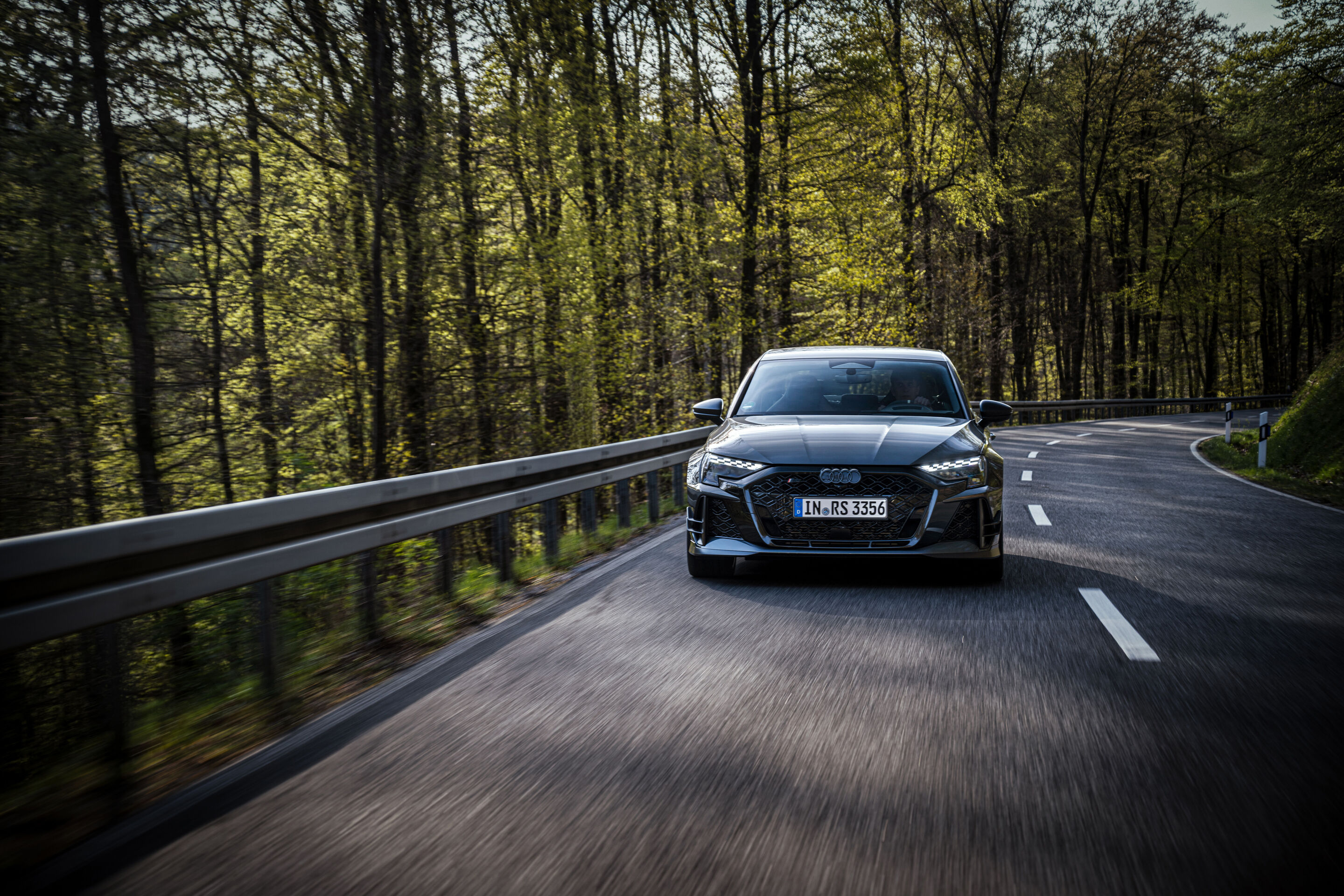
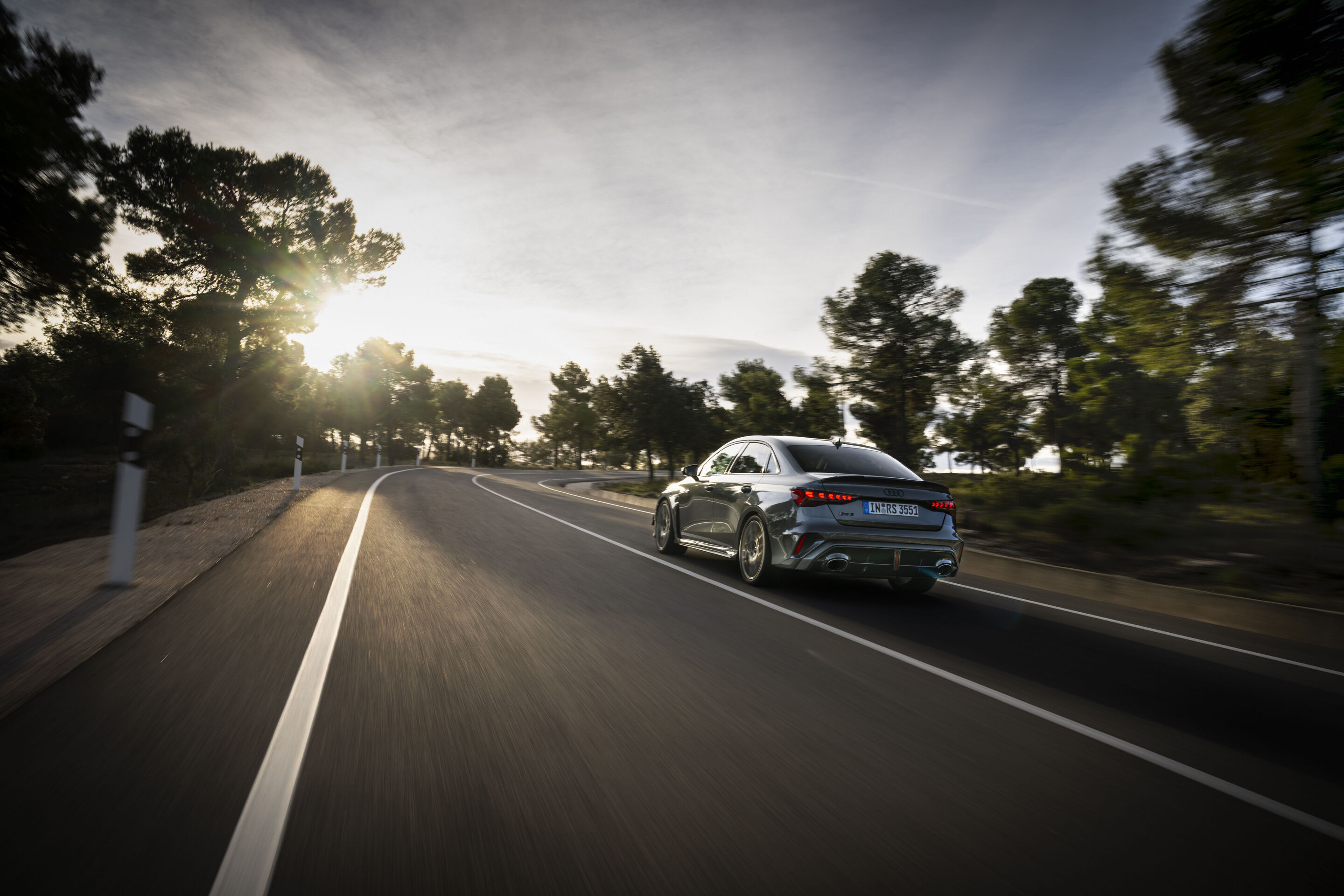
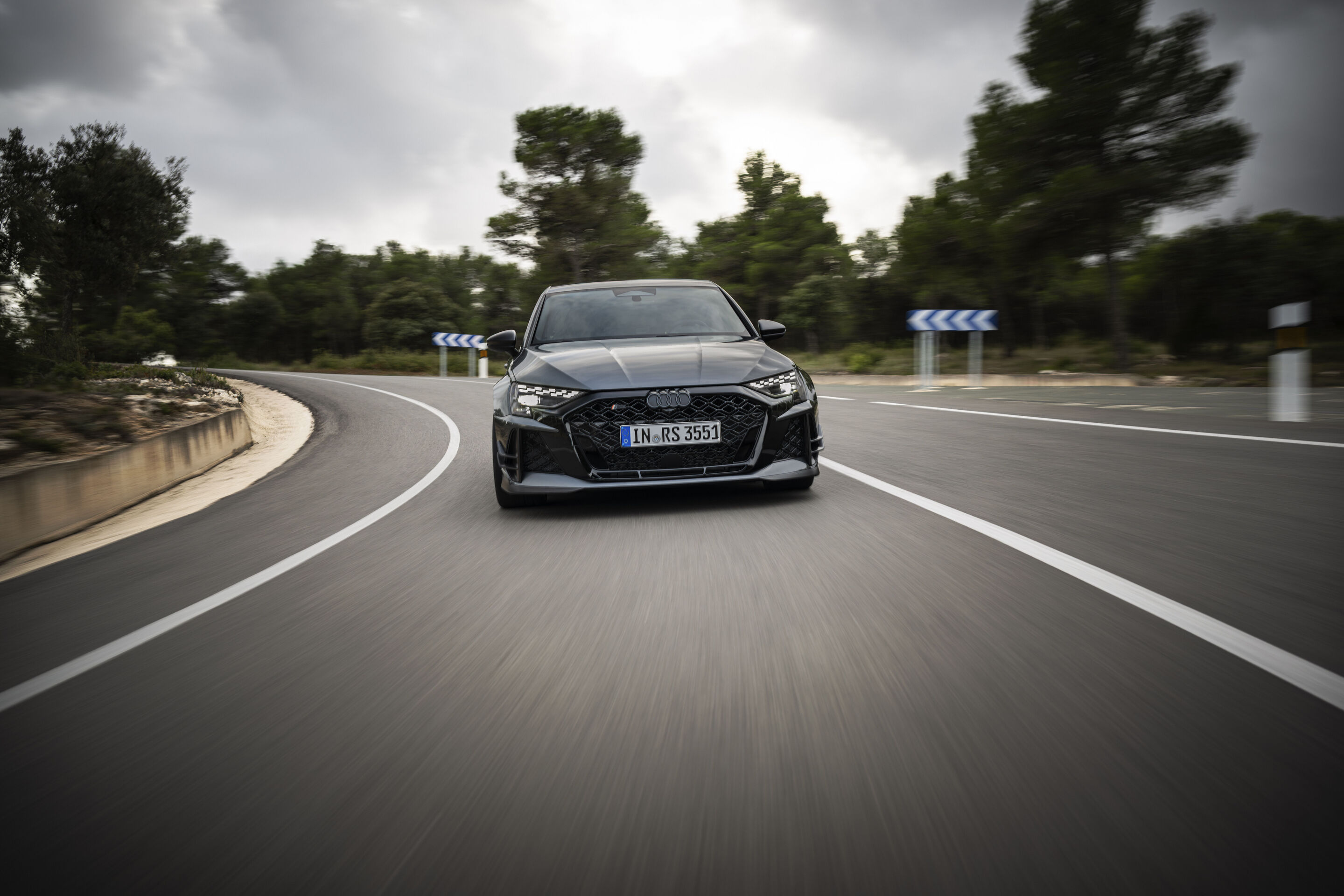
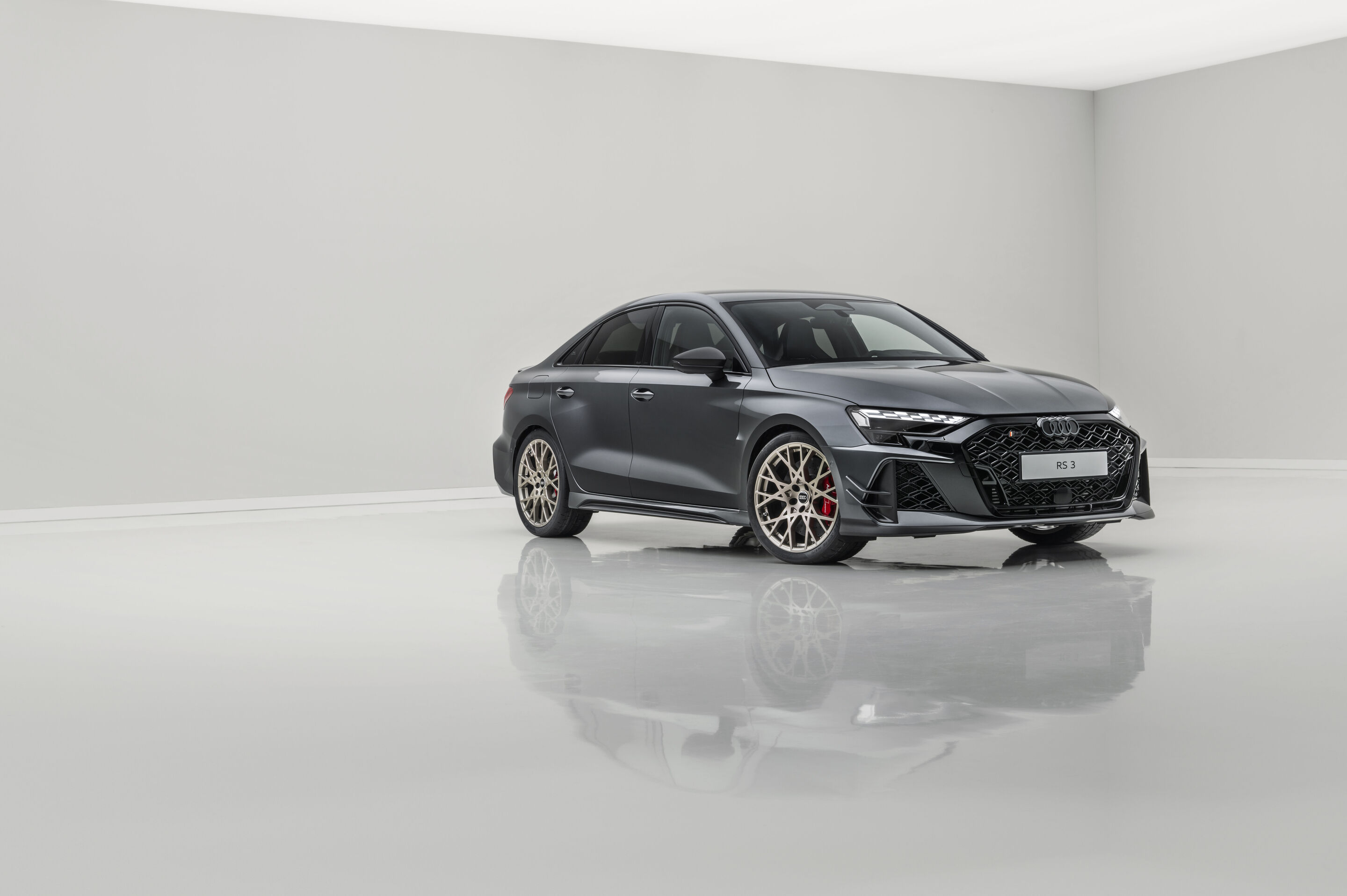
Sportiness informs all visual features of the Audi RS 3 – starting with the voluminous Singleframe that appears to form a unit with the air intakes at either side, and the striking front lip. This area has been sharpened even further on the RS 3 competition limited. Together with badges boasting heritage colors at front and rear, it stands for maximal individuality. The special edition combines expressive design with matte carbon elements. These include two new canards on either front corner, which are arranged on top of each other and are made of carbon to match the vertical blades of the air curtains. Combined with the now split front lip, which is fitted below the intakes, this makes the special edition appear even wider. The RS 3 competition limited is seemingly crouched as if ready to pounce.
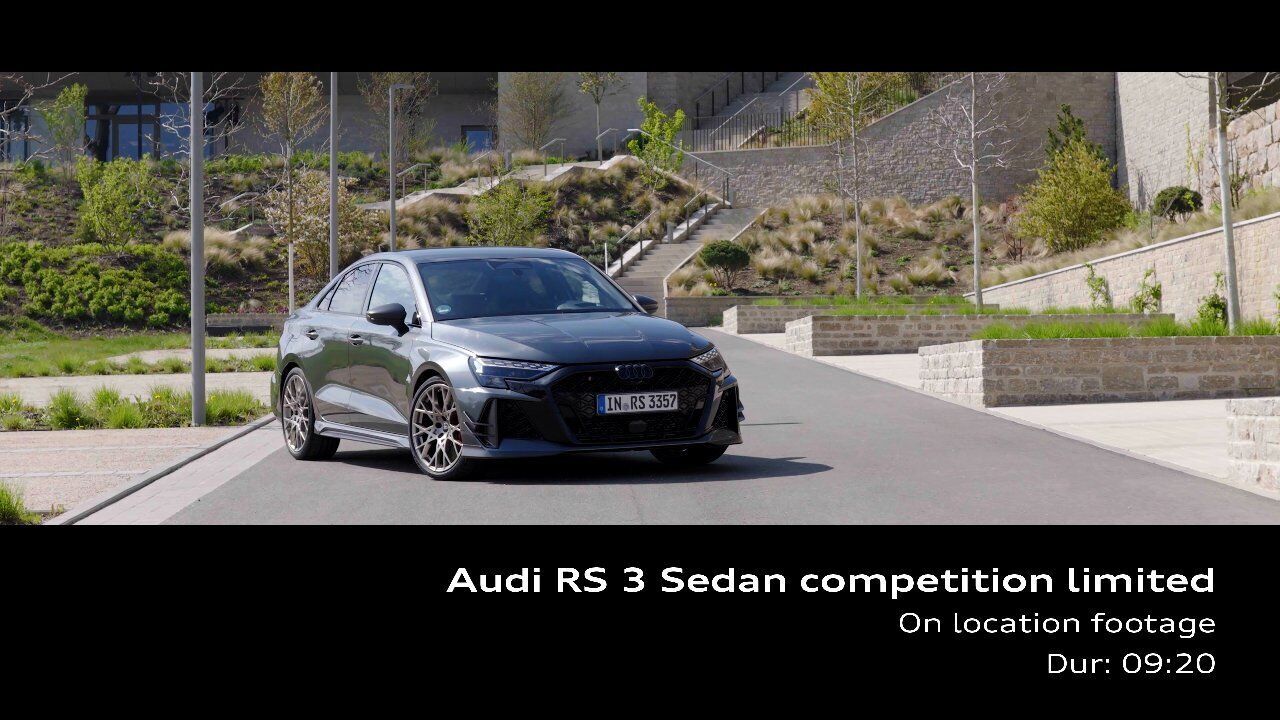
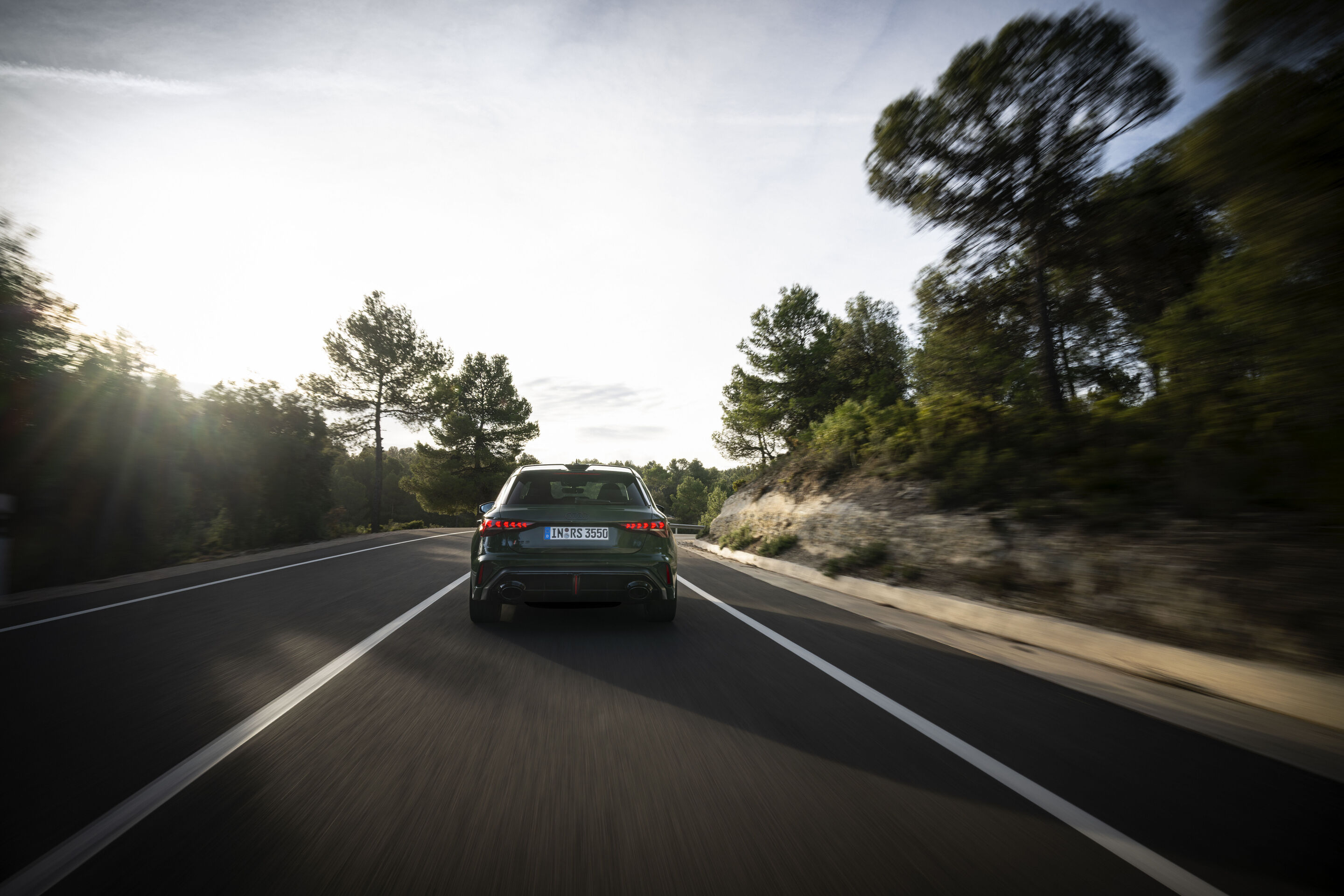
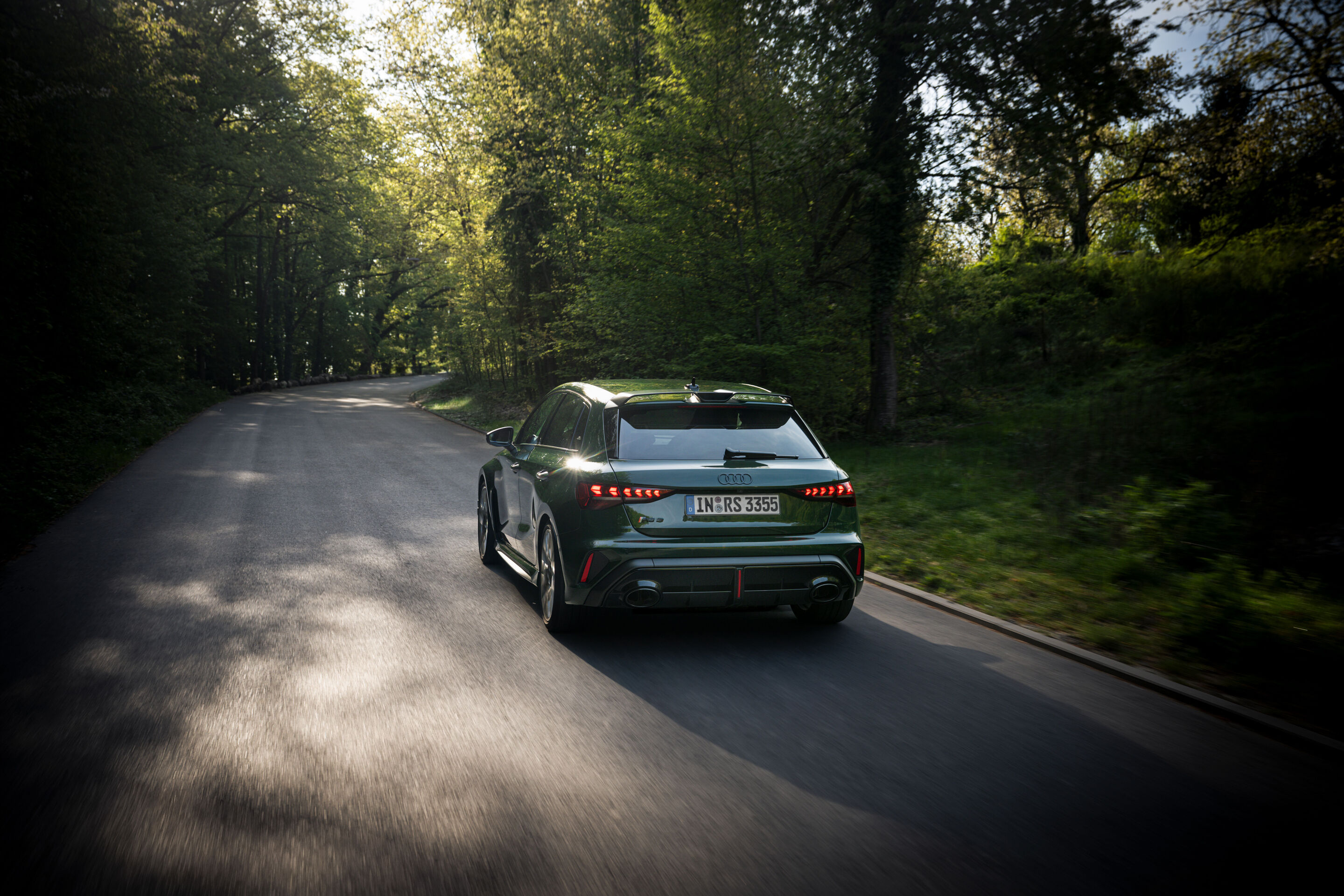
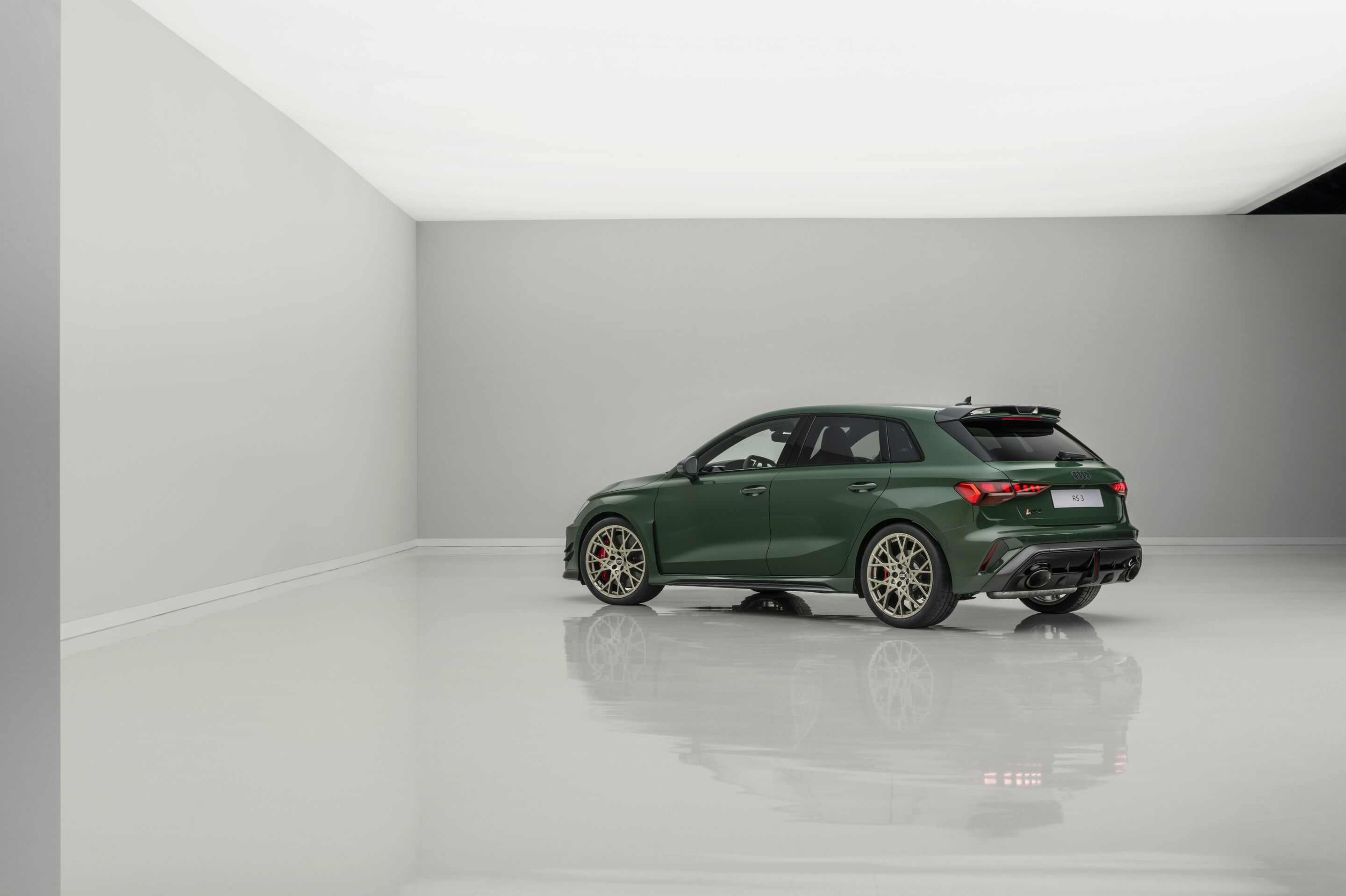
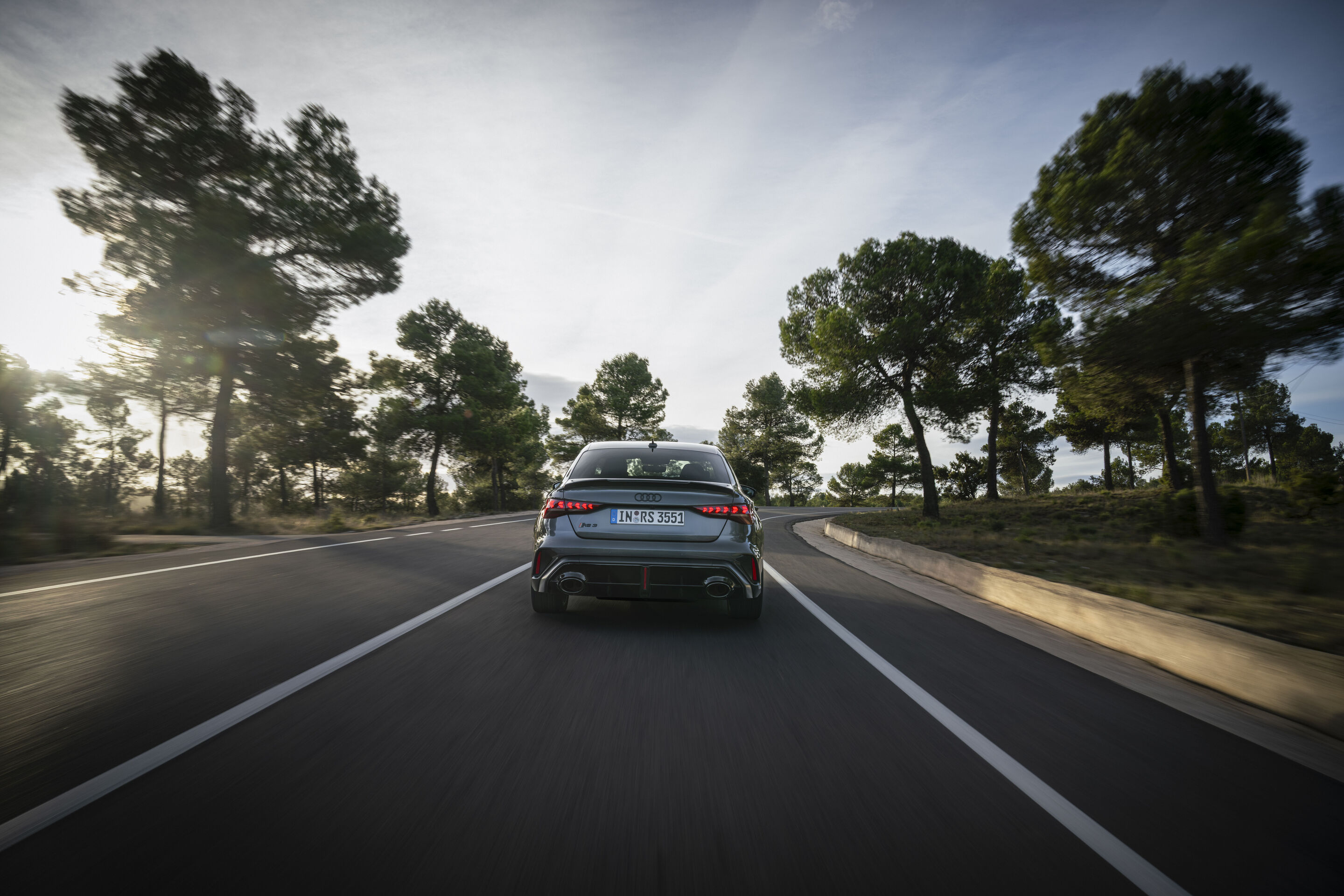
Imposing 19-inch wheels with ten cross spokes in Neodymium gold matte fill the arches. Mirror caps, side skirts, and a rear spoiler, all in matte carbon, as well as the matte carbon trim above the large functional diffuser complete the model’s cooly technical appearance. Partial matting on the rear side window to show the model name underlines it even further.
The darkened matrix LED headlights are also unique to the special edition. When locking or unlocking the car, their segments illuminate in a 1-2-4-5-3 pattern – a nod to the five-cylinder engine’s firing order.
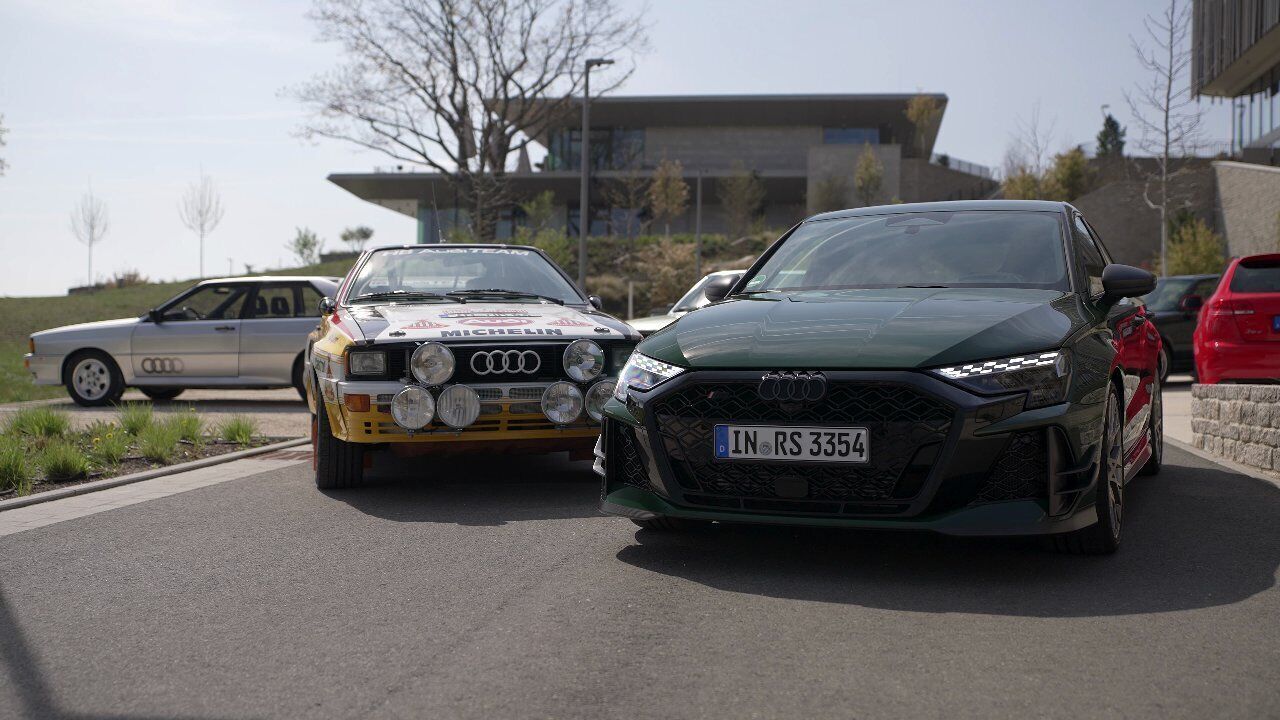
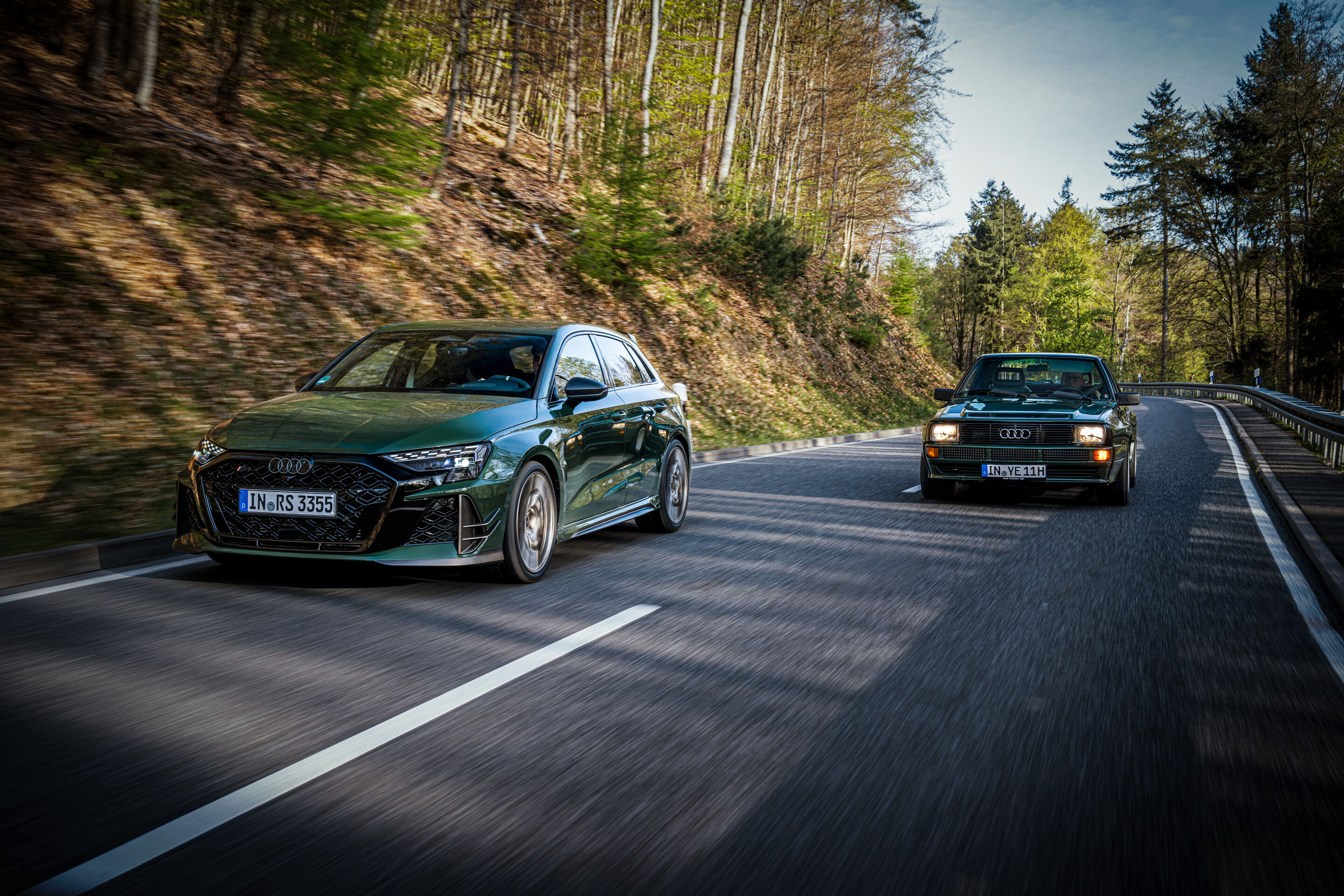
Three exterior colors can be specified. Offered alongside the best-selling Daytona gray and the new Glacier white matte, the exclusive Malachite green finish is especially eye-catching. This iconic color is reminiscent of the Audi Sport quattro that provided the basis for a golden age of rallying with five-cylinder power.
Five-cylinder engine: strong performance and distinctive sound
Back in 1983, the Audi Sport quattro developed 225 kW (306 PS) and 350 Nm from 2.1 liters of displacement. Today, the inline five-cylinder engine of the Audi RS 3 comes with 2.5 liters of displacement and boasts 294 kW (400 PS) and 500 Nm. Coming curtesy of an engine that is the only one of its kind in this segment, these figures lend the RS 3 competition limited extraordinary performance. The model accelerates from 0 to 100 km/h in 3.8 seconds and reaches a top speed of 290 km/h. Along the way, the unmistakable sound of the five-cylinder turbo engine provides extra emotion. It stems from the firing order 1-2-4-5-3. This means that the engine’s cylinders ignite in an alternating pattern — some that are next to each other and some that are further apart.
With its fully variable flap control, the RS sports exhaust system broaden the spectrum of the exhaust note while reduced insulation around the firewall means the engine sound reaches the occupants even more directly. The flaps open earlier in the Audi drive select modes dynamic, RS Performance, and RS Torque Rear, meaning that the car’s throaty sound is even more pronounced than in other modes.
Driving dynamics: coilover suspension and stiffer rear stabilizer
For the first time, the Audi RS 3 features a coilover suspension including a new rear stabilizer. In combination with the torque splitter and the standard ceramic brakes, the limited edition offers distinctly sporty handling. The coilover suspension was specially developed and tuned for the RS 3 competition limited. The materials used in the twin-tube shock absorbers’ construction – stainless steel at the front and aluminum at the rear – were chosen for stiffness, and their increased volumes help cool the hydraulic fluid. The front shock absorbers have external reservoirs. Better cooling means the dampers perform consistently, even under high loads. At the rear, larger diameter damper tubes with thicker piston rods compared to the standard model provide more stable mounting and rigidity.
High flexibility and a wide spread in driving characteristics are offered by three-way adjustable shock absorbers: High-speed and low-speed compression can be changed separately and rebound can be adjusted too. As a result, the driver can customize the comfort and performance of the vehicle to suit their personal requirements, driving style, and the road conditions. A setup manual for adjusting compression and rebound as well as the needed tools are on board the RS 3 competition limited.
Adjusting compression means changing how quickly the shock absorber shortens. It works by altering the oil flow inside the cylinder and thus changing the damping force that works against the suspension as it loads up. Low-speed compression changes how the suspension reacts to forces like those occurring during cornering and significantly influences tire grip. It can be adjusted in 12 steps using a dial. The further it is turned towards the “+” sign, the stiffer the damping and thus the setup. This maximizes lateral grip, leading to higher cornering speeds, more eager turn in, and thus more direct handling. The further the dial is turned towards the “-” sign, the lower the damping force. This makes for a more comfortable ride.
High-speed compression determines how the body reacts when suddenly high forces impact the chassis. This includes driving over bumps as well as rapid steering movements. It can be adjusted in 15 steps. Stiffer high-speed compression (turning the dial towards “+”) means high-frequency vertical excitations are damped more, resulting in sharper feedback to the driver. As damping force is reduced (turning the dial towards “-”), the ride becomes more comfortable and the RS 3 competition limited encounters imperfections in the road surface more smoothly.
The adjustable rebound offers even more variety for the driver to change the vehicle’s reactions and handling. It controls how directly the body is linked to the road, which can be altered in 16 steps. High damping on rebound means the suspension decompresses more slowly; handling therefore becomes very precise and direct. Lower damping on rebound means the springs can expand more quickly, thus increasing ride comfort. Stability at the rear is further increased by a new tubular stabilizer with increased wall thickness. With a stiffness of 85 Newtons/millimeter (N/mm), it is stiffer than on the standard model. The spring rates at the back have been increased to 80 N/mm to match. As a result, the RS 3 competition limited provides the perfect combination of directional stability, safety, and agility when accelerating out of a fast corner.
Complementing the additional aerodynamic elements at the front, the specific roof spoiler of the RS 3 Sportback competition limited also positively influences driving dynamics. Those new elements reduce lift at both axles and were developed specially for the limited edition in the wind tunnel. On the sedan, the split chin spoiler and the canards improve balance between the front and rear axles. As the brawny compact agilely rounds corners, it is helped by the torque splitter with fully variable torque distribution at the rear as well as by brake torque vectoring. When turning in, torque is delivered to the outside wheel. At the same time, the inside wheel is braked slightly, positioning the RS 3 competition limited to exit the bend perfectly. Like its RS 3 brethren, the special edition has a confident stance on the road and is optionally equipped with Pirelli PZero Trofeo R semi slicks. Ceramic brakes with red calipers are always on hand to reign in the speed. They are both especially light and resistant to thermal fade.
Interior: exclusive design and iconic displays
The special model’s exclusivity also becomes apparent when opening the doors, thanks to a color combination of black, Neodymium gold, and Ginger white. The door lighting projects the lettering “RS 3 competition limited” with the same adorning the black floor mats, the cover below the headrests, and the trunk carpet. In the center console, a matte serial number in front of the shifter reflects the model’s limited run and illustrates how special this vehicle truly is.
No matter how dynamic the cornering, driver and front passenger are perfectly held in place by highly contoured RS bucket seats. Their bolsters are covered in black leather, their centers fashioned in Dinamica microfiber colored Neodymium gold. The arm rests in the doors and center are also golden. Contrast stitching in Ginger white accentuates the cabin and underlines the diamond pattern on the seats.
Rear passengers also get a sense of the vehicle’s exclusivity. The centers of their seats as well as their arm rests are covered in soft Dinamica in Neodymium gold with Ginger white contrast stitching. The front seats’ matte carbon backs are large visual reminders of the model’s sportiness.
At any event, the driver’s seat is the best place to be and have everything under control. The 10.1-inch touch display in the instrument panel provides information about RS-specific performance parameters: the temperature ranges of the coolant, torque splitter, brakes, as well as engine and transmission oil are illustrated in color; tire pressure and temperature are also shown. To make finding the center position easier and help visualize the most minute steering inputs, the wheel – flattened at both the top and bottom – has a Ginger white mark at the top. Contrast stitching in the same color goes around its rim made of black Dinamica. The Audi virtual cockpit plus also features an exclusive design. When the Audi RS2 Avant debuted with the first RS five‑cylinder engine in 1994, it had white instrument dials. Harking back to those, the digital instruments of the Audi RS 3 competition limited also have a white background. They are joined by displays of the engine’s current power and torque outputs, G forces, acceleration, and a lap timer. When launch control is used to fully exploit the turbocharged inline five’s potential for acceleration, starting lights indicate the ideal moment to launch.
It’s time to fasten your seatbelts! Reach for the Ginger white belts, press the start button to awaken five raucous cylinders and experience impressive driving dynamics. In the meantime – looking at the quattro badge in the matte carbon decor inlay – the front passenger will remember that Audi's quattro history has lasted almost as long as that of the legendary five‑cylinder engine.
Pricing: one limited edition, two body styles, three colors
The RS 3 competition limited is available as Sportback and Sedan. All vehicles for the German market are pre-specified and have extensive standard equipment. Both body styles feature matte carbon elements on the exterior, Neodymium gold wheels, and an exclusive interior with RS bucket seats, special digital dials, and consecutive numbering. Carbon is also found under the hood: the engine cover atop the five-cylinder impresses with its technical look. Dynamically, the RS 3 competition limited is characterized by an adjustable coilover suspension, a stiffer rear stabilizer, the RS sport exhaust system, a top speed of 290 km/h, and ceramic brakes with red calipers. Three-zone climate control, seat heating, a Sonos sound system, numerous assistance systems, and rear privacy glass are also standard. Furthermore, the Sportback features comfort opening for the luggage compartment lid. Besides the in-demand color Daytona gray, the exclusive options Malachite green and Glacier white are available. The base price for the Sportback in Germany is 108,365 euros. The Sedan starts at 110,005 euros. European deliveries of the RS 3 competition limited commence in mid-2026.

Images Audi RS 3 Sportback competition limited
Images Audi RS 3 Sedan competition limited

Videos Audi RS 3 competition limited