Search
All search results for "audi a2"
(84)
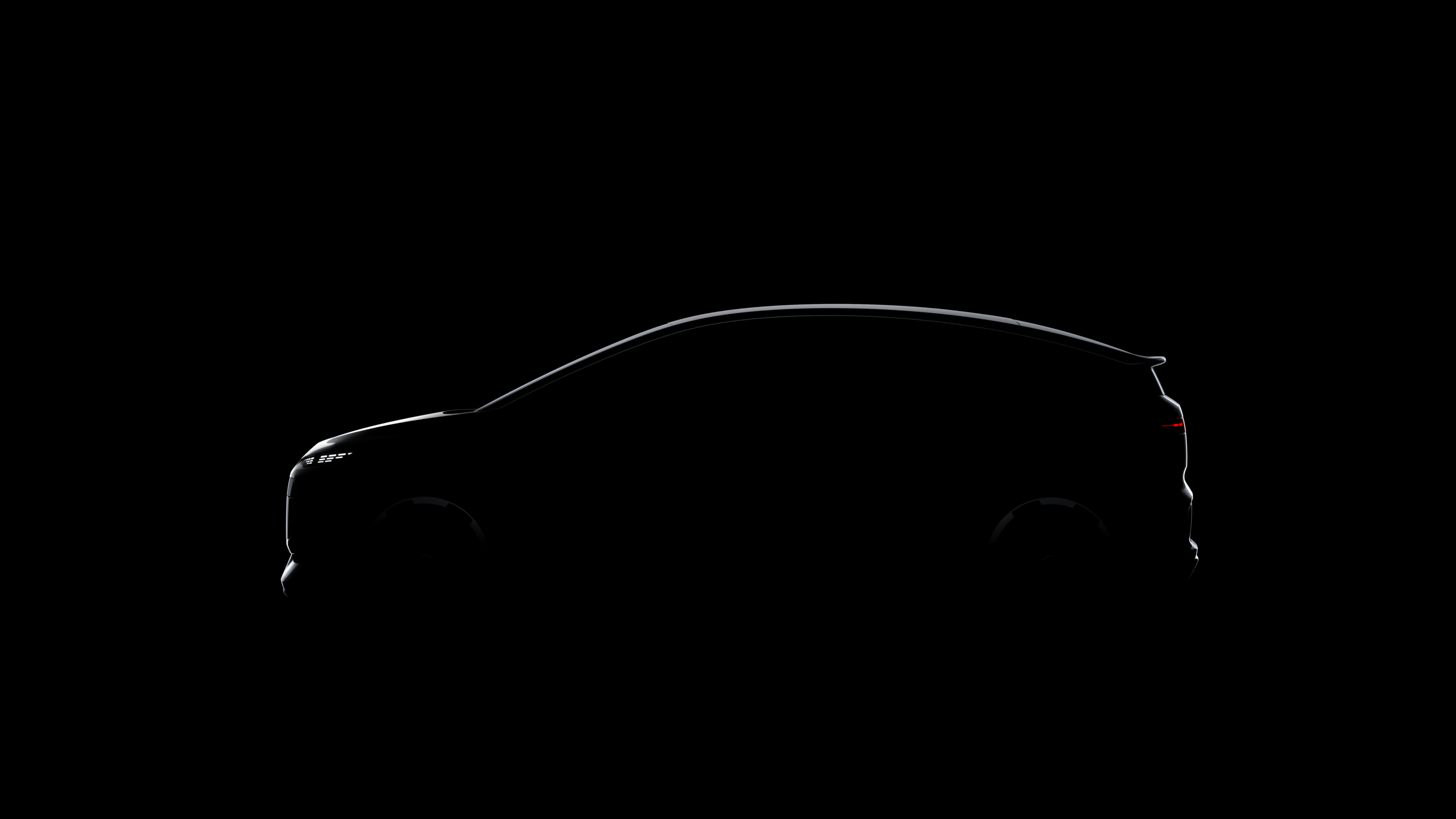 Audi announces a new entry-level electric model family: the A2 e-tron
Audi will unveil the new A2 e-tron in fall 2026, complementing its portfolio with an all-electric entry-level model family in the compact class. The A2 e-tron, manufactured in Ingolstadt, will further rejuvenate Audi’s model range and open up access to premium electric mobility. A preview of the vehicle’s silhouette can already be seen in the first design sketch.
Audi is taking the next big step on the road to a consistently electric future. Audi CEO Gernot Döllner has announced the A2 e-tron – the new electric model family from the brand with the four rings – at Audi’s Annual Media Conference. “We’ve listened. Our customers want electric mobility that impresses in everyday life. The A2 e-tron is our promise to deliver exactly that – efficient, compact, and confident. We’re making entry into the electric Audi world easier and more relevant than ever,” said CEO Gernot Döllner. New chapter in the compact premium segment The market for compact electric vehicles continues to grow – especially in large European cities. With the new A2 e-tron, Audi is targeting a broad international customer base that values everyday usability in the city, sustainability, high efficiency, and digital connectivity. The A2 e‑tron strengthens a younger, clearer, and increasingly electric portfolio and makes entering the brand more modern and more relevant for new target groups. Its name is a deliberate nod to the Audi A2, which pioneered efficiency and urban mobility over 25 years ago. The new A2 e-tron carries this mission forward into the electric age. Production in Ingolstadt The A2 e-tron is another fully electric product line to be built at Audi’s German home in Ingolstadt, underlining the company’s commitment to transforming its plants in Germany and Europe. “The A2 e-tron is crucial for our brand and also for our German home.
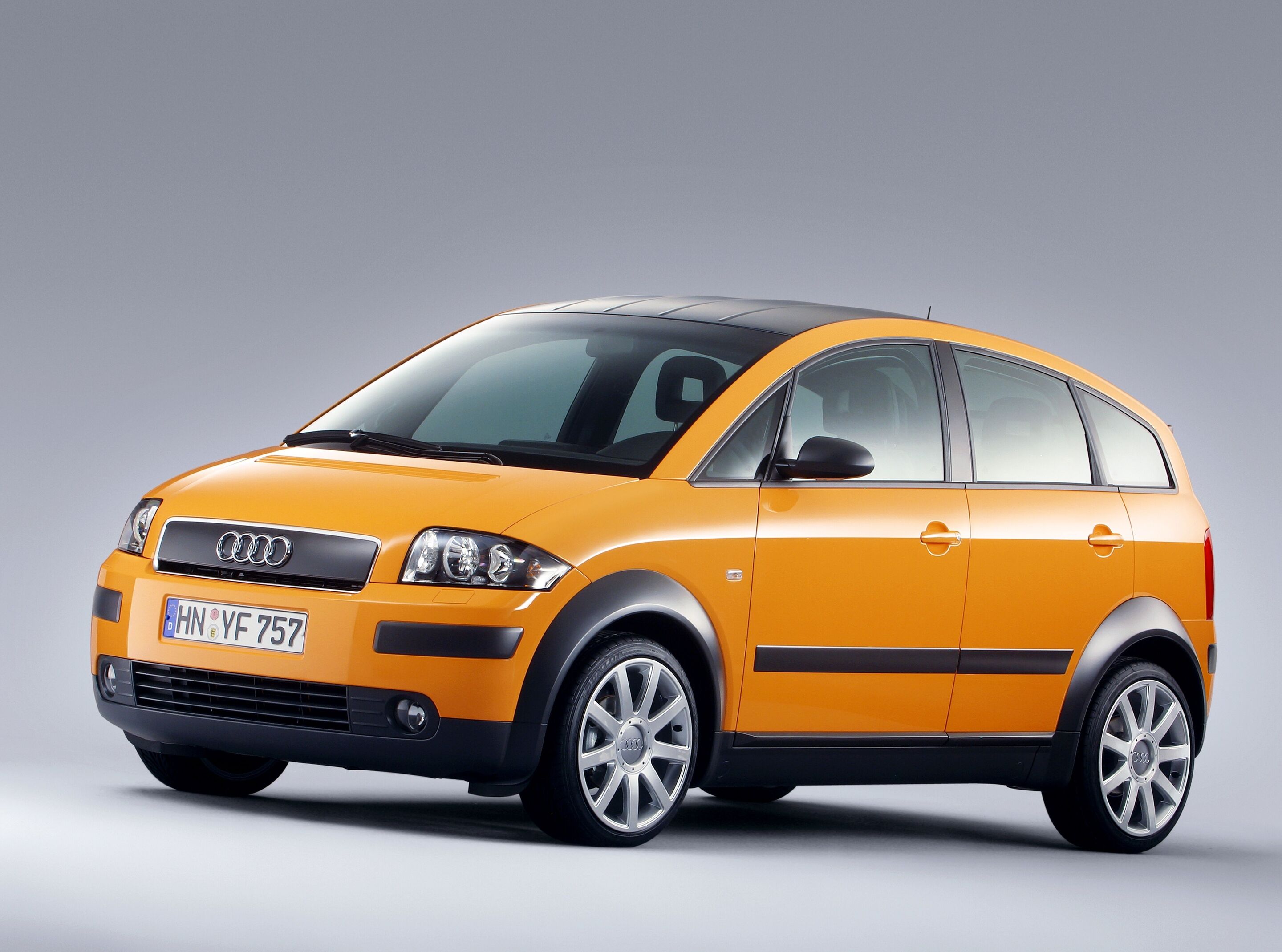 Leading light: 25 years Audi A2
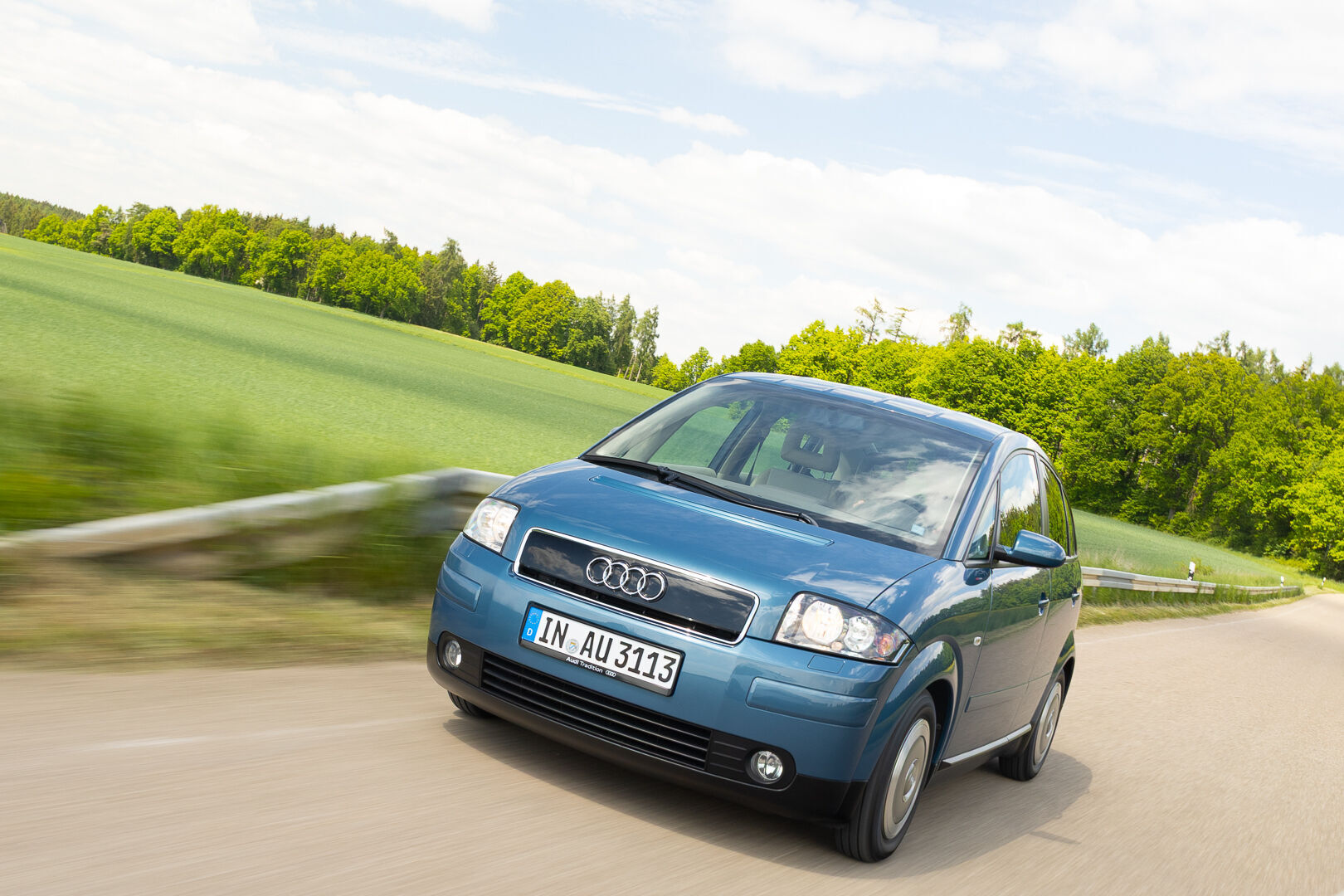
Premium in the entry-level segment: the Audi A2 – progressive in design and technology, and with top long-term quality The Audi A2 1.2 TDI was the world’s first four-door three-liter car
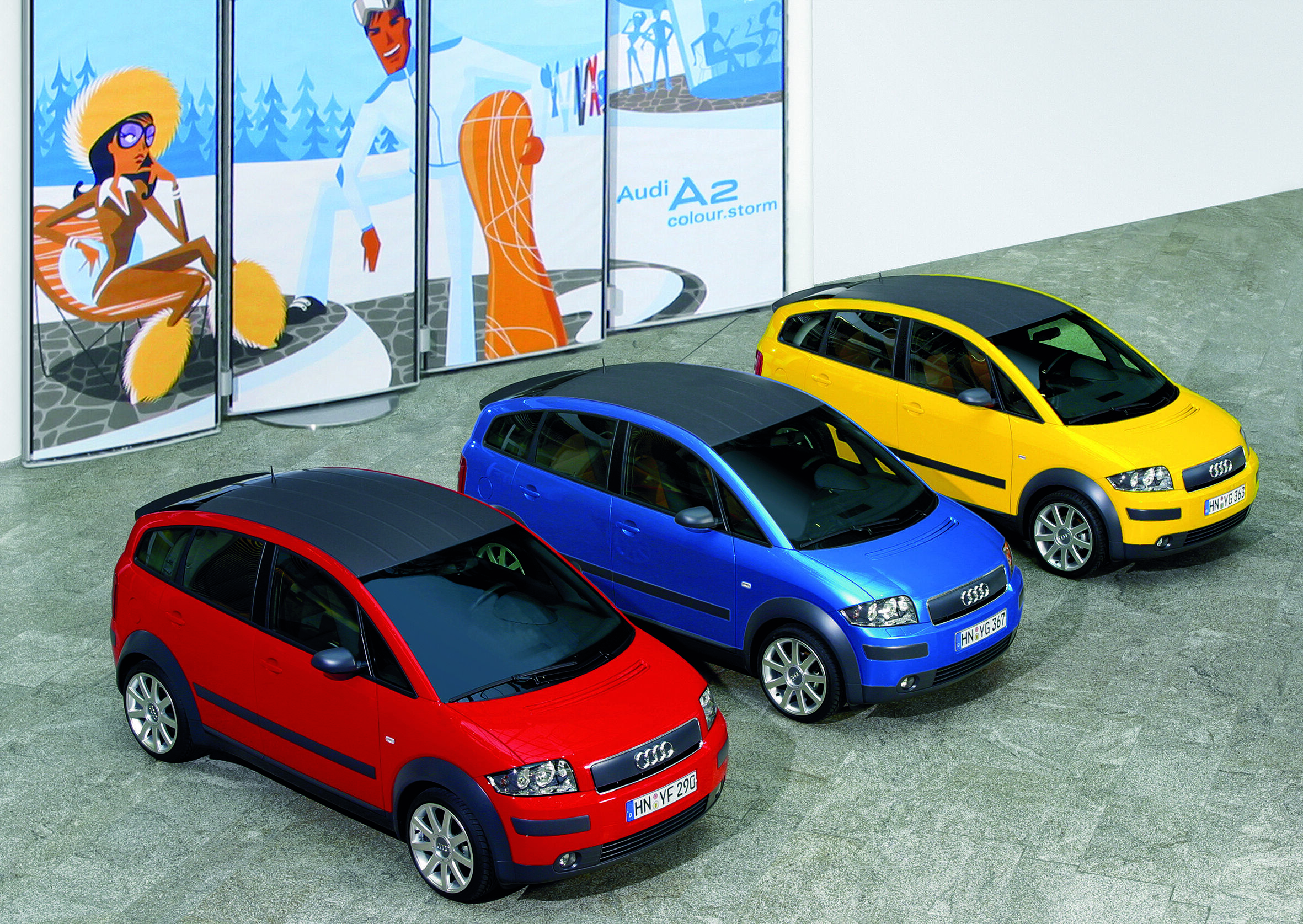
It was launched 25 years ago – and polarized opinions: the Audi A2. With its innovative aluminum body, the compact car was light, aerodynamic, and economical in terms of consumption. There were five engine variants to choose from; the A2 1.2 TDI caused a sensation as the world’s first four-door three-liter car. And since 2003, the special “colour.storm” edition has attracted attention with its special paint colors. However, since sales fell short of expectations, Audi ended production in 2005 after about five years and 176,377 units built. The innovative Audi A2 can showcase its qualities in a “second career”: as a modern classic with a stable value, the A2 has a loyal fan base and can still be seen on the road today as a daily companion.
In the early 1990s, the three-liter car was announced as a development goal by the Volkswagen Group and Audi, and the first work on the project began shortly afterwards. The designers in Ingolstadt worked closely with the experts at the aluminum center in Neckarsulm. In May 1995, they presented a concept study called “Ringo,” whose Audi Space Frame (ASF) was less complex than the ASF of the Audi A8, which was largely built by hand. Stefan Sielaff – the former head of Audi’s Munich design studio – took over the project and led the interior design, while Belgian designer Luc Donckerwolke handled the exterior. Together with future design chief Gerhard Pfefferle, they gave the “rolling cage” Ringo a two-door body – which proved already close to the later design. As development progressed, two studies were created: one was a show car at the IAA in Frankfurt in 1997 and, in addition to the provisional model designation Al2, it bore the nickname “Light Green” because of its color.
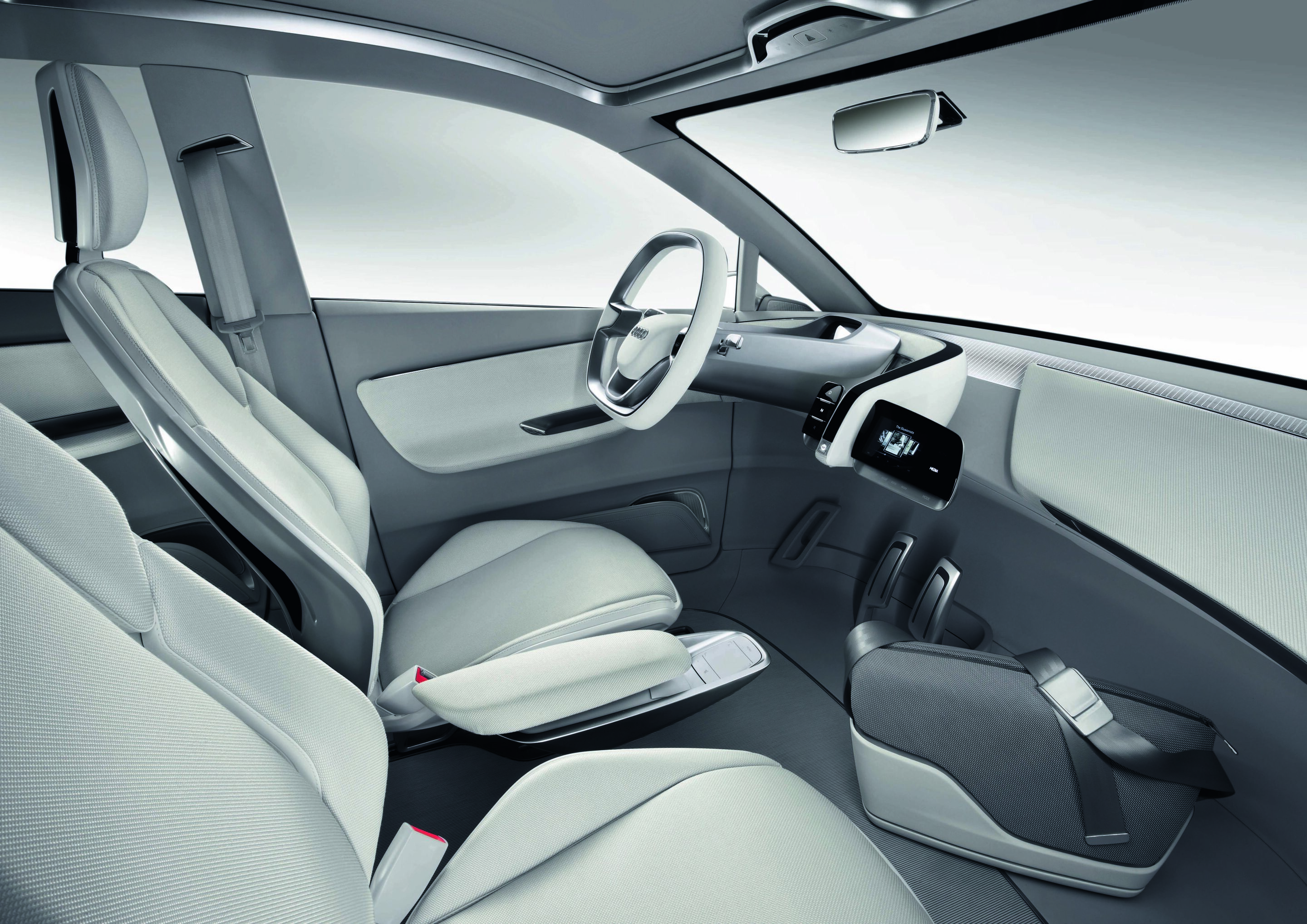
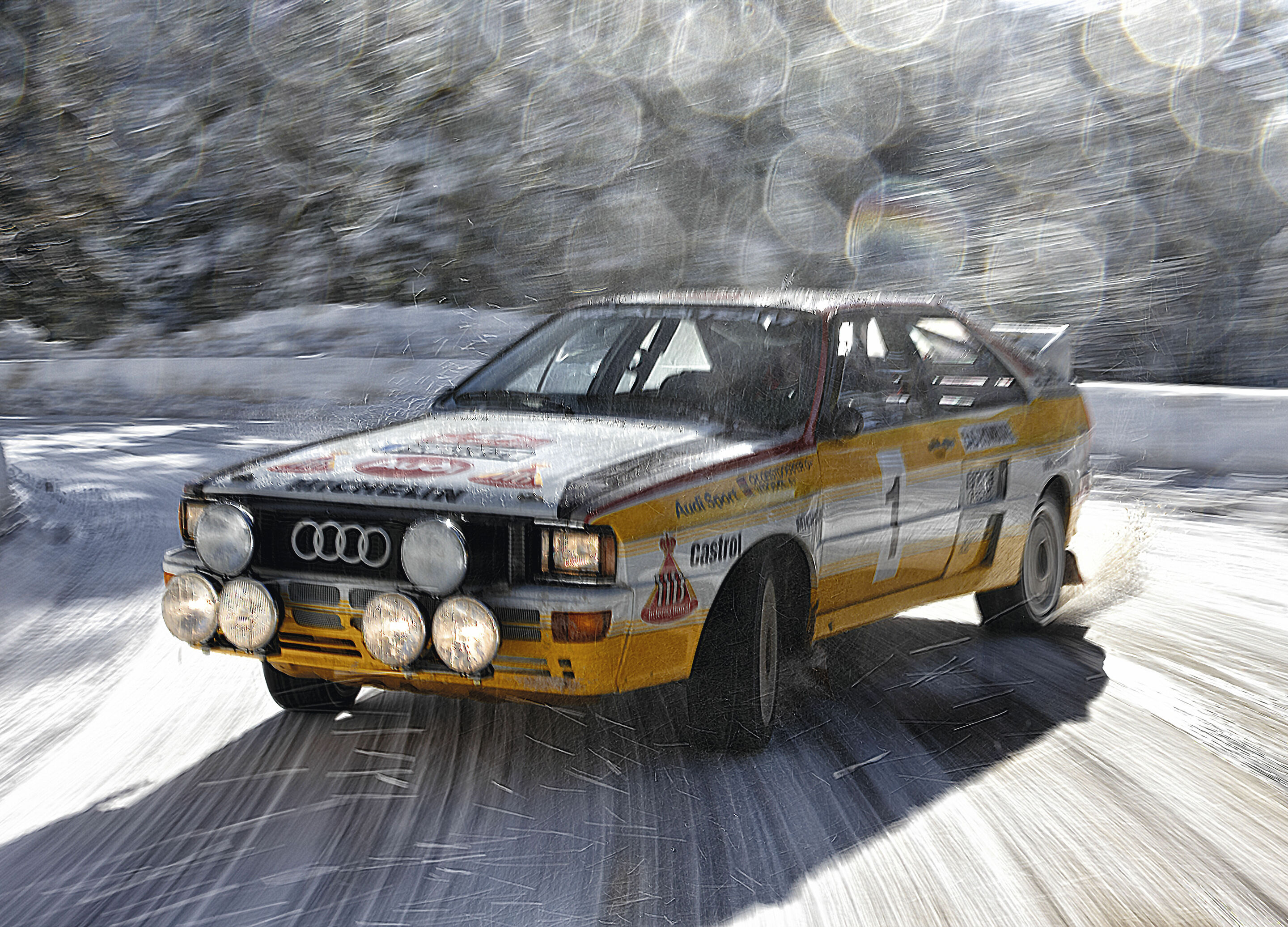
 Audi strengthens production network: integrated production and new fully electric model in Ingolstadt
Production of the Audi Q3 will begin at the main plant in Ingolstadt in mid-2026 in collaboration with Audi Hungaria in Győr, Hungary. Preparations for the start of production of the fully electric Audi A2 e-tron in Ingolstadt are well underway. Through a high degree of flexibility, the expansion of electric mobility, and tight-knit international collaboration, Audi is positioning its sites to be future-ready and competitive.
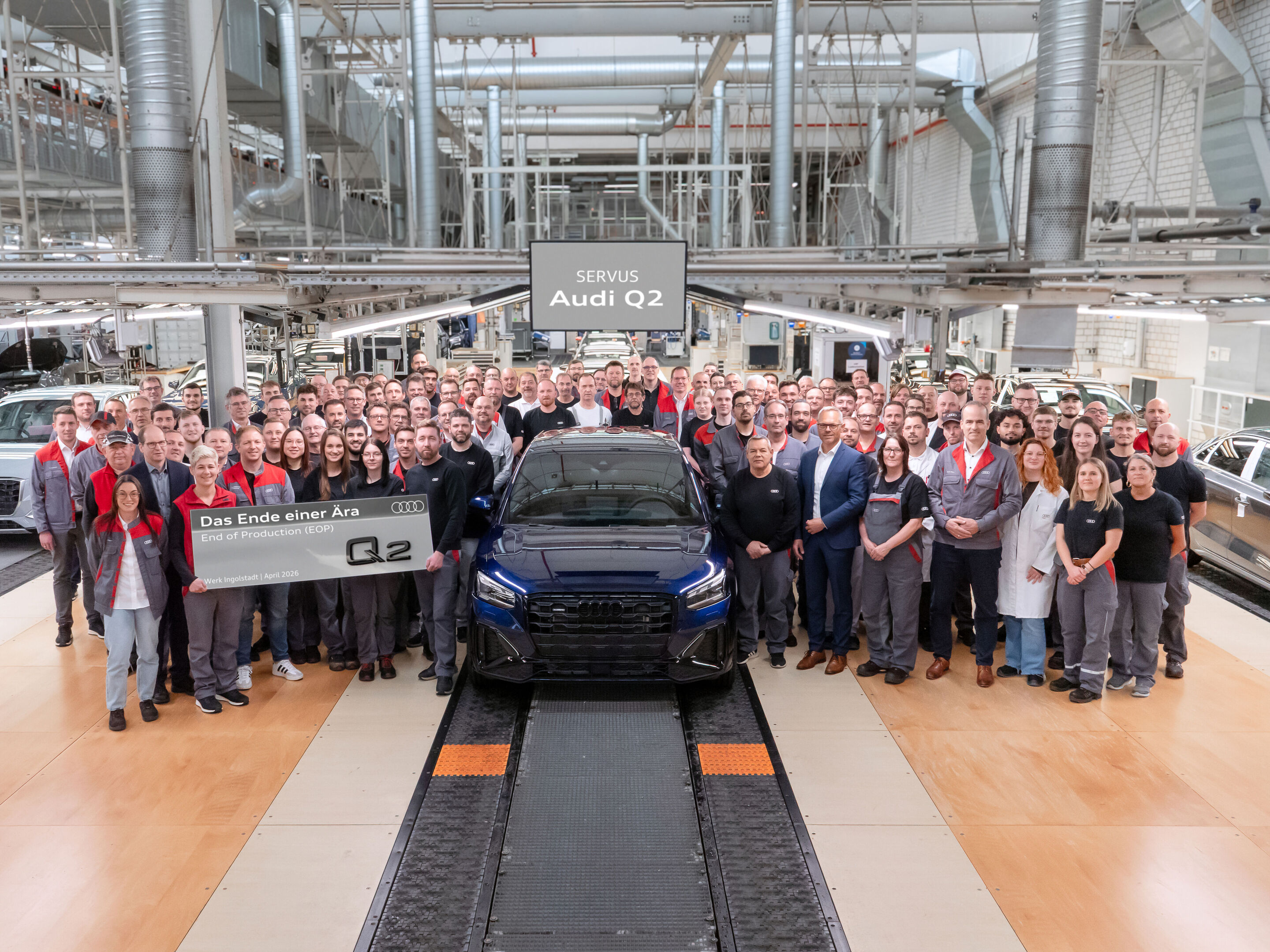
Production of the Audi Q2 at the Ingolstadt site will end in April. The compact SUV has been a staple of the production lineup at the main plant since 2016. The company has delivered 887,231 units to customers. At the same time, production of the Audi A1 is also winding down at the site in Martorell, Spain. Since the vehicle was launched in 2010, Audi has delivered 1,389,658 units.These two models are particularly popular in Germany, the United Kingdom, and Italy, among other markets. “The teams at the Ingolstadt plant have passionately driven the success of the Audi Q2. Working closely with Győr, we are turning a new page and will begin the integrated production of the Audi Q3 in mid-2026,” explains plant manager Siegfried Schmidtner. Through this partnership, Audi is meeting the strong demand for SUVs while ensuring balanced capacity utilization at both sites. The vehicle bodies for the additional volume will be manufactured in Győr and then painted and assembled in Ingolstadt. The integrated production of the Q3 is a core element of the agreement for the future signed in March 2025 and exemplifies the flexibility of the international production network. From a logistics perspective, the joint production of the Audi Q3 serves as an example of close integration: in less than a year, the supply chain teams in Ingolstadt and Győr have established all the necessary logistics processes. Well-established logistics chains ensure the transport of the car bodies by rail.
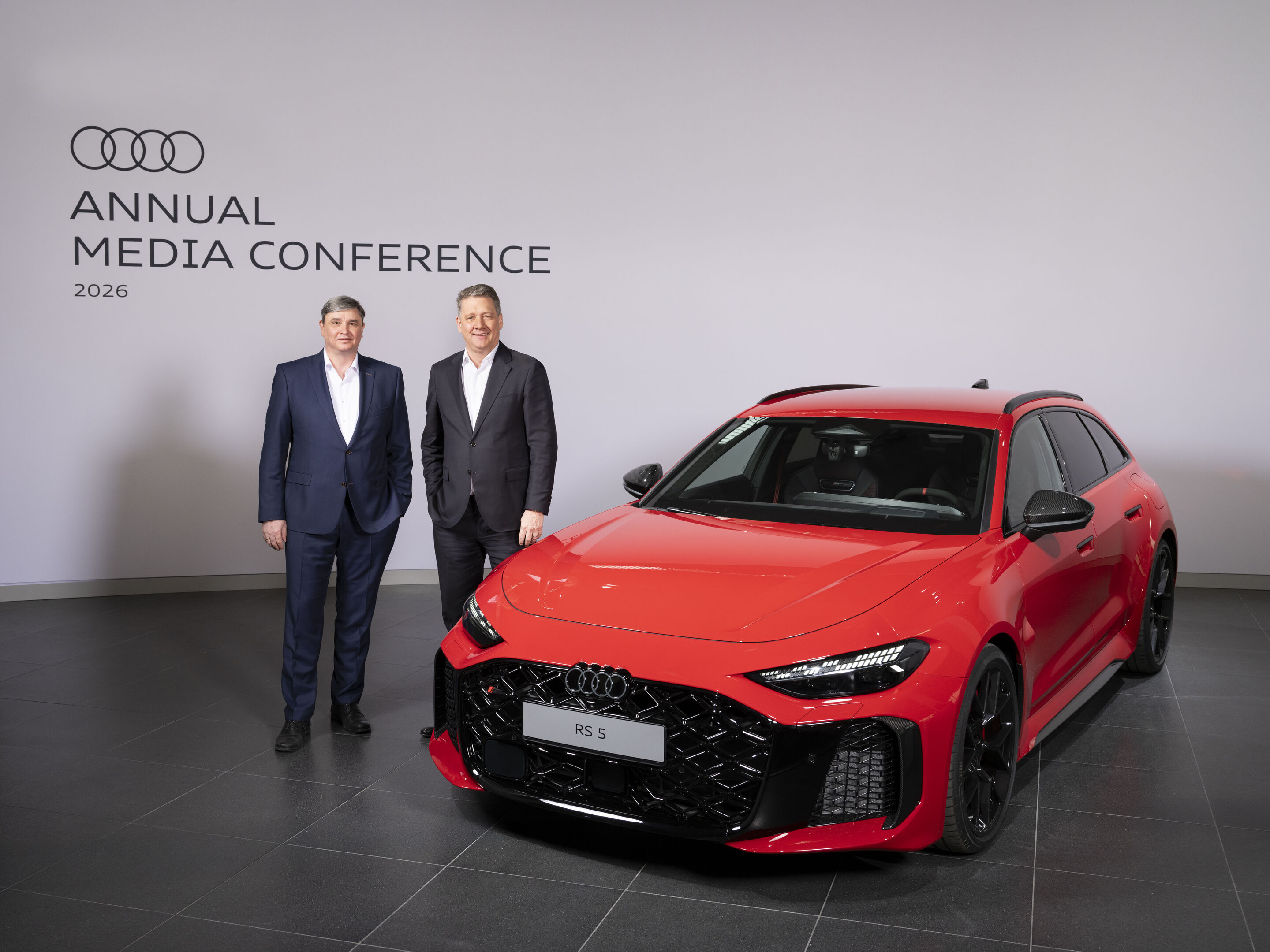
At AUDI AG's Annual Media Conference, CEO Gernot Döllner and CFO Jürgen Rittersberger presented the company's results for the 2025 fiscal year. In addition to an overview of the current corporate strategy, they shared updates on the ongoing model initiative. Here are the key takeaways.
Gernot Döllner: “In 2025, Audi set out on a new path — with a clear design philosophy, the first model from our China-exclusive sister brand AUDI, and preparations for our entry into Formula 1. We have reinvented ourselves: for our customers, for our employees, and for a strong industrial core in Germany.” “Our growth targets through 2030 are both realistic and ambitious — and we are squarely aligning our position in our core regions of Europe, the US, and China to achieve them.” “The new Audi Q9 strengthens our position in the US and defines the top of our portfolio. And with the A2 e-tron, we are bringing a highly efficient entry point into electric mobility to market in fall 2026 — a clear statement on efficiency.” “We are making a deliberate bet on strong partnerships and leveraging the power of the Group. Set to arrive as early as 2028 is the first Audi built on the new E/E architecture from RV Tech — a joint venture between the Volkswagen Group and Rivian.” “The industry — and Germany as a whole — needs to reinvent itself. Today, the US and China are driving the major technology trends, while Germany and Europe have fallen behind. Innovation for customers must therefore become the top priority again.” Jürgen Rittersberger: “In a difficult environment, clear decisions were needed – and that's exactly what we made: we established a new corporate strategy, pushed the restructuring further, and made Audi leaner and more competitive.” “We steered Audi through a geopolitically and industrially difficult environment in 2025 and delivered solid financial performance. At the same time, the numbers clearly show that we still need to make further gains on efficiency and competitiveness.”
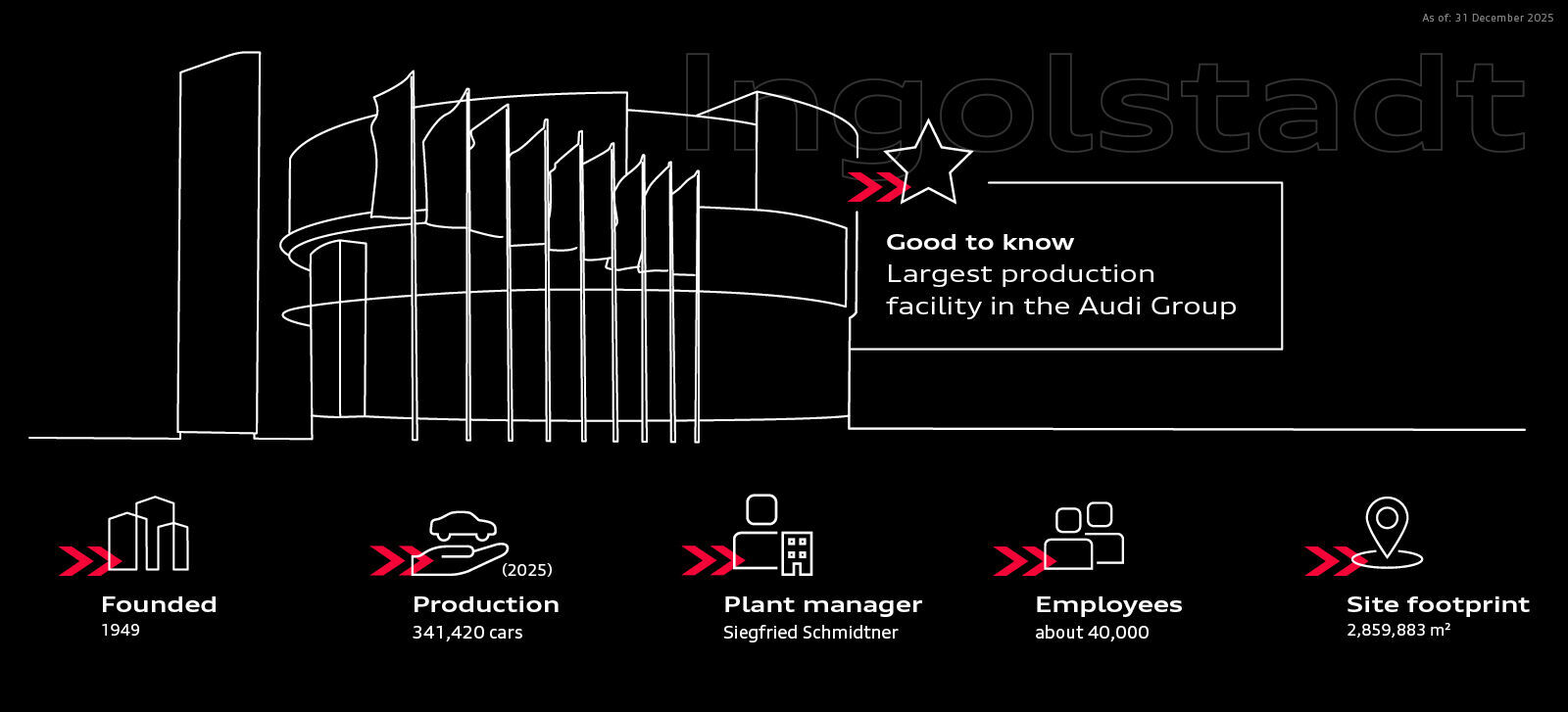 Audi in Ingolstadt
Audi in Ingolstadt
Audi has built cars at the Ingolstadt site for 75 years. This is where AUDI AG has its headquarters; around 40,000 employees (as of December 31, 2025) work in Ingolstadt to achieve “Vorsprung durch Technik”. From the initial idea to the finished automobile, the entire production process for the Audi A3, Audi A6 e-tron, and Audi Q6 e-tron takes place at the Ingolstadt plant. The Audi Ingolstadt location continues to develop into a networked digital factory for the electrified future. Modern production systems and high-tech solutions enable highly efficient, sustainable manufacturing. With the Audi A6 e-tron and Audi Q6 e-tron, two fully electric models are rolling off the line in Ingolstadt. In addition, production of the new Audi A2 e-tron will start in 2026. With the mix of fully electric models and combustion models such as the new Audi Q3, which will be manufactured jointly at the Győr and Ingolstadt sites in the course of the year, Audi is ensuring that the Ingolstadt site remains robust and future-proof. Current model series at location: Audi A3, Audi A6 e-tron, Audi Q6 e-tron Find a portrait of location here
Images
Videos
Production Sites Audi Group
 Audi Tradition to commemorate numerous anniversaries in 2025
Booklet features a selection of more than two dozen anniversaries The launch of the Audi A2 25 years ago; the first new Audi in post-war times 60 years ago; and Hans Stuck’s record-breaking exploits in the “world’s fastest road-going car” near Lucca 90 years ago
With the “Anniversary Dates 2025” booklet, Audi Tradition is showcasing the most important moments in the product and company history of Audi, which is as eventful as it is diverse. Audi historians have selected a total of 27 dates to commemorate in 2025.
Twenty-five years ago, the Audi A2 hit the market. With its aluminum body, it made a name for itself as a progressive compact car: light, aerodynamic, and economical. The Audi A2 polarized opinion with its design and unusual proportions; the concept was ahead of its time. However, sales remained below expectations, and Audi ended production after roughly five years and 176,377 units built. Since then, the A2 became a fan favorite and is now a sought-after collector’s item. Sixty years ago, the first post–World War II Audi rolled off the production line. With the “Auto Union Audi” vehicle, Auto Union GmbH revived the tradition-steeped Audi brand name in 1965. The new name was meant to show that this car represented a fresh start for Auto Union in terms of technology. The Audi was the first car from the brand with four rings to feature a four-cylinder four-stroke engine, and it marked the beginning of a new era in Ingolstadt. Twenty years later, on January 1, 1985, Audi NSU Auto Union AG was renamed AUDI AG, and since that time, the company and its products have shared the same short, memorable name. Ninety years ago, in February 1935, a spectacular attempt to break speed records took place in Italy. After test drives in October 1934 with the Grand Prix racing car on the AVUS in Berlin, the Auto Union racing department started developing the vehicle that would later be known as the “Lucca” car.
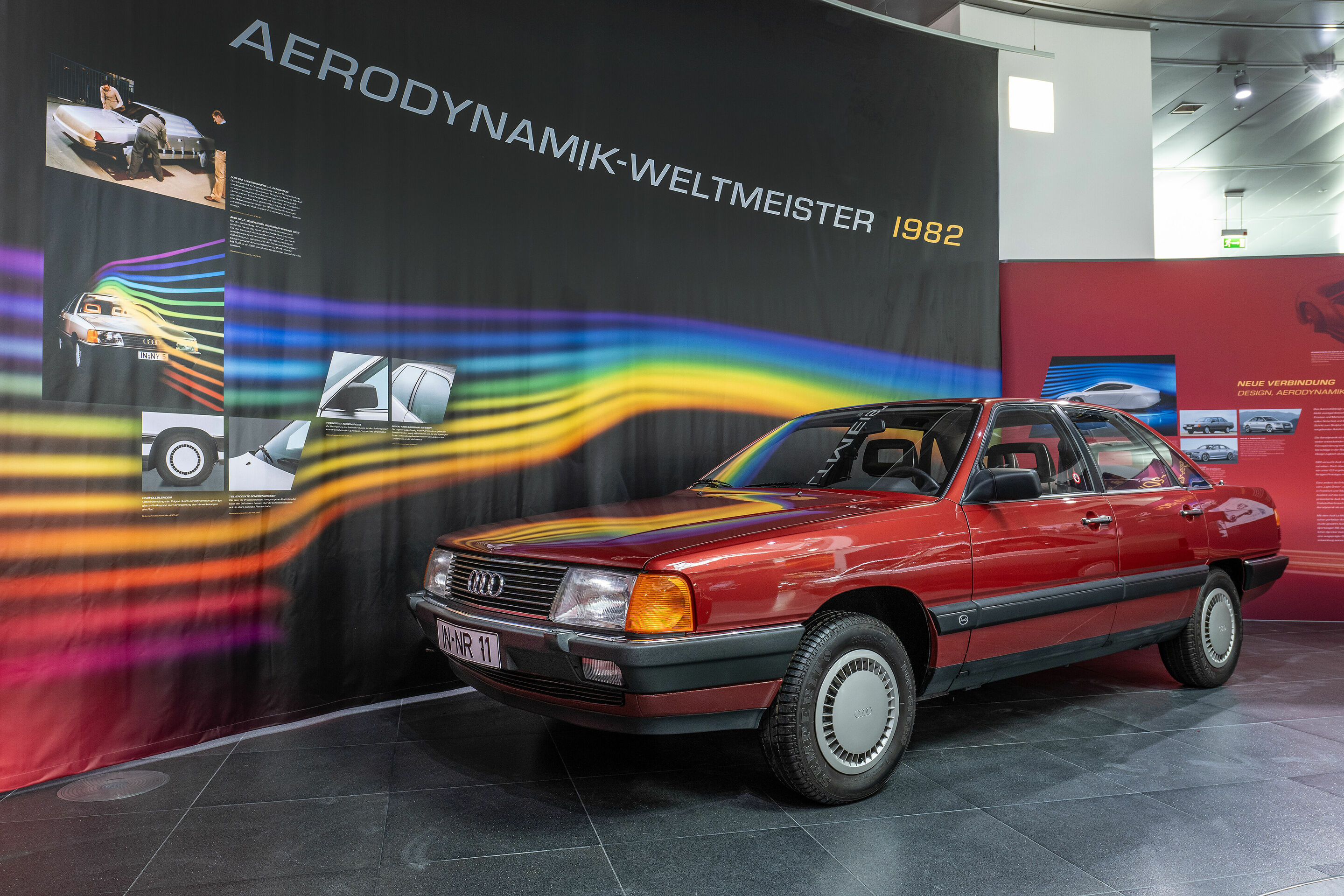 After “Windschnittig” comes “Form vollendet”: A new special exhibition at the Audi museum mobile
Aerodynamics in automotive manufacturing from 1945 to the present day: from concept cars and record-breaking models to race cars and the Cd world champion, the Audi 100 Almost 30 exhibits feature in a special exhibition from July 25, 2024, to March 2, 2025
Audi wrote engineering history in 1982 with the Audi 100. With its drag coefficient of 0.30, the third-generation Audi 100 was the world’s most aerodynamically efficient production saloon at the time, making it an essential part of the new special exhibition "Form vollendet". The new special exhibition will be at the Audi museum mobile in Ingolstadt until March 2, 2025, where Audi Tradition will present aerodynamic concepts from 1945 to the present day.
The aerodynamics research that flourished before the Second World War and which was the subject of Audi Tradition’s “Windschnittig” exhibition (German for “streamlined”) that ran until the end of June received little attention after 1945. Europe’s automotive industry was busy getting back on its feet. During this period, pre-war developments were still in use and improved upon. It wasn’t until the rising cost of fuel during the 1973 oil crisis prompted a shift in thinking that automotive engineers began focusing on reducing fuel consumption. One of the dials used to achieve this was aerodynamic drag. In 1982, Audi made a splash with the Audi 100; its drag coefficient of 0.30 set a world record for production sedans, a value that would become the benchmark for years to come. The new Audi Tradition special exhibition “Form vollendet” (German for “form perfected”) showcases the Cd world champion Audi 100 alongside other models such as the NSU Ro 80, the Porsche 356, the Lamborghini Countach, and the Ducati Paso 950.
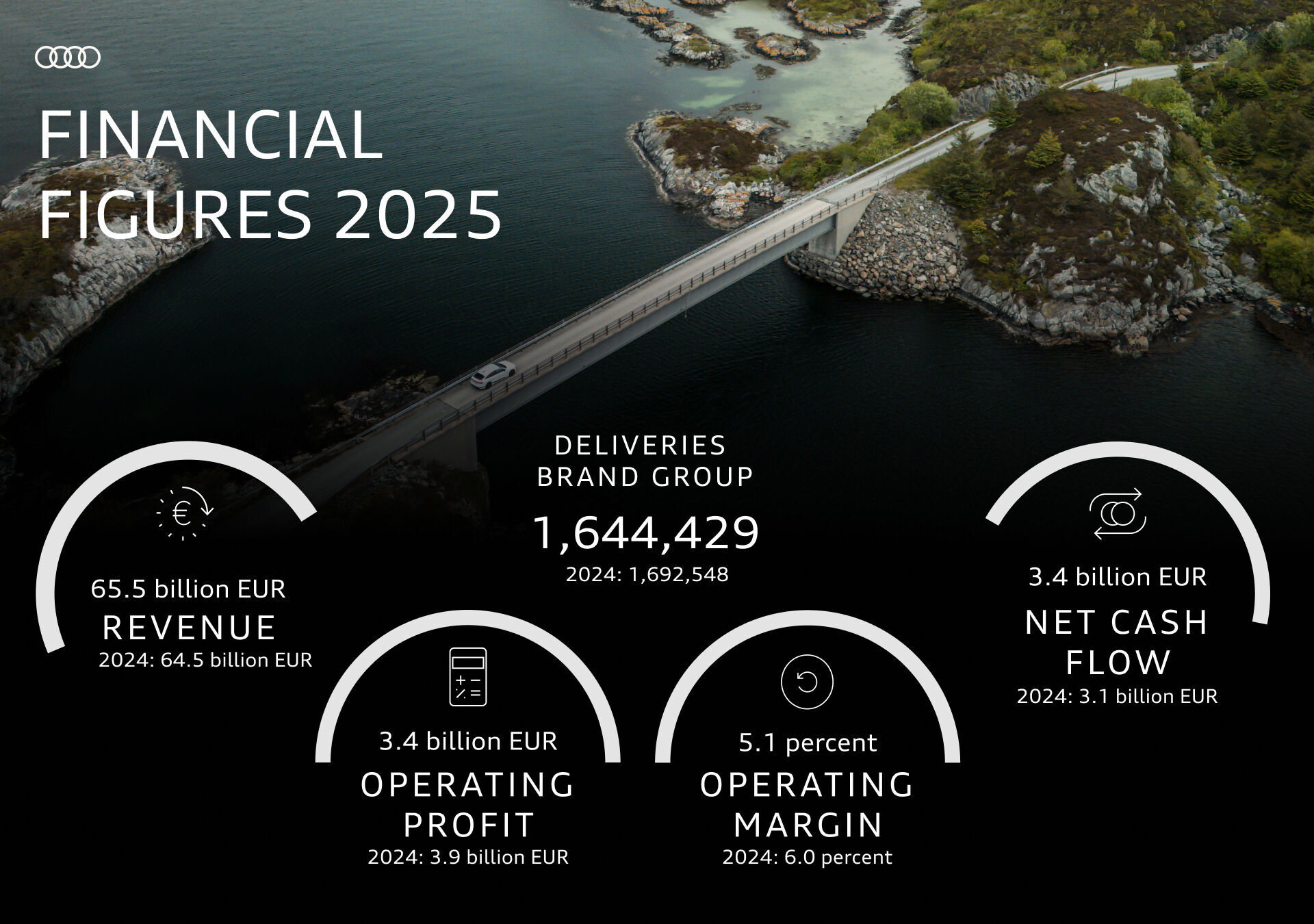 Strong end to the year: Audi Group closes 2025 with solid performance
CEO Gernot Döllner: “Audi took bold decisions in 2025 and has the answers to the current challenges.” CFO Jürgen Rittersberger: “We ended a challenging year with robust finances. The key now is to seize all operational and financial opportunities to make Audi more efficient, competitive, and profitable.” Revenue rose to 65.5 billion euros, operating profit came to 3.4 billion euros, and net cash flow reached 3.4 billion euros.
The Audi Group delivered a robust financial performance in fiscal year 2025. Revenue rose to 65.5 billion euros, operating profit amounted to 3.4 billion euros, and the operating margin was 5.1 percent. Net cash flow reached 3.4 billion euros. The company proceeded at pace with the rejuvenation of its portfolio and its structural renewal. Audi’s fully electric models set a delivery record, and the first model from sister brand AUDI, the AUDI E5 Sportback, was released in China. Audi also has big plans for 2026. As well as unveiling more key models – including the Audi A2 e-tron as a new entry-level electric model family and the Audi Q9 as the new flagship SUV – the company continues to tailor its portfolio to the needs of its international customers. And Audi’s Formula 1 debut will be a highlight for all motorsport fans.
“Geopolitical uncertainties and global competitive pressure kept the automotive industry on its toes again last year,” says Audi CEO Gernot Döllner. “In times like these, Audi has the right answers and takes bold decisions. In 2025, we introduced the first model from AUDI, our China-exclusive sister brand, and previewed a rigorously clean new design. We will continue to push our renewal forward in 2026, launching key new models, focusing on strong partnerships, and entering Formula 1 for the first time. In this way, we’ll accelerate our push in global competition.” Audi CFO Jürgen Rittersberger: “Audi delivered a resilient performance under difficult conditions in 2025.