
The Chinese market has particular strategic importance for Audi. That’s why Audi cooperates with two partners to produce locally in addition to developing market-specific technologies and managing sales of its vehicles directly in the market. AUDI AG is represented in the world’s largest single market by the subsidiary Audi China in Beijing as well as by the joint ventures FAW-Volkswagen with headquarters in Changchun and SAIC Volkswagen in Shanghai. As a result of the two-partner strategy implemented in 2021, Audi has a broad model portfolio in China to date. Furthermore, Audi has successfully launched the new EV brand “AUDI” in 2024 to reach new tech-savvy target groups.
With the Audi FAW NEV Company, Audi is expanding the local electric portfolio. Production of all-electric Audi models based on the PPE platform at a new plant in Changchun commenced in late 2024.
Audi in the Chinese market
The history of Audi in China goes back a long way: the company has had a presence there for almost 40 years. In 1988, it began its cooperation with the Chinese automaker First Automotive Works (FAW). As such, Audi was the first foreign premium manufacturer in the market and also the first to adapt its product portfolio to the specific needs of Chinese customers, for example by offering Audi models with extended wheelbases.
AUDI AG is represented in Beijing by its 100%-owned subsidiary, Audi China. More than 600 employees at Audi China coordinate the cooperation between AUDI AG and its partners, the joint venture FAW-Volkswagen with head office in Changchun and – since 2021 – SAIC Volkswagen in Anting (Shanghai). With its two partners, Audi manufactures vehicles at a total of seven production sites at six locations: Changchun, Foshan, Tianjin, Qingdao, Anting (Shanghai), and Ningbo. Furthermore, Audi launched the new EV brand “AUDI” in late 2024 to reach new tech-savvy target groups. AUDI introduced the E5 Sportback as its first production model in September 2025, to be followed by the AUDI E7X in 2026.
One of the main focuses of Audi China is on the intensification of local research and development activities in order to offer market-specific technologies and products for the Chinese market. Audi China R&D develops models, products, and technologies that are specifically adapted to local customer requirements. Audi places particular emphasis on developing electronics, advanced driver assistance systems, market-specific connectivity features, and extended smart-cockpit features, i.e., intelligent operating and comfort functionalities. To integrate technologies and services from the digital Chinese ecosystem into its vehicles, Audi also enters joint ventures with Chinese tech corporations.
Audi delivered 617,514 vehicles in China (incl. Hong Kong) in 2025.
Audi production locations
Audi models are currently being manufactured at a total of seven production sites at six locations belonging to the two partners, FAW and SAIC: Changchun, Foshan, Tianjin, Qingdao, Anting (Shanghai), and Ningbo.
Automobile production in the joint venture with FAW-Volkswagen in Changchun in northeastern China encompasses the four principal areas of car manufacturing: pressing, body construction, paintwork, and assembly.
Following the establishment of the Audi FAW NEV Company Ltd., a state-of-the-art manufacturing facility was constructed in Changchun for all-electric Audi models. The new site makes an important contribution to advancing electrification of the product portfolio in China.
With series production beginning in late 2024, Audi is producing the three models Audi Q6L e-tron, Q6L Sportback e-tron, and Audi A6L e-tron at the new site.
The long-wheelbase versions are oriented towards the needs of Chinese customers. The plantwas built on around 150 hectares and, as the newest production facility within the Audi production network, it is setting new standards in terms of digitalization, efficiency, and sustainability. A central IT system that also includes the neighboring supplier park helps in efficiently controlling and monitoring all production steps. Audi’s cross-site environmental program “Mission:Zero” sets the parameters for sustainability and ensures net carbon-neutral vehicle production. The Audi FAW NEV Company is the first cooperation company with a majority Audi holding in China.
Finished at the end of 2013, the FAW-Volkswagen plant in the southern Chinese city of Foshan manufactures the Audi Q2L based on the MQB. In addition, the Audi Q4 e-tron is produced in Foshan.
Meanwhile, the Audi Q3 and the Audi Q3 Sportback are manufactured at a plant in Tianjin in northern China, which opened in 2018.
At Tianjin, the Audi transmission plant has also been manufacturing 7-gear S tronic transmissions at Volkswagen Automatic Transmission (Tianjin) Corporation Ltd. (VWATJ) for the locally produced Audi A6L, and Audi Q5L models since 2016.
Qingdao is the youngest location in the production network of FAW-Volkswagen. Opened in 2018, the plant is situated in Jimo, around 60 kilometers from Qingdao. In addition to automobile production with the Audi A3 Sportback and the Audi A3L Sedan, the plant also possesses manufacturing facilities for high-voltage batteries.
Alongside cars from other Group brands, Chinese partner SAIC manufactures Audi models at two of its plants in Anting (Shanghai). The plant where the Audi A7L is manufactured covers a total of 448,900 square meters (536,900 sq yd). The manufacturing facility for electric vehicles in Anting has been making an all-electric Audi model exclusively for China in the form of the Audi Q5 e-tron. On a total area of 406,000 square meters (485,600 sq yd), the plant for electric vehicles includes production areas such as a press shop, body construction, a paint shop, a final assembly line, and a battery assembly facility. A separate production facility for the models of the new AUDI brand has also been built on the factory premises. The brand’s first series model, the AUDI E5 Sportback, has been in production there since August 2025.
SAIC manufactures the Audi Q6 Roadjet in Ningbo. The Ningbo plant is located in a developing area along Hangzhou Bay. It has a press shop, body construction, paint shop, and assembly hall, as well as a technology center, training center, and energy center.
Electrification in China
Audi is steadily expanding its range of locally available all-electric models in collaboration with its two partners. Audi FAW NEV Company plays an important role in this. The joint venture between Audi and its Chinese partner FAW produces the Audi Q6L e-tron, Q6L Sportback e-tron and Audi A6L e-tron models in Changchun.
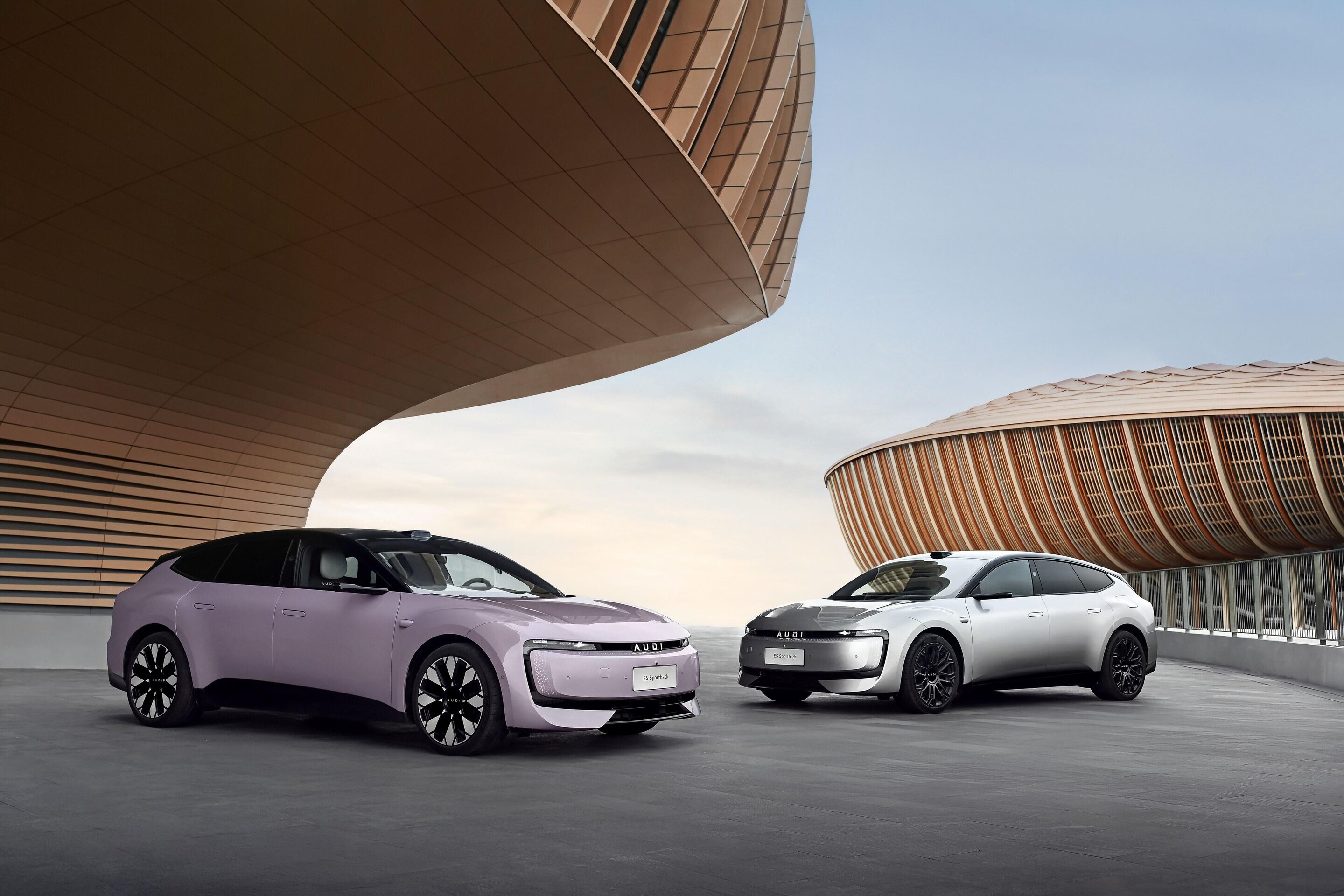
AUDI: New sister brand exclusively for China
At the same time, Audi and its partner SAIC founded the AUDI brand specifically for the Chinese market. AUDI combines the Audi DNA with the specific expectations of new, very digital-savvy target groups in China. Brand-defining Audi virtues, for example in terms of design, driving dynamics, and premium products, characterize the sister brand along with its comprehensive integration into China’s digital ecosystem. The first model of the new brand is the AUDI E5 Sportback. The second model, the AUDI E7X, will be launched in 2026, followed by a third model in 2027. The vehicles are produced at the Shanghai Volkswagen plant in Anting. The AUDI E5 Sportback is based on the jointly developed Advanced Digitized Platform (ADP) and is the result of close collaboration between development teams in China and Germany. This enabled the development process for the brand’s first model to be shortened by roughly 30 percent.
Fast charging as part of the digital ecosystem
To promote the rapid development of a nationwide charging infrastructure, Audi is relying in part on brand-exclusive quick-charging stations, the Audi Charging Stations. In this way, Audi is building a nationwide high-power charging (HPC) network with a top charging power of up to 360 kilowatts at a maximum voltage of 1,000 volts. By the end of 2024, the Audi-branded charging network had already deployed 600 fast chargers in over 30 cities across the country, with charging services accessible via its premium digital ecosystem via the Audi MMI and Audi App. Audi branded charging stations are accessible for both 4-rings and 4-letters customers.
Partnerships in sales, marketing, service
The global concept Audi Progressive Retail, embodied by a completely new, inviting, and progressive showroom architecture, interactive digital elements, and employees to spark enthusiasm for new technologies, will be gradually localized and rolled out in China and be tailored to Chinese customer demands in digitalization, electrification, and personalization.
With the foundation of the FAW Audi Sales Company at the end of 2022, Audi has been consolidating its sales activities in China in Hangzhou in the southeast of the country. This makes Hangzhou, a dynamic and innovative metropolis with a population of ten million, another attractive Audi location in China.
To provide a holistic customer journey in China, the company has also continuously upgraded its offline touchpoints and expanded its innovative sales setup to deliver a progressive retail experience.
FAW Audi operates a well-established and customer-oriented dealer network, comprising approximately 560 full function 4S dealerships and 9 urban showrooms for product experience.
SAIC Audi offers customers a comprehensive brand and product experience with the “SAIC Audi Customer Center”. SAIC Audi currently operates nearly 230 points of sale covering over 100 prioritized premium automotive cities.
Research and development
Since 2013, Audi has relied on its own local development team in China, which develops market-specific models and technologies.
Audi is continuously intensifying its development activities in China with a clear product and technology roadmap. At the end of 2022, the Audi China development team moved into a new development center in Beijing, the Audi China Building. Located in the Chinese capital’s northern Central Business District, the 6,000-square-meter building houses a design studio, an electronics development laboratory, and predevelopment workshops, among other things. In the development of future technologies, Audi China R&D is investing systematically in the following areas: smart cockpits, local adaptation, and market-specific contents of new electronics architectures, China-specific driver assistance systems and automated driving systems, customized connectivity offerings, and local homologation. In addition, Audi uses synergies within the VW Group in China and works with the corporation-wide Hub CARIAD software hub.
In the areas of connectivity and infotainment in particular, Audi is expanding its cooperation with local tech companies and start-ups. To this end, Audi China R&D is collaborating with leading Chinese tech companies.